
TL;DR:
- Choosing a mover in Exeter NH requires verifying federal registration, obtaining binding estimates, and checking complaint history.
- A reliable mover operates under full FMCSA authority, offers clear pricing, and provides full valuation options to protect belongings.
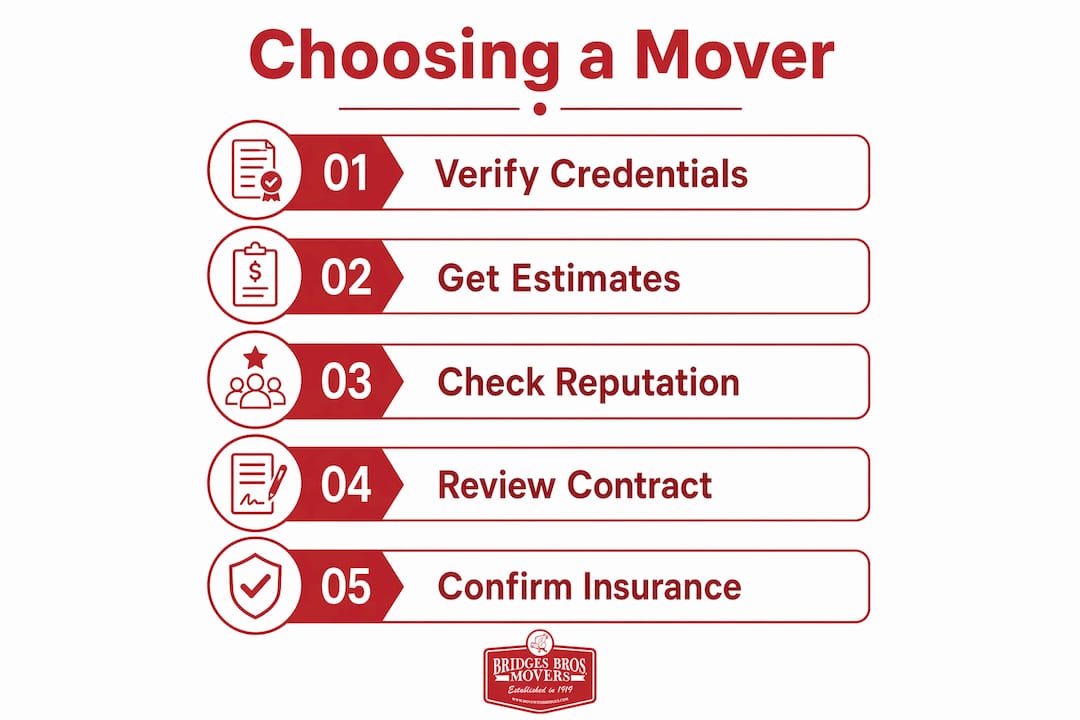
Choosing a mover in Exeter NH is defined by three non-negotiable steps: verifying federal registration, securing binding written estimates, and checking complaint history before signing anything. The moving industry reports over 3,000 scams annually in the U.S., which means hiring the wrong company carries real financial risk. Bridges Bros Movers, a family-owned company serving New Hampshire since 1919, operates under full FMCSA authority and provides transparent pricing. This guide walks you through every verification step so you can hire with confidence, whether you are moving across Exeter or across state lines.
How to verify mover credentials when choosing a mover in Exeter NH
Every legitimate interstate mover carries a USDOT number issued by the Federal Motor Carrier Safety Administration. You can confirm active operating authority at safer.fmcsa.dot.gov in under two minutes. Active status means the company is currently authorized to operate. Inactive or revoked status is an immediate disqualification.

Beyond active status, check whether the company is registered as a carrier or a broker. These are legally different roles. Carriers vs. brokers must be disclosed in writing before pickup, per 49 CFR 371. A carrier moves your belongings directly. A broker arranges the move through a third party. If a broker does not name the actual carrier in writing before moving day, walk away.
New Hampshire does not require intrastate mover licensing at the state level. That gap makes federal verification and third-party reputation checks even more critical for local moving services in Exeter NH. When state oversight is limited, your own due diligence fills the gap.
Watch for these red flags during your credential check:
- Frequent name changes. Three or more name changes in five years signal identity rotation, a tactic scammers use to shed bad reviews and complaints.
- No physical address. Legitimate movers list a verifiable street address, not just a phone number.
- Refusal to provide a USDOT number. Any mover who declines to share this is operating outside federal requirements.
- No written carrier disclosure. Brokers who skip this step cannot be held accountable if something goes wrong.
Pro Tip: Run the USDOT number on the FMCSA website before your first phone call. If the status is not “authorized,” end the conversation there.
Why you need multiple binding written estimates
The type of estimate you accept determines your financial exposure on moving day. Three estimate types exist in the industry: non-binding, binding, and binding not-to-exceed. Each works differently, and the difference matters.
| Estimate type | What it means | Consumer risk |
|---|---|---|
| Non-binding | Final price can exceed the quote | High |
| Binding | Price is locked at the quoted amount | Low |
| Binding not-to-exceed | Price is capped; you pay less if actual cost drops | Lowest |
A binding not-to-exceed estimate offers the strongest consumer protection. It caps what you can be charged while refunding the difference if the actual cost comes in lower. This is the estimate type to request first.
Industry standards recommend at least three binding written estimates based on in-home or virtual walkthroughs. Phone-only quotes are unreliable because the mover has not seen your actual inventory. A low phone quote often becomes a much higher final bill once the crew arrives. For interstate moves, federal regulations require that estimates be based on a physical or virtual walkthrough of your belongings.
Comparing three estimates also reveals pricing outliers. If one quote is significantly lower than the others, that is not a bargain. It is a warning sign. Lowball estimates are a common setup for price inflation after your belongings are loaded.
Pro Tip: Ask each mover to itemize the estimate. A line-by-line breakdown makes it easy to compare services and spot hidden fees like fuel surcharges or stair fees before you commit.
How to evaluate mover reputation and complaint history
Verified registration confirms a mover is legal. Complaint history tells you whether they are trustworthy. These are separate checks, and both are required. Checking complaint patterns is as important as confirming active registration status.
Use the FMCSA National Consumer Complaint Database to search for patterns. A single complaint on a high-volume mover may be noise. Repeated complaints about the same issue, such as overcharging, damaged goods, or delayed delivery, indicate a systemic problem. Pay attention to the nature of the complaints, not just the count.
The most serious complaint pattern to watch for is a hostage load. This is when a mover loads your belongings and then demands extra payment before unloading. It is a documented scam pattern and grounds for immediate disqualification. Any mover with this complaint in their history should be removed from your list.
For BBB ratings, a grade of B or higher is the recommended threshold. Grades below B with unresolved complaints indicate a company that does not address customer concerns. Reading the actual complaint narratives and resolution records gives you more insight than the letter grade alone. Complaint resolution patterns reveal how a company treats customers when things go wrong, which is the truest test of reliability.
What moving insurance options actually cover
Moving insurance is the industry term, but the correct legal term is “valuation.” Two options exist under federal law for interstate moves, and the difference in coverage is significant.
Released Value Protection is the default option and comes at no additional cost. It covers only $0.60 per pound per article. That means a 50-pound television worth $800 would be reimbursed at $30 if damaged. That gap is why this option is considered inadequate for most households.
Full Value Protection requires the mover to repair, replace, or reimburse the full current market value of any lost or damaged item. It costs more, but it provides real coverage. Before your move, confirm the Full Value Protection terms in writing and ask whether a deductible applies. You can also review your options in detail through Bridges Bros Movers’ moving insurance guide.
| Valuation type | Coverage basis | Best for |
|---|---|---|
| Released Value | $0.60 per pound | Low-value items only |
| Full Value Protection | Current market value | Most households |
Pro Tip: Check your homeowner’s or renter’s insurance policy before your move. Some policies extend coverage to belongings in transit, which could reduce your out-of-pocket cost for Full Value Protection.
Key contract terms to review before signing
The Bill of Lading is the legal contract for your move. It must match your written estimate exactly. If any number or service description differs, do not sign until the discrepancy is resolved in writing.
Before signing, confirm these four items:
- Pickup and delivery windows. Vague windows like “within 21 days” are common for long-distance moves. Negotiate a tighter window and get it in writing.
- Accessorial charges. These are add-on fees for stairs, long carries, or elevator use. Ask for a complete list upfront so there are no surprises on moving day.
- Cancellation and rescheduling policy. Confirm the deadline for changes and whether a deposit is refundable. Get this in writing, not just verbally.
- Claims procedure. Federal law gives you nine months to file a damage claim on interstate moves. Know the process before you need it.
Completing a pre-load walkthrough with the crew chief on moving day is one of the most effective ways to protect yourself. Photograph your items before they are loaded and review the inventory sheet for accuracy. Discrepancies are far easier to resolve before the truck leaves than after. For a full breakdown of estimate types and what they protect, the Bridges Bros Movers moving estimate guide covers each option in plain language.
Key Takeaways
Selecting a reliable mover in Exeter NH requires stacking multiple verification checks, including FMCSA registration, binding estimates, complaint history, and Full Value Protection, before signing any contract.
| Point | Details |
|---|---|
| Verify FMCSA registration first | Confirm active USDOT status and carrier or broker role before any other step. |
| Get three binding estimates | Request in-home or virtual walkthrough quotes from at least three movers to compare accurately. |
| Check complaint patterns | Search the FMCSA database and BBB for repeated issues like hostage loads or overcharging. |
| Choose Full Value Protection | Released Value covers only $0.60 per pound; Full Value Protection covers current market value. |
| Review the Bill of Lading | Confirm every detail matches your written estimate before signing on moving day. |
What I have learned after years of watching moves go wrong
The biggest mistake Exeter residents make is treating mover selection like a price comparison. They collect three quotes, pick the lowest, and assume the job is done. That approach works fine for buying groceries. It fails badly for moving.
The movers who cause the most problems are rarely the most expensive ones. They are the ones who gave a suspiciously low estimate, skipped the walkthrough, and showed up with a truck that did not match the company name on the contract. By the time the customer realizes something is wrong, their belongings are already loaded.
Early planning is the single most effective protection against this. Last-minute mover hiring increases the risk of overpaying and choosing a low-quality company. When you start six to eight weeks out, you have time to run every check, compare estimates properly, and walk away from a bad deal without pressure. When you start two weeks out, you take whatever is available.
I have also seen people skip the complaint database check because the mover had good Google reviews. Online reviews are easy to manipulate. The FMCSA complaint database is not. A company with 40 five-star reviews and three hostage load complaints in the federal database is not a trustworthy mover. Use both sources, and weight the federal data heavily.
Working with an established, transparent company like Bridges Bros Movers removes most of this risk. A mover with over 100 years of operation in New Hampshire has a track record you can actually verify, not just a handful of recent reviews.
— Patrick
Bridges Bros Movers: licensed moving services in Exeter NH
Bridges Bros Movers has served New Hampshire families and businesses since 1919, operating under full FMCSA authority with transparent pricing and binding estimates on every move. Whether you are planning a local Exeter relocation or a long-distance move to Massachusetts or Maine, the team provides in-home and virtual consultations so your estimate reflects your actual inventory. Full Value Protection is available on all moves, and every contract is reviewed with you before signing. For residential moving services in Exeter NH, Bridges Bros Movers brings the credentials, the history, and the straightforward process that makes a move go smoothly. Get a personalized quote at movewithbridges.com.
FAQ
How do I verify a mover’s credentials in Exeter NH?
Search the mover’s USDOT number at safer.fmcsa.dot.gov to confirm active operating authority. Also check whether the company is registered as a carrier or broker, since brokers must disclose the actual carrier in writing before your move.
What is the safest type of moving estimate?
A binding not-to-exceed estimate is the safest option. It caps the maximum price you pay and refunds the difference if the actual cost is lower.
Does New Hampshire require movers to be licensed by the state?
New Hampshire does not require intrastate mover licensing at the state level. This makes federal FMCSA registration, BBB ratings, and attorney general complaint records the primary verification tools for local moves.
What is a hostage load scam?
A hostage load occurs when a mover loads your belongings and then demands extra payment before unloading. Any mover with this complaint pattern in the FMCSA database should be removed from your list immediately.
What does Released Value Protection actually cover?
Released Value Protection covers only $0.60 per pound per item. A 40-pound item worth $600 would be reimbursed at $24, making Full Value Protection the recommended choice for most households.