
TL;DR:
- Commercial moves involve complex logistics, stricter timing, and higher insurance needs compared to residential relocations. Planning for business moves requires early coordination of IT infrastructure, inventories, and stakeholder communication to prevent costly disruptions. Bridging experience ensures smooth relocations by addressing unique commercial and residential challenges effectively.
A residential move is defined as the relocation of a personal living space, including homes, apartments, and all personal belongings. A commercial move, by contrast, relocates an entire business operation, covering offices, retail spaces, manufacturing facilities, IT infrastructure, and specialized equipment. Understanding commercial vs residential moves explained in practical terms is the first step toward planning either type of relocation without costly surprises. Bridges Bros Movers has handled both types across New Hampshire, Maine, and Massachusetts since 1919, and the differences between them are more significant than most people expect before they start planning.
What distinguishes commercial moves from residential moves?
The core difference between commercial and residential moving comes down to scale, stakeholders, and timing pressure. A residential move typically involves one household, a few decision makers, and a timeline you control. A commercial move can involve dozens of departments, hundreds of employees, and a hard deadline tied to a lease expiration or a landlord’s schedule.

Logistics complexity is the clearest separator. Residential moves center on personal belongings: furniture, clothing, kitchen items, and appliances. Commercial moves require coordinating IT systems, office partitions, filing systems, specialized machinery, and confidential documents. Each of those categories carries its own handling requirements, and a mistake with any one of them can cost real money.
Timing is where commercial moves become genuinely difficult. Planning timelines for office moves range from 6–8 weeks for small offices to 16–20+ weeks for larger operations, depending on IT infrastructure, lease timing, and employee count. Residential moves offer far more personal flexibility on scheduling. A family can shift their move date by a week with minimal consequence. A business cannot.
Commercial moves also require specialized equipment and services that residential moves rarely need. Movers must handle specialized items like servers, safes, large appliances, and office partitions that require disassembly and reassembly. That level of service requires trained crews and purpose-built equipment, not just a truck and moving blankets.
- Scale: Residential moves cover one household; commercial moves span multiple departments and locations.
- Stakeholders: Residential moves involve 1–2 decision makers; commercial moves require coordination across management, IT, HR, and building management.
- Equipment: Commercial moves include servers, safes, and specialized machinery requiring professional handling.
- Timing: Commercial moves follow strict business calendars; residential moves allow personal scheduling flexibility.
Pro Tip: Assign a single internal project manager for your commercial move before you sign a new lease. That person should own every vendor relationship, from the moving company to the internet service provider.
How do costs and insurance differ between commercial and residential moves?
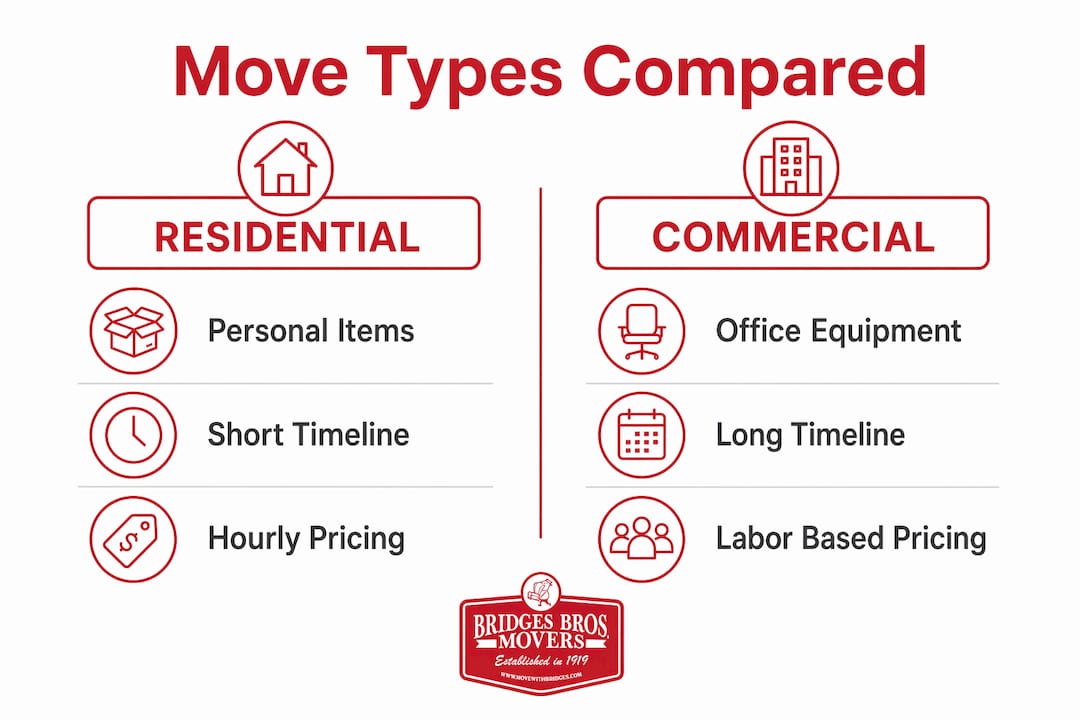
Cost structures for the two move types follow completely different logic. Residential moves are typically quoted by hours, distance, and volume. You know roughly what you own, and a moving company can estimate the job with a walkthrough or a virtual consultation. Commercial moves add layers: specialized equipment handling, labor complexity, after-hours scheduling, and the cost of business downtime.
That last factor is the one most businesses underestimate. Business downtime during a move costs $100 to $400 per employee per day. For a 50-person office, even one lost day of productivity represents a significant financial hit on top of the moving invoice itself.
Insurance requirements also diverge sharply. Standard homeowner or renter’s insurance often covers personal belongings during a residential move, though you should always verify your policy limits before moving day. Commercial moves carry a higher bar. Businesses require higher liability coverage because business equipment, confidential files, and inventory exceed standard homeowner policy limits. Many building managers require vendors to present a certificate of insurance before allowing any move to begin.
| Factor | Residential moves | Commercial moves |
|---|---|---|
| Pricing model | Hourly, distance, volume | Labor complexity, equipment, downtime costs |
| Insurance type | Standard valuation coverage | Higher liability, certificates of insurance required |
| Scheduling | Flexible, personal preference | Evenings and weekends to minimize disruption |
| Cost variables | Furniture volume, distance | Employee count, IT systems, specialized equipment |
| Risk exposure | Personal belongings | Business continuity, confidential data, equipment |
Pro Tip: Ask your moving company for a written breakdown of commercial insurance coverage before signing any contract. Verify that their policy covers IT equipment and confidential documents specifically, not just general cargo.
What planning steps are critical for commercial vs. residential moves?
Commercial move planning follows a structured sequence, and skipping any step creates downstream problems. The single most common failure point is IT infrastructure. Internet service installation at a new commercial location takes 2–4 weeks to schedule. If you wait until after signing a lease to contact your provider, you risk opening in a new office with no connectivity. That delay costs money every day it continues.
Here is the planning sequence that works for commercial relocations:
- Assign an IT lead before signing the new lease and contact your internet and phone providers immediately.
- Audit your current inventory to identify what moves, what gets replaced, and what gets discarded.
- Notify building management at both locations to reserve elevators, loading docks, and parking permits.
- Communicate with employees early, including timeline, new address, and any changes to workstation assignments.
- Hire a commercial moving company with documented experience in office and equipment relocation.
- Schedule the physical move during evenings or weekends to minimize disruption to operations.
- Confirm IT setup and testing at the new location before the first full workday.
Residential move planning is less sequential and more personal. A solid home moving checklist covers packing room by room, updating your address with utilities and the post office, and coordinating school transfers if you have children. The stakes are lower in terms of financial downtime, but the emotional weight is real, and preparation still reduces stress significantly.
Commercial moves involve complex coordination including building management, elevator reservations, parking permits, and communication across multiple departments. Residential moves typically involve one or two decision makers. That difference in stakeholder count is why commercial moves require a formal project management approach, not just a moving day plan.
Bridges Bros Movers provides planning support for both move types, including in-home and virtual consultations that help you build a realistic timeline before any boxes are packed. Their office relocation guide walks through each phase of a commercial move in detail.
How does inventory complexity affect commercial and residential moves?
Residential inventory is straightforward to categorize. You have furniture, clothing, kitchen appliances, personal effects, and maybe a few items requiring extra care, like artwork or a piano. Most of it can be packed with standard materials and loaded by a well-organized crew.
Commercial inventory is a different challenge entirely. Commercial moves involve office furniture, IT servers, specialized machinery, and confidential documents, each requiring different packing methods, labeling systems, and handling protocols. A mislabeled server rack or an improperly packed filing cabinet full of client records creates problems that go far beyond a broken dish.
Specialized commercial items that require professional handling include:
- Servers and networking equipment: Must be packed in anti-static materials and transported upright.
- Safes and heavy filing systems: Require specialized dollies and floor protection.
- Office partitions and modular furniture: Must be disassembled, labeled by section, and reassembled in the correct configuration.
- Large appliances and break room equipment: Need disconnect and reconnect services.
- Confidential documents: Require chain-of-custody protocols and secure transport.
One often-overlooked step before any commercial move is a thorough inventory audit. Purging broken or obsolete furniture before a move reduces transport costs and helps businesses right-size their new space. Many companies discover they are paying to move equipment they no longer use. A pre-move decluttering process solves that problem and often pays for itself in reduced moving costs.
Professional packing services make a measurable difference for both move types, but they are especially valuable in commercial settings where sensitive equipment and documentation are at stake. Bridges Bros Movers offers packing support tailored to the specific inventory demands of office and business relocations.
Key Takeaways
Commercial and residential moves require fundamentally different planning approaches, timelines, and insurance coverage, and treating them the same way is the most common and costly mistake movers make.
| Point | Details |
|---|---|
| Planning timelines differ sharply | Commercial moves need 6–20+ weeks of planning; residential moves allow flexible personal scheduling. |
| Downtime has a real dollar cost | Business disruption during a commercial move costs $100–$400 per employee per day. |
| Insurance requirements are higher for commercial | Businesses need liability certificates and coverage beyond standard homeowner policy limits. |
| IT infrastructure is the critical path | Internet installation takes 2–4 weeks; assign an IT lead before signing any commercial lease. |
| Inventory complexity drives service needs | Commercial moves include servers, safes, and confidential documents requiring specialized handling. |
What I’ve learned from watching commercial moves go wrong
After years of working with clients on both sides of this comparison, the pattern I see most often is businesses treating a commercial move like a large residential move. They focus on the physical logistics, book a moving date, and assume the rest will fall into place. It rarely does.
The IT timeline failure is the one that hurts the most. A business opens in a new office on a Monday morning with no internet, no phones, and no way to serve customers. That is not a minor inconvenience. It is a revenue event. The fix is simple: contact your internet provider the same week you sign your lease, not the week before you move. But most businesses do not know to do that until after it has already cost them.
Modern office moves are also increasingly driven by space optimization. Hybrid work has changed how companies think about square footage, and many firms are downsizing their office footprint as part of the relocation decision itself. That means the move is not just a logistics event. It is a real estate and operations decision happening simultaneously. A good moving partner helps you think through both.
For residential moves, the biggest mistake I see is underestimating the emotional load. People know the physical work is hard. They do not always account for the decision fatigue that comes with packing an entire life. Starting earlier than you think you need to, and using professional packing support for at least the fragile or complex rooms, makes a real difference in how you feel on moving day and the week after.
The right moving partner for either type of relocation is one who asks questions before quoting, not one who gives you a number over the phone in two minutes. Bridges Bros Movers has been doing this since 1919 because they take the time to understand what you are actually moving before they tell you what it will cost.
— Patrick
Bridges Bros Movers handles both types of relocation
Bridges Bros Movers brings over a century of experience to both commercial moving services and residential moving services across New Hampshire, Maine, and Massachusetts. For businesses, the team coordinates IT timelines, building access, specialized equipment handling, and after-hours scheduling to protect your operations. For homeowners and renters, Bridges Bros Movers offers personalized planning, professional packing, and flexible scheduling that fits your life. Whether you are relocating a single apartment or an entire office floor, the process starts with a transparent consultation and a realistic plan. Contact Bridges Bros Movers for a personalized quote and find out why they have been named Best Mover in NH.
FAQ
What is the main difference between a commercial and residential move?
A residential move relocates personal belongings from one living space to another. A commercial move relocates an entire business operation, including IT systems, specialized equipment, and confidential documents, with strict timing requirements to minimize business downtime.
How long does a commercial move take to plan?
Small office moves require 6–8 weeks of planning, while larger operations need 16–20+ weeks. IT infrastructure scheduling, lease timing, and employee count all affect the timeline.
Why does IT setup matter so much in a commercial move?
Internet and phone service installation at a new commercial location takes 2–4 weeks to schedule. Delaying that process causes business downtime from day one in the new space, which costs real money in lost productivity.
Do commercial moves cost more than residential moves?
Commercial moves typically cost more because they involve specialized equipment handling, higher insurance requirements, after-hours scheduling, and the added financial risk of business downtime at $100–$400 per employee per day.
What insurance do I need for a commercial move?
Commercial moves require higher liability coverage than standard homeowner policies provide. Most building managers require a certificate of insurance from your moving vendor before allowing any work to begin on their property.