
Start with your storage areas, not your closets. Clear the attic, garage, or basement first, sort duplicates into keep-donate-discard-store piles, and pack out-of-season gear into labeled bins this weekend. That single move trims your moving volume before you touch a single kitchen drawer, which means a lighter load, a smaller bill, and a faster unpacking day once you’re settled.
TL;DR:
- Decluttering storage spaces like the attic, garage, and basement early reduces volume and moving costs significantly, often more than weekend efforts on daily rooms.
- Starting four to six weeks before the move with a clear sequence helps avoid last-minute chaos, focusing first on low-dependency areas then on kitchens and bathrooms.
- Using decision rules like the four-box method or the rule of 3 prevents decision fatigue and streamlines the purge process across entire households.
- Storage should be used for seasonal, delayed, or family-held items, with proper packing and labeling to protect belongings over long periods.
- Coordinating decluttering, utility disconnections, and moving schedules in advance ensures a smoother move and reduces the risk of chaos on moving day.
Table of Contents
- Your Weekend Checklist For End-Of-Summer Decluttering Before A Fall Move
- When Should You Start Decluttering Before A Fall Move?
- Which Decision Framework Should You Use To Declutter Faster?
- When Should You Store Items Instead Of Moving Them?
- How Should You Pack And Label Boxes For A Fall Move?
- How Do You Sell, Donate, Or Dispose Of Items Before Moving?
- How Bridges Bros Movers Fits Into Your Decluttering Plan
- What Should You Do With Summer Gear Before A Fall Move?
- How Do You Prioritize Decluttering Around Your Moving Deadline?
- How Do You Handle Sentimental Items Under Time Pressure?
- How Do You Coordinate Decluttering With Movers And Utilities?
- What Should Go Into Storage Versus What Should Move Immediately?
- What Most People Get Wrong About Decluttering Before A Move
- Get Professional Help For Your Fall Move
- Sources
- FAQ
Your Weekend Checklist For End-Of-Summer Decluttering Before A Fall Move
Bulky, forgotten storage spaces produce the biggest volume reduction for the least emotional effort, so they come first on any real checklist. Here’s the order that gets you visible progress in a single weekend:
- Clear the attic, garage, and basement. Bag obvious trash immediately. Anything broken, expired, or unidentifiable goes straight to the curb.
- Set up four labeled boxes or bins. Keep, Donate, Discard, and Store. Every item you touch gets assigned to one box, no exceptions and no “maybe” pile.
- Pack seasonal items into labeled bins. Summer clothing, beach gear, camping equipment, and patio furniture that won’t get used again until next year belong in storage bins now, not moving boxes.
- Pull together fast-sale and donation items. Set them near the door and schedule pickups before the weekend ends so they physically leave the house.
Finishing this sequence once, without interruption, does more for your moving budget than any other single afternoon of work. Decluttering before moving can save you hundreds of dollars, since movers typically price jobs by weight and volume, and fewer boxes on the truck is money back in your pocket.
When Should You Start Decluttering Before A Fall Move?
Starting several weeks before the move is the recommended timeframe for beginning a serious purge, and the sequence matters as much as the start date. Professional organizers consistently recommend working from the least-used spaces to the everyday ones, which avoids the common mistake of packing your coffee maker three weeks before you actually move.
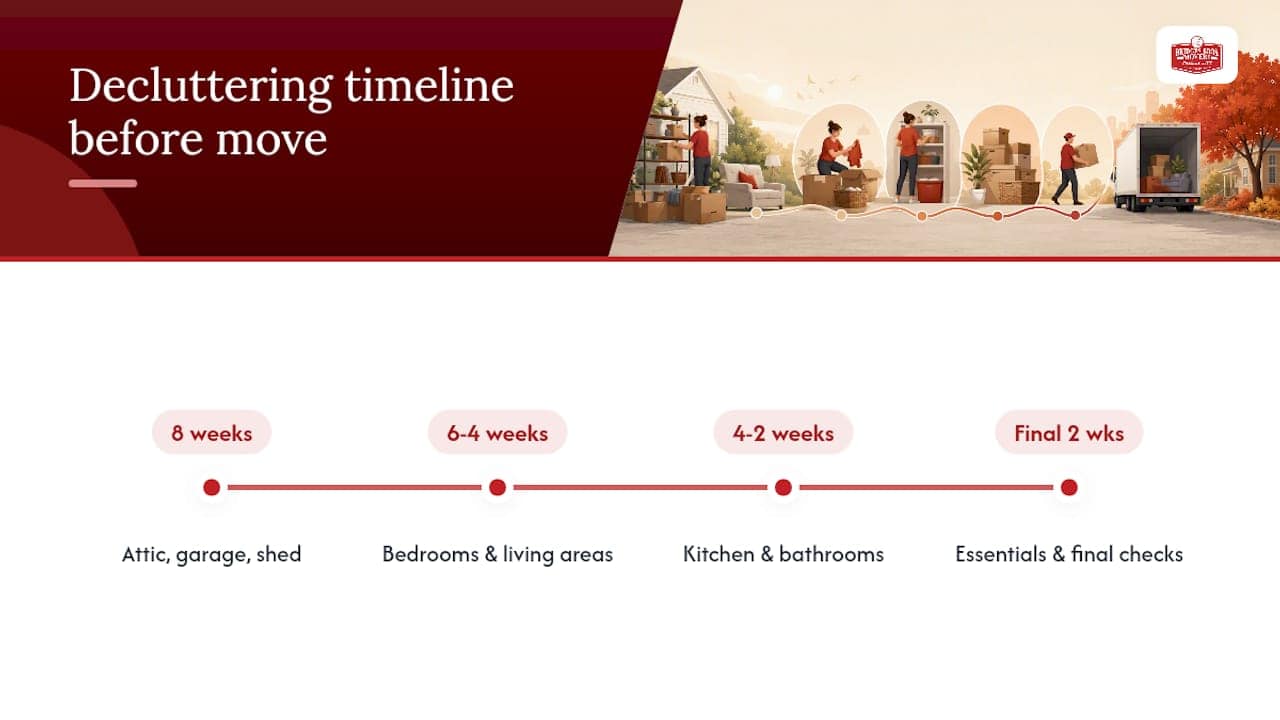
Eight weeks out is attic, garage, and shed territory. These are the spaces where boxes from your last move still sit unopened, so bulky and forgotten items get sorted first while there’s no time pressure yet.
Six to four weeks out shifts to bedrooms and living areas. This is when you purge clothes you haven’t worn in a year, thin out bookshelves, and go through decor. It’s also the right window to measure furniture against your new floor plan, since a couch that fit your old living room might not fit the new one.
Four to two weeks out covers the kitchen and bathrooms. Use up or toss perishables, expired spices, and half-empty toiletries rather than moving them. Pack appliances you rarely use, like the panini press or stand mixer, early. Leave the coffee maker and everyday dishes for last.
The final two weeks are for essentials only. Build your essentials kit, secure valuables and important documents, and do one last sweep through every closet and drawer you may have skipped. This is also when experts recommend resisting the urge to start “just one more project,” since new organizing efforts at this stage usually create more boxes, not fewer.
Which Decision Framework Should You Use To Declutter Faster?
Indecision is what turns a weekend project into a three-week slog. A compact rule forces a decision in seconds instead of minutes, and that speed compounds across hundreds of items in a full house.
- 3-3-3: Pick three items to keep, three to donate, three to discard, in one short round. Best for a quick reset when you only have twenty minutes.
- 5-5-5: The same idea scaled up, five per category, for a slightly longer session in one room.
- 12-12-12: Twelve items to trash, twelve to donate, twelve to keep. This is the go-to for a full closet, garage shelf, or pantry when you need real volume moved in one sitting.
- The four-box method: Label four boxes Keep, Sell/Donate, Recycle/Dispose, and Store, then assign every single item to one of them as you go through a room. This consistency technique is what keeps a whole-house purge from stalling out in “maybe” piles.
- Rule of 3: For closets specifically, if you can’t picture three realistic outfits built around an item, it goes.
For most time-pressed movers, the four-box method is the right default because it applies to every room without modification. Save 12-12-12 for spaces with obvious excess, like a garage or linen closet.
Pro Tip: For sentimental items that stall you out, use the rule of 3 with a twist: if you’re truly unsure, put it in a labeled “outbox” and revisit it in one year. If you haven’t thought about it by then, you have your answer.
When Should You Store Items Instead Of Moving Them?
Storage makes sense when an item doesn’t belong in your new home yet, not when you simply can’t decide what to do with it. Three situations call for a storage unit rather than the moving truck: seasonal furniture like patio sets and snow gear that has no use in the off season, items on hold during a renovation at the new place, and belongings you’re keeping for a grown child or aging parent but don’t need in daily rotation.
Unit sizing depends on what’s going in. A 5x5 unit handles a few dozen boxes and small furniture. A 10x10 fits the contents of a two-bedroom apartment. A 10x20 covers most full households in transition. Climate control matters for anything sensitive to temperature swings or humidity: wood furniture, electronics, photographs, musical instruments, and leather goods all degrade faster in an uncontrolled unit, especially through a New England winter.
Packing for storage differs from packing for a move because these boxes might not open for months:
- Wrap furniture legs and edges before stacking anything on top.
- Use uniform box sizes so stacks stay stable and don’t collapse under their own weight.
- Elevate boxes off the concrete floor with pallets or shelving to avoid moisture damage.
- Label every box with contents and the approximate date you’ll need it back.
A detailed storage options guide can help you match the unit size and features to what you’re actually storing, rather than guessing and paying for space you don’t use.
How Should You Pack And Label Boxes For A Fall Move?
Your last box packed should be the first one you need. Build an essentials kit with a few days of clothing, toiletries, phone chargers, basic cookware, a few plates and utensils, and any medication or important documents. Keep this kit in your car or hand-carry it, never in the moving truck.
- Label every box with three pieces of information: the room it’s going to, a short list of contents, and a priority number from 1 to 3, where 1 means “open this first.”
- Color-code by room using dot stickers or colored tape if you’re managing a large house. It speeds up unloading more than most people expect.
- Disassemble large furniture before wrapping it, and keep hardware in a labeled bag taped to the piece itself.
- Wrap fragile items individually and pack them upright, never flat, in boxes marked clearly on all sides, not just the top.
Labeling boxes as you go and avoiding overfilled boxes keeps them safe to lift and stack, which matters as much for your back as for your belongings. A step-by-step packing guide covers additional specifics for fragile and oversized items.
How Do You Sell, Donate, Or Dispose Of Items Before Moving?
List furniture online four to six weeks before your move, not the week before. That window gives buyers time to respond without forcing you into a fire sale. For pricing, start around half of retail for newer items and drop the price if nothing sells within two weeks.
- Confirm donation centers’ condition requirements before you load the car. Many refuse stained furniture or broken electronics outright.
- Schedule donation pickups a week or two ahead. Popular pickup slots fill fast in September and October as other movers hit the same deadline.
- Book junk removal at least two weeks before moving day. Last-minute requests often carry rush fees or simply aren’t available.
- Stage items for pickup by category so a removal crew or donation driver can load quickly and leave.
Our donate, toss, or move decision guide walks through the specific calls that trip people up most.
How Bridges Bros Movers Fits Into Your Decluttering Plan
Bridges Bros Movers has served New England families since 1919, and that kind of longevity comes from solving the actual problems that stall a move, not just showing up with a truck.
A family-owned mover recognized as “Best of Seacoast” and “Best Mover in NH” brings packing, storage, and junk removal under one roof, so decluttering decisions turn into action the same week instead of sitting on a to-do list.
Packing, storage, and junk removal handled by one team means your donated couch, your storage-bound patio furniture, and your moving-day boxes never cross paths twice. That’s fewer trips, fewer decisions made twice, and a faster move-in.
What Should You Do With Summer Gear Before A Fall Move?
Summer gear takes up disproportionate space for how little you’ll use it before spring, which makes it the highest-value category to clear before moving day. Beach chairs, coolers, inflatable pool toys, and warm-weather clothing you haven’t worn since July are prime candidates for the discard or donate pile, not the moving truck.

Start with outdoor gear. Grills, patio furniture, and garden tools take up serious cubic footage, and much of it, hoses, cracked planters, half-used bags of fertilizer, isn’t worth the cost of moving. If your new home has different outdoor space, a smaller yard or no yard at all, that mismatch alone justifies letting go of large items now rather than storing them “just in case.”
Summer clothing deserves the rule of 3 treatment specifically. Swimsuits, sandals, and warm-weather layers you can’t picture wearing again next year should go straight to donation rather than a moving box you’ll unpack in October and re-store for eight months.
Garden tools split into two categories: what you’ll use at the new address and what you won’t. If you’re moving to an apartment or a home with established landscaping, most of your tool collection is dead weight. If you’re keeping a yard, keep the tools you actually reach for and donate the rest, including anything rusted or duplicated.
This category alone often accounts for several cubic feet of truck space that never needed to travel with you.
How Do You Prioritize Decluttering Around Your Moving Deadline?
Work backward from moving day, not forward from your to-do list. Once you know your move date, every decluttering task gets a deadline attached to it, and that structure prevents the scramble that hits so many households in the final week.
Storage-area purges come first because they have zero daily-life dependency. You don’t need your attic tomorrow morning, so it can be tackled at leisure eight weeks out. Kitchen and bathroom items carry the most daily dependency, which is exactly why they land in the four-to-two-week window instead of earlier.
The biggest prioritization mistake is treating every room as equally urgent. It isn’t. A cluttered garage doesn’t slow down your Tuesday morning, but a half-packed kitchen absolutely does. Rank your rooms by how often you use them, then tackle them in reverse order: least-used rooms first, most-used rooms last.
If your moving date shifts earlier, and it sometimes does when a buyer’s financing closes faster than expected, having already cleared the low-dependency spaces gives you a buffer. You won’t be starting from zero in the final crunch; you’ll just be compressing an already-familiar routine into fewer days.
How Do You Handle Sentimental Items Under Time Pressure?
Sentimental items are where decluttering timelines fall apart, because these decisions genuinely take longer and shouldn’t be rushed alongside a stack of old magazines. The fix isn’t to speed up the emotional part. It’s to isolate it so it doesn’t hold up everything else.
Set sentimental items aside in their own box the moment you find them, rather than stopping your momentum to decide on the spot. Handle that box in a separate, dedicated session, ideally earlier in your timeline rather than the final week, when decision fatigue is highest and you’re most likely to keep everything just to avoid the choice.
Photographs, letters, and childhood items respond well to a modified rule of 3: keep the pieces that represent a specific memory clearly, and consider photographing the rest before letting them go. A photo takes up no truck space and preserves the memory just as well for most people.
The one-year outbox mentioned earlier works particularly well here. If you’re unsure whether to keep something with sentimental weight, box it, label it with a date, and revisit it after you’ve settled into your new home. Distance from the move itself often makes the decision much easier, and clearer, than trying to make it under deadline pressure.
How Do You Coordinate Decluttering With Movers And Utilities?
Decluttering and logistics should run on the same calendar, not two separate ones. Book your moving company as soon as you have a firm date, ideally six to eight weeks out, since availability tightens fast during peak fall moving weeks.
Once your mover is booked, share your inventory estimate as your decluttering progresses. A lighter load, thanks to the donation and disposal work you’ve already done, can sometimes qualify you for a smaller truck or a shorter labor window, which affects your final quote.
Utility shutoffs deserve their own line on the calendar, separate from packing tasks. Schedule the disconnection of your current utilities for the day after you move out, not the day of, in case of any delay. Schedule new-address utility activation to align with your move-in date, not before, so you’re not paying for two active accounts longer than necessary.
Coordinate your junk removal and donation pickups to happen before your movers arrive, not the same day. Trying to run three different service crews through your house in one morning creates the kind of chaos that turns a planned move into a stressful one. A residential moving essentials checklist can help you map these dates against each other before they collide.
What Should Go Into Storage Versus What Should Move Immediately?
Not everything you’re keeping needs to travel with you on moving day, and separating those two categories early avoids paying to move something twice.
Store long-term if: the item is seasonal and won’t be used for months (patio furniture, holiday decorations, winter sports gear packed in September), your new home isn’t ready for it yet (renovation delays, a smaller starting space before an addition), or it belongs to a family member who isn’t ready to take possession.
Move immediately if: you’ll need it within the first two weeks in your new home (kitchen basics, bedding, toiletries, work materials), it’s part of your essentials kit, or it’s a valuable or irreplaceable item you don’t want out of your direct control, like documents, jewelry, or family photos.
Reassess before deciding if: an item has sat unused in storage from a previous move and you’re tempted to store it again. That’s usually a sign it belongs in the donate pile instead.
Running every item through this three-way filter, rather than defaulting everything uncertain into storage, keeps your storage costs proportional to what you actually need preserved.
What Most People Get Wrong About Decluttering Before A Move
Most advice about decluttering before a move treats every room as equally urgent, and that’s the biggest flaw in how people actually approach it. The research is clear that sequencing matters more than intensity: starting in storage areas eight weeks out does more for your final moving cost than a frantic, all-rooms-at-once purge crammed into one long weekend.
The other place conventional wisdom falls short is sentimental items. Most checklists lump them in with everything else, as if a childhood photo box deserves the same thirty-second decision as an old spatula. It doesn’t, and pretending it does is exactly why so many people either stall out entirely or make rushed calls they regret. Isolate that category early and give it its own session.
If you take one thing from this guide, prioritize the boring, low-emotion spaces first: attics, garages, basements. They’re where volume hides, and volume is what drives your moving cost. Save the hard decisions for when you have breathing room, not when the truck is already scheduled.
— Patrick
Get Professional Help For Your Fall Move
Bridges Bros Movers offers what a decluttering checklist alone can’t: someone to actually handle what’s left once your piles are sorted. Where a DIY approach means juggling a donation truck, a storage unit rental, and a moving crew as three separate headaches, Bridges Bros Movers coordinates packing, storage, and junk removal under one team, so your “store” pile and your “discard” pile leave the house without you managing three different schedules.
If you’re ready to see what a fully coordinated move looks like, request a moving quote and get a straightforward estimate based on your actual inventory. It’s the same trusted, award-winning service New England families have relied on for generations, minus the guesswork of doing it all yourself.
Sources
- Decluttering Before Moving House: The Ultimate Room-by-Room Guide
- Decluttering before moving: room-by-room checklist
- Decluttering Before Moving
- The rule of 3 closet organization
FAQ
What Is The 3-3-3 Rule For Decluttering?
The 3-3-3 rule has you choose three items to keep, three to donate, and three to discard in one quick round, making it a fast way to build momentum in a single room without overthinking each decision.
When Should You Start Decluttering Before A Move?
Start several weeks before moving day, beginning with storage-heavy spaces like the attic, garage, and basement, then working toward daily-use rooms like the kitchen in the final phase.
What Is The 5-5-5 Rule For Decluttering?
The 5-5-5 rule scales up the 3-3-3 method: pick five items to keep, five to donate, and five to discard in one session, which suits a slightly larger space like a full closet or pantry shelf.
What Are Common Items People Throw Away Before Moving?
Expired pantry food, half-used toiletries, duplicate kitchen tools, worn-out linens, broken electronics, mismatched food storage containers, old paint cans, expired medications, single-use batteries, worn shoes, outdated documents, and rusted garden tools top most pre-move discard lists.
Should You Hire A Moving Company To Help With Decluttering?
A moving company like Bridges Bros Movers won’t do your sorting for you, but its packing, storage, and junk removal services handle everything left over once you’ve made your keep, donate, and discard decisions, which removes the logistics burden from an already time-pressured schedule.