
TL;DR:
- Comparing moving quotes requires a structured process to uncover hidden fees and ensure accurate comparisons.
- Families should gather detailed information on price, services, insurance, and fees using standardized checklists and in-home surveys.
Getting three moving quotes and picking the middle price sounds simple enough. But families across New Hampshire, Maine, and Massachusetts discover too late that the quote they chose left out furniture disassembly, stair fees, or adequate insurance coverage, and what looked like a $1,800 move turned into a $2,900 surprise on moving day. Comparing moving quotes takes more than scanning the bottom line. It requires a structured process that surfaces every detail, so you can make a confident, informed decision and protect both your belongings and your budget.
Table of Contents
- What you need to compare moving quotes effectively
- Step-by-step: How to compare moving quotes without missing details
- Red flags and risks: What to watch out for in moving quotes
- Making the final decision: Value, trust, and peace of mind
- What moving industry insiders wish you knew about quote comparisons
- Get started with a transparent, detailed moving quote
- Frequently asked questions
Key Takeaways
| Point | Details |
|---|---|
| Organize for comparison | Using a checklist or spreadsheet ensures you compare all key details and avoid surprises. |
| Look beyond price | The lowest quote often hides risks—value and trust are more important for a stress-free move. |
| Watch for red flags | Unusually cheap quotes, vague terms, or big deposits are major warning signs to avoid. |
| Always verify credentials | Confirm the mover’s licensing and insurance directly with official registries for protection. |
| Choose reputation over ambiguity | Paying a bit more for a well-reviewed, insured mover protects valuables and delivers peace of mind. |
What you need to compare moving quotes effectively
Now that you see why missing details can lead to regrets, gather what you need to get organized from the start.
Before you request a single quote, set up a system that keeps every detail in one place. Most people receive quotes as PDFs or emails, open them side by side on their screen, and try to hold everything in their head. That approach fails quickly once three or four documents are in play. A simple spreadsheet or printed moving checklist solves this instantly.
Your tracking system should capture these core criteria for every mover you contact:
- Total price (binding vs. non-binding estimate)
- Services included (loading, transport, unloading, packing, disassembly)
- Insurance coverage (released value vs. full value protection)
- Estimated timeframe (pickup window, delivery window)
- Deposit requirements and payment terms
- Licensing and USDOT number (for interstate moves)
- Extra fees (stairs, long carry, fuel surcharge, weekend rates)
Using a checklist request form when reaching out to movers ensures you ask every company the same questions upfront. This makes your eventual comparison genuinely apples-to-apples rather than a patchwork of different information formats.
As Moving Quotes: Best Practices recommends, use a side-by-side spreadsheet or checklist to compare quotes, focusing on value rather than simply the lowest price. Value means factoring in everything a company offers, not just the number at the bottom of the page.
| Criteria | Mover A | Mover B | Mover C |
|---|---|---|---|
| Base price | $1,800 | $2,100 | $1,950 |
| Packing included | No | Yes | Partial |
| Insurance type | Released value | Full value | Released value |
| Stair fee | $75/flight | Included | $50/flight |
| Deposit required | 50% | 10% | 25% |
| USDOT licensed | Yes | Yes | Unverified |
That table reveals something important: Mover A’s base price looks best, but once you add stair fees, packing costs, and weaker insurance, the real cost shifts significantly.
Pro Tip: Send every mover an identical inventory list and list of questions before the quote. This saves you time following up and makes your spreadsheet far easier to populate accurately.
For more guidance on finding affordable mover tips without cutting corners on quality, review what experienced movers say separates a fair price from a risky one.
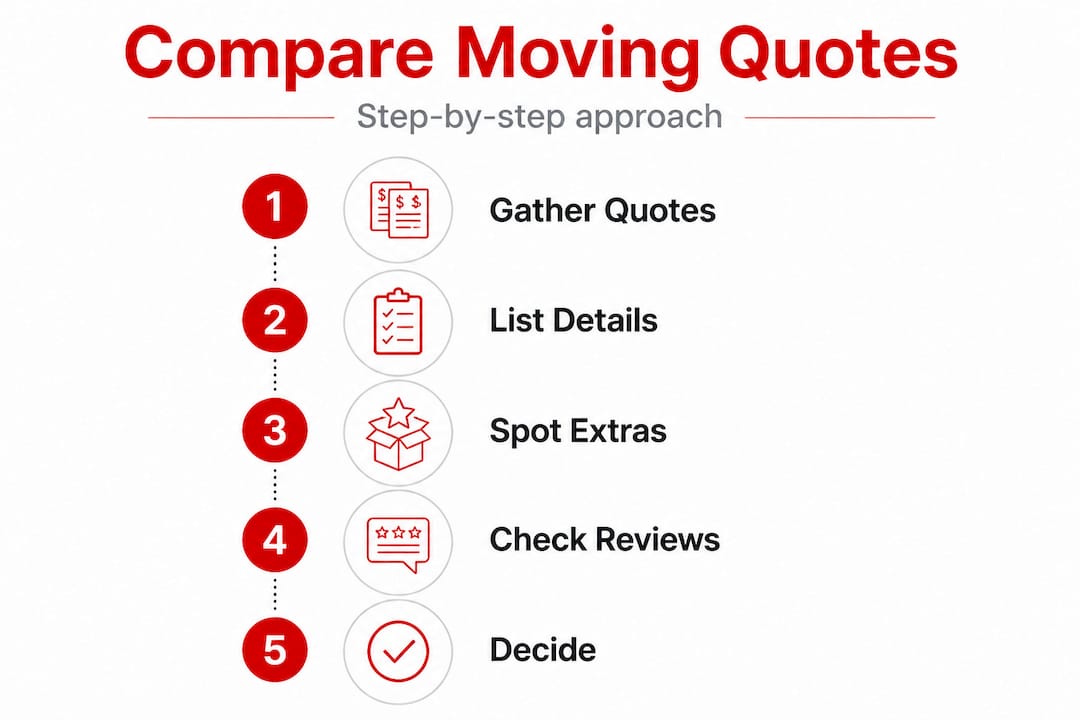
Step-by-step: How to compare moving quotes without missing details
With your prep work in place, move into a detailed, step-by-step approach to ensure no detail slips through the cracks.
Rushing this process is where most families run into trouble. Following a clear sequence keeps you methodical and prevents the confirmation bias of falling in love with a low number before you’ve read the fine print.
-
Request at least three quotes. Three gives you a meaningful range. Fewer and you risk anchoring to a number without knowing if it reflects the market. More than five and the comparison becomes unwieldy. Aim for three to four movers who serve your specific route in New Hampshire, Maine, or Massachusetts.
-
Conduct in-home or virtual surveys. A mover who quotes over the phone based purely on your square footage cannot give you an accurate number. An in-home or virtual walk-through allows them to account for heavy furniture, tight staircases, fragile items, and access challenges. Without this step, a quote is really just a rough guess.
-
Enter all details into your spreadsheet immediately. Don’t wait. Memory distorts details quickly, especially across multiple conversations. Populate your tracking sheet as soon as you receive each quote document.
-
Analyze service inclusions and exclusions. Read every line. Some companies include free furniture padding and wrapping. Others charge per item. Packing services, appliance disconnection, specialty item handling, and storage are frequently excluded without explicit mention.
-
Review insurance and liability terms carefully. The default option for most moves is released value protection, which covers only $0.60 per pound per item. That means a 20-pound laptop worth $1,500 is covered for just $12. Full value protection costs more but ensures meaningful reimbursement if something is damaged or lost.
-
Compare payment and deposit terms. A reputable mover typically requires a modest deposit of 10% to 20%. If a company demands 50% or more upfront before any work has been done, that is a meaningful warning sign worth taking seriously.
-
Verify credentials before finalizing. Check that interstate movers hold a valid USDOT number and that local movers carry state-required licensing. Review this alongside the quote before you make any final decisions.
Learning how to choose a mover involves more than comparing prices. It means evaluating reliability, transparency, and responsiveness throughout the quoting process itself.

| Feature | What to look for | Red flag |
|---|---|---|
| Estimate type | Binding or “not-to-exceed” | Non-binding with vague language |
| Insurance | Full value protection offered | Only released value available |
| Deposit | 10 to 25 percent | Over 50 percent required upfront |
| Contract | Detailed, written agreement | Verbal only or single-page form |
| Contact info | Physical address, license number | PO box only, no verifiable number |
If you are planning a residential moving quote, ask specifically about what happens if the move takes longer than estimated. Some companies charge by the hour beyond a threshold, and that cost can add up fast if your move day runs long.
Pro Tip: Ask each mover, “What would cause my final price to be higher than this quote?” Their answer tells you everything about their transparency and whether they have thought through your specific situation.
Red flags and risks: What to watch out for in moving quotes
After learning how to compare quotes, it’s just as important to know which ones you should avoid altogether.
Some quotes should be disqualified before they even enter your spreadsheet. Recognizing dangerous patterns early protects you from scams and poor service that can derail your entire move.
Here are the most common red flags to watch for:
- Unusually low pricing. If one quote is 40% below every other, ask why. Low prices are sometimes subsidized by hidden fees that appear later, or they reflect a company that lacks proper insurance and licensing.
- Large upfront deposits. Requiring more than 25% upfront before the move is a pressure tactic. Fraudulent movers sometimes collect large deposits and then hold belongings hostage for additional payment.
- No physical address. A legitimate moving company has a verifiable business address. A PO box or vague city-level reference is a concern.
- No licensing or insurance information. Any mover who cannot produce a USDOT number for interstate moves, or who cannot verify state licensing for local moves, creates real legal and financial risk for you.
- Vague contract language. Terms like “additional charges may apply” without defining what those charges are or when they trigger is a sign the company is leaving room to inflate your final bill.
- Pressure to decide immediately. Reputable movers understand you need time to compare options. Aggressive urgency is a manipulation tactic.
“Red flags: unusually low quotes, large upfront deposits, vague terms, no licensing. The cheapest is often riskiest, carrying hidden fees, poor service, and potential scams.”
Knowing how to recognize a sketchy mover before you hand over a deposit is one of the most practical skills you can develop during this process. And if you are moving within New England, understanding the importance of working with licensed movers is especially relevant given the region’s specific regulatory expectations.
Moving scams are more common than most people expect. The Federal Motor Carrier Safety Administration tracks hundreds of moving fraud complaints annually, many involving exactly the patterns described above. Staying alert during the quote comparison stage is your strongest defense.
Making the final decision: Value, trust, and peace of mind
Once you’ve eliminated red flags, it’s time to figure out which mover actually deserves your trust and business.
This is the stage where the temptation to default to the lowest remaining price is strongest. Resist it. At this point, you have already eliminated risky options. The remaining decision is about value, not just cost.
Here is what to weigh when making your final choice:
- Licensing and insurance. Confirm they are covered. Review their moving insurance options and understand exactly what protection applies to your belongings during the move.
- Customer reviews. Look at Google, the Better Business Bureau, and local review platforms. A pattern of complaints about late arrivals, damaged items, or billing disputes tells you what written contracts cannot.
- Responsiveness during quoting. How a company communicates before the move is a reliable preview of how they’ll handle problems on moving day. Slow replies, vague answers, or reluctance to provide written confirmation are all meaningful signals.
- Written contract with full terms. Before committing, every detail should be in writing: pickup date, delivery window, exact services, total price, insurance coverage, and payment terms.
- Binding estimate. A binding estimate locks in your price so you aren’t subject to surprise charges. Some movers offer a “not-to-exceed” estimate, which is the next best thing. Non-binding estimates mean your final cost can be higher.
The benefits of insured movers are especially important when you are moving furniture with high sentimental or monetary value, or when your timeline is tight and a claim needs to be resolved quickly.
Established, transparent companies that offer binding estimates, carry full insurance, and have a verifiable track record consistently outperform cheaper alternatives, especially when accounting for the real cost of damaged items, delays, and poor communication. Reducing moving costs is a reasonable goal, but it works best when you save on logistics, not on the quality and accountability of the company you hire.
As Moving Quotes: Best Practices notes, the cheapest option carries genuine risk through hidden fees and poor service, while established, insured movers are worth a premium for a smooth relocation, especially for families moving with valuables.
Pro Tip: Pay a little more for a mover who has been in business for many years, carries full value protection, and can provide verifiable local references. That small premium is cheap insurance against a move that turns into a months-long dispute.
What moving industry insiders wish you knew about quote comparisons
Stepping back, let’s get real about what experienced moving professionals observe when customers focus too heavily on price during the quote comparison process.
The biggest misconception is that comparing quotes is primarily a math exercise. It is not. It is a communication test. The way a company responds to your questions, the clarity of their written documents, and their willingness to explain line items all tell you more about your likely experience than the number itself does.
Most of the costly mistakes we hear about from families who have moved before reaching out to us share a common thread: they noticed something felt off during the quoting process but dismissed it because the price was attractive. A quote that cannot survive your honest scrutiny is not a deal. It is a warning.
Families with complex timelines, high-value items such as antiques or artwork, or multi-stop moves should put trust and reputation at the top of their criteria list. These are situations where an ambiguous contract can cause real damage. Understand what great movers do differently and use that as your benchmark when evaluating every company you consider.
Reliable movers are never reluctant to show you their insurance certificates, their licensing, and a step-by-step contract breakdown. If a company hesitates when you ask for any of these, move on. Insisting on full transparency is not being difficult. It is being smart.
Get started with a transparent, detailed moving quote
Ready to put these tips into action and take the stress out of your move? Here’s an easy step forward.
At Bridges Bros Movers, transparency is built into every quote we provide. We have served families and individuals across New Hampshire, Maine, and Massachusetts since 1919, and we understand that a clear, detailed quote is the foundation of a move you can feel confident about. You can explore our full range of moving services to understand exactly what we offer, from professional packing solutions to long-haul moving across state lines. Every quote includes a breakdown of services, insurance options, and all applicable fees so you can compare accurately and move forward with confidence. Reach out today for a no-surprise quote built around your specific needs.
Frequently asked questions
How many moving quotes should I get before comparing?
It’s best to get at least three quotes to ensure a fair comparison and to spot significant price or service differences between movers.
What are the biggest risks if I choose the cheapest moving quote?
The cheapest moving quote often signals hidden fees, excluded services, or an unlicensed mover who provides little recourse if something goes wrong.
What details should always be in a professional moving quote?
A professional quote should list all included services, insurance coverage type, itemized fees, pickup and delivery windows, and full payment terms, as outlined in Moving Quotes: Best Practices.
How do I verify a mover’s licensing and insurance?
Ask the mover to provide their USDOT number and insurance certificate directly, then cross-reference their USDOT number with the Federal Motor Carrier Safety Administration’s online registry.
Do moving quotes include packing, storage, or junk removal?
These services are frequently excluded by default, so always ask each mover explicitly and use a side-by-side checklist to track exactly what each quote covers and what it does not.