
TL;DR:
- Handling a move during a delayed move-in requires prompt documentation, early communication with your mover, and choosing flexible temporary housing options to maintain stability. Proper storage solutions, organized labeling, and stress management strategies help ensure a smooth transition despite the disruption. Coordinating with professionals and planning ahead minimizes costs, reduces stress, and keeps your relocation on track.
Handling a move when your new place is not ready yet means coordinating temporary housing, storage, and flexible moving timelines simultaneously. This situation, which moving professionals call a “gap move” or transitional relocation, affects more people than you might expect. More than 1 in 3 homebuyers experience a gap between closing and actual move-in. The good news is that with the right preparation, a delayed move-in does not have to derail your entire relocation. This guide walks you through every step, from immediate actions to storage logistics and stress management.
How to handle a move when your new place isn’t ready yet
The moment you learn your new home will not be available on your planned move-in date, your first priority is information gathering. Contact your landlord, seller, or property manager immediately and get the delay confirmed in writing. Documented confirmation with timestamps is necessary for adjusting mover schedules, protecting your liability coverage, and avoiding cancellation penalties. Do not rely on a verbal update. A written record protects you at every stage.
Once you have documentation, call your moving company right away. Early communication gives movers the flexibility to adjust pickup dates, reroute trucks, or arrange temporary storage without charging you for last-minute changes. The longer you wait, the fewer options remain on the table.
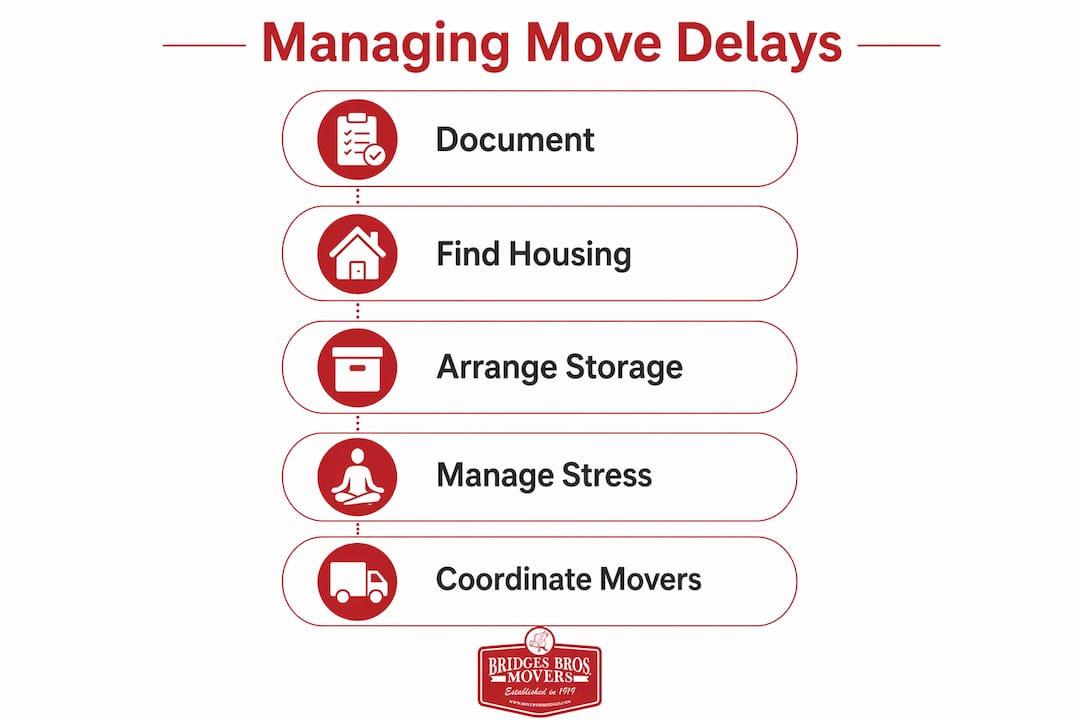
Follow these first steps in order:
- Confirm the delay in writing from your landlord, seller, or builder with a specific revised date.
- Contact your moving company to discuss rescheduling, storage-in-transit, or split delivery options.
- Revise your budget to account for temporary housing costs, which average $70 to $300 monthly for short-term storage alone.
- Label your boxes using a three-category system: “Essentials,” “Storage,” and “New Home.” This advanced labeling system prevents unpacking chaos and enables split deliveries.
- Pack a transition bag as if you are leaving for a week-long trip. Include clothing, medications, chargers, important documents, and comfort items.
Pro Tip: Pack your transition bag last and load it into your personal vehicle, not the moving truck. You will need it immediately, regardless of where your belongings end up.
Use your moving preparation checklist to track every task during this adjustment period. Staying organized from day one prevents small oversights from becoming expensive problems later.
What are the best temporary housing options during a move delay?
Choosing the right temporary housing determines how comfortable and stable your family feels during the gap period. The options range from budget-friendly to full-service, and the right choice depends on your timeline, family size, and budget.
Here is a breakdown of the most practical options:
- Short-term furnished rentals: These are the most home-like option. Corporate rental providers define short-term furnished housing as any lease lasting 30 days or more, with terms extending up to 12 months for indefinite delays. Providers like Furnished Finder and Airbnb offer monthly rates that are often lower than extended-stay hotels.
- Extended-stay hotels: Brands like Marriott’s TownePlace Suites and Hilton’s Home2 Suites offer kitchenettes and weekly rates. These work well for stays under 30 days but become expensive beyond that window.
- Vacation rentals: Platforms like VRBO give you full home access, which matters for families with children or pets. Rates vary widely, so book early to secure better pricing.
- Family or friends: Free but not always practical for longer stays. Set clear expectations upfront about duration and shared space to protect the relationship.
- Corporate housing providers: Companies like Oakwood and National Corporate Housing specialize in furnished apartments for relocating professionals. These often include utilities, Wi-Fi, and housekeeping, making them worth the premium for stays over 60 days.
When reviewing any short-term lease, check for flexible cancellation terms. Your new home’s readiness date may shift again, and you need the ability to extend or exit without penalty.
Pro Tip: When finding short-term rentals, ask specifically about month-to-month flexibility before signing anything. Many landlords offer it but do not advertise it.
Temporary housing that feels like home supports emotional wellbeing during transitions in a measurable way. Prioritize a space where your family can cook, sleep comfortably, and maintain some sense of normalcy.
Storage solutions and logistics for moving with a gap between homes
When your belongings cannot go directly to your new address, you have three main storage paths. Each carries different costs, risks, and convenience levels.

| Storage Type | Best For | Average Cost | Key Consideration |
|---|---|---|---|
| Self-storage units | Longer gaps, DIY access | $70–$300/month | You handle all loading and unloading |
| Storage-in-transit (mover-managed) | Short to medium gaps | Varies by mover | Reduced handling, climate control available |
| Short-term warehouse storage | Large volume, commercial moves | Quote-based | Less accessible but secure for bulk items |
Storage-in-transit, offered directly by moving companies, is often the most cost-effective choice for gaps under 90 days. Hidden costs of multiple handlings can exceed the cost of a self-storage unit rental when you factor in truck rentals, labor, and the risk of damage from repeated loading. Professional storage-in-transit solutions keep your items in a climate-controlled environment with fewer touchpoints, which directly reduces the chance of breakage.
Key logistics tips to keep in mind:
- Separate your boxes clearly using the “Essentials,” “Storage,” and “New Home” labeling system before the truck arrives.
- Photograph high-value items before they go into storage. This creates a visual record for insurance purposes.
- Ask your mover about split deliveries so your essential furniture can go to temporary housing while the rest stays in storage.
- Avoid double handling by planning your storage exit date before you book. Knowing when you need delivery gives movers time to schedule efficiently.
For a detailed comparison of your options, the short-term vs. long-term storage guide from Bridges Bros Movers breaks down exactly what works for different gap lengths. Choosing the wrong storage type for your timeline is one of the most common and avoidable mistakes in a gap move.
How do you manage stress when your move takes longer than expected?
Moving stress is not just inconvenient. 27% of people find moving more stressful than losing a job, which means the emotional weight of a delayed move is a real and serious concern. When a gap move extends your timeline by weeks or months, that stress compounds. Managing it requires both practical organization and deliberate self-care.
Moving stress most often arises from a lack of contingency-based planning rather than the move itself. When you have a backup plan, uncertainty loses most of its power. Build a realistic timeline that includes buffer weeks, not just your ideal move-in date.
Practical strategies that actually work:
- Maintain daily routines. Wake up at the same time, keep meal schedules consistent, and preserve exercise habits. Routine creates psychological stability when your physical environment is in flux.
- Set up an unwind zone in your temporary housing. Mental health experts advise dedicated relaxation spaces to mitigate stress during transitional living. A corner with your favorite blanket, books, or a small lamp is enough.
- Communicate openly with your family. Children and partners feel the uncertainty too. Regular check-ins about how everyone is coping prevent small frustrations from building into larger conflicts.
- Limit decision fatigue. Decision fatigue and physical exhaustion compound emotional difficulty during moves. Delegate tasks to your moving company wherever possible and reduce the number of daily choices you need to make.
“Adaptability is the primary skill needed to manage unexpected housing gaps effectively. The families who come through a delayed move in the best shape are the ones who planned for the possibility that things would not go perfectly.” — Planning skills for a stress-free move
For more guidance on keeping your family grounded during extended transitions, the stress-free move guide from Bridges Bros Movers covers both emotional and logistical strategies in detail.
How to coordinate with professional movers when your plans change
Working with your moving company through a delay is far easier than most people expect, provided you communicate early and clearly. Open communication with your moving coordinator allows flexible rerouting, split deliveries, and scheduling adjustments that avoid costly double-handling. The key is giving your mover as much lead time as possible.
Follow this coordination sequence when a delay occurs:
- Notify your mover immediately when you receive confirmation of the delay. Do not wait until you have a new move-in date confirmed.
- Request written confirmation of any schedule changes, new delivery windows, or storage arrangements. Documenting every delay with timestamps and signatures protects you for insurance claims and legal purposes.
- Discuss split delivery options. Ask whether your mover can deliver essential furniture to your temporary housing and hold the rest in storage until your new home is ready.
- Clarify storage fees upfront. Ask specifically about daily or weekly rates for storage-in-transit, and get the pricing in writing before your items are loaded.
- Confirm a flexible re-delivery window. Movers with scheduling flexibility can often accommodate a two-week delivery window, which gives you room to adjust if your new home’s readiness date shifts again.
Pro Tip: When you call your mover about a delay, have your original contract in front of you. Know your cancellation and rescheduling terms before the conversation starts so you can negotiate from a position of knowledge.
Avoid last-minute changes without notice. Calling your mover the night before your scheduled pickup to announce a delay will likely trigger fees and limit your options significantly. The full-service moving options at Bridges Bros Movers include flexible scheduling and storage-in-transit specifically designed for situations like this.
Key takeaways
A gap move succeeds when you document the delay immediately, choose the right temporary housing for your timeline, and coordinate storage logistics with your mover before your belongings are loaded.
| Point | Details |
|---|---|
| Document delays immediately | Get written, timestamped confirmation from your landlord or seller to protect scheduling and liability. |
| Label boxes in three categories | Use “Essentials,” “Storage,” and “New Home” labels to enable split deliveries and reduce unpacking confusion. |
| Choose housing by timeline length | Extended-stay hotels work for under 30 days; furnished rentals and corporate housing suit longer gaps. |
| Use storage-in-transit when possible | Mover-managed storage reduces handling costs and protects items better than repeated self-storage transfers. |
| Communicate with movers early | Early notification gives your moving company time to adjust schedules, arrange storage, and avoid penalty fees. |
What I have learned from clients navigating delayed move-ins
Patrick’s perspective:
After working with families across New Hampshire, Maine, and Massachusetts for years, the pattern I see most clearly is this: the clients who struggle most are not the ones with the longest delays. They are the ones who waited too long to make a plan.
The families who come through a gap move with their sanity intact are the ones who treated the delay as a logistics problem with a solution, not a catastrophe. They called us early, asked about storage options before they needed them, and made a temporary housing decision within 48 hours of learning about the delay. That speed matters more than perfection.
One thing I tell every client: your temporary space does not need to feel permanent to feel livable. Set up a few familiar items, keep your routines, and give yourself permission to treat this as a short chapter rather than a setback. The move is still happening. You are just managing the timing.
— Patrick
How Bridges Bros Movers helps when your new home isn’t ready
Bridges Bros Movers has been helping New England families navigate complicated moves since 1919, and delayed move-ins are a situation we handle regularly. Our flexible moving and storage services include storage-in-transit, split deliveries, and adjustable scheduling so your belongings stay safe while you wait for your new home to be ready. We also offer quality packing materials to help you organize your essentials separately from items headed to storage. Whether your gap is two weeks or two months, our team works around your timeline, not the other way around. Contact Bridges Bros Movers for a personalized quote and let us build a plan that fits your situation.
FAQ
What should I do first when my move-in date gets pushed back?
Contact your moving company immediately and get written confirmation of the delay from your landlord or seller. Documented delays with timestamps protect your scheduling options and any liability coverage adjustments.
How much does temporary housing cost during a move delay?
Costs vary by type: extended-stay hotels typically run $80 to $150 per night, while short-term furnished rentals average less per month for stays over 30 days. Short-term storage costs average $70 to $300 monthly depending on unit size and location.
Is storage-in-transit better than renting a self-storage unit?
Storage-in-transit managed by your mover is often more cost-effective for gaps under 90 days because it reduces the number of times your items are handled. Multiple transfers between trucks and storage units increase both cost and the risk of damage.
How long can a rent-back agreement last after closing?
Lenders typically require buyer occupancy within 60 days of closing, which caps most rent-back agreements at that same limit. If your gap exceeds 60 days, you will need a separate temporary housing arrangement.
How do I keep my family calm during an extended moving delay?
Maintain daily routines as much as possible and set up a dedicated relaxation area in your temporary housing. Open communication with your family about the timeline and regular check-ins reduce anxiety for both adults and children.