
TL;DR:
- Managing overlapping closing dates requires a realistic timeline, contingency plans, and clear communication.
- Building a buffer of three to five days between closing and moving helps absorb delays and prevents chaos.
Moving between two closings is one of the most logistically demanding situations a homeowner can face. You are selling one property, buying another, and trying to coordinate two sets of attorneys, agents, lenders, and movers, all on a timeline that can shift at any moment. Learning how to move between closing dates without the stress comes down to three things: a realistic timeline, smart contingency planning, and clear communication with every person involved. This guide gives you the exact strategies to manage the gap, protect your budget, and keep your sanity intact when the dates do not line up perfectly.
Table of Contents
- Key takeaways
- Building your moving timeline around closing dates
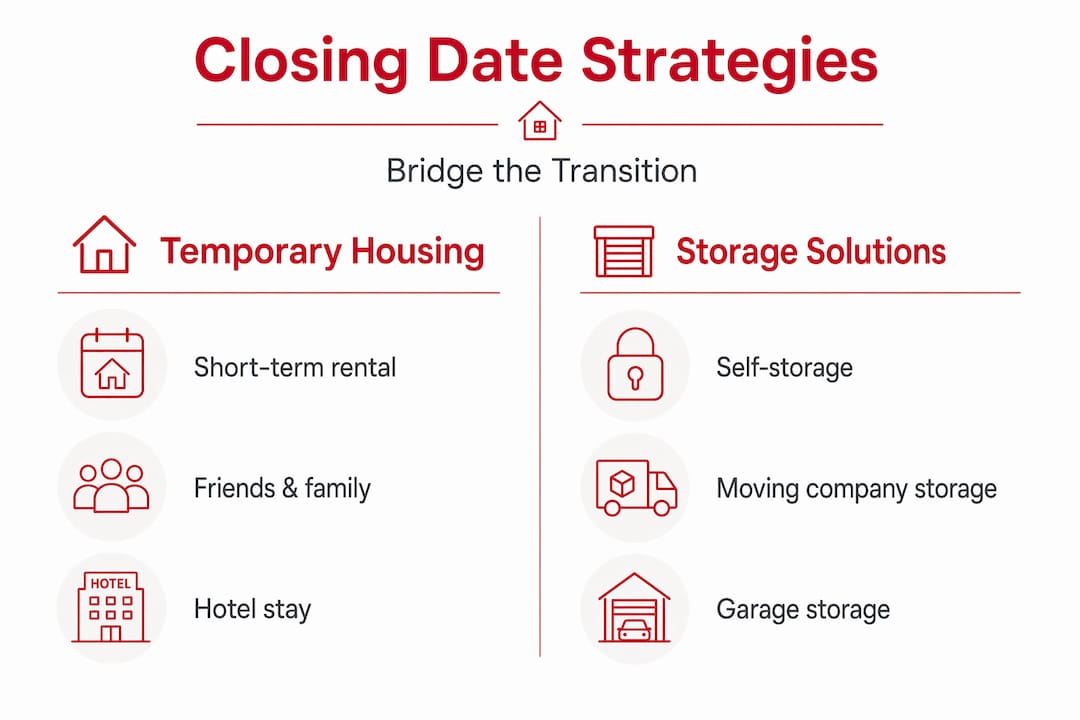
- Temporary housing and storage when dates do not align
- Packing strategies and communication during date changes
- Financial and legal considerations for closing gaps
- Comparing strategies for overlapping closing dates
- What I have learned from working with families through this
- Let Movewithbridges handle the hard part
- FAQ
Key takeaways
| Point | Details |
|---|---|
| Build timeline buffers | Add a 3 to 5 day cushion between your closing and move-in dates to absorb unexpected delays. |
| Plan for the gap | Use temporary housing or short-term storage to manage the period between move-out and move-in. |
| Pack in phases | Start with non-essentials early and keep a first-night box accessible throughout the transition. |
| Know your legal options | Rent-back agreements can buy sellers time but carry legal implications beyond 30 or 60 days. |
| Book movers with flexibility | Choose moving companies that allow rescheduling without penalties when closing dates shift. |
Building your moving timeline around closing dates
The single biggest mistake people make is treating closing day and moving day as the same event. They are not. Scheduling your move at least one day after closing is critical because last-minute funding issues, final walkthroughs, and paperwork delays can push a closing by hours or even an entire day. If your movers are already at the curb when the closing falls apart, you are paying for a truck that cannot unload.
Good moving timeline management starts with confirming your target closing dates as early as possible, then working backward from those dates to schedule every other piece of the move. Here is how to build that plan:
- Confirm closing dates in writing as soon as your purchase and sale agreements are signed. Verbal estimates are not reliable.
- Add a 3 to 5 day buffer between your closing date and your scheduled move-in. Industry experts recommend this cushion specifically to prevent chaos if either closing shifts.
- Book movers early. About 70% of U.S. moves happen between May and August, which means movers’ calendars fill up quickly. In peak season, book 3 to 4 weeks ahead. Off-peak, one to two weeks is usually sufficient.
- Choose providers with rescheduling policies. Penalty-free rescheduling on movers, utilities, and storage units is a practical safeguard when navigating closing date changes.
- Keep a contingency plan in writing. Know your backup options before you need them, whether that is a short-term rental, a family member’s spare room, or a storage unit you have already priced out.
Pro Tip: When you book your movers, ask directly whether they offer penalty-free date changes. Some companies allow one free reschedule if you provide 48 to 72 hours of notice. That single policy can save you hundreds of dollars and an enormous amount of stress.
For New England families moving during busy summer months, you can learn more about peak-season booking timelines to avoid getting caught without a mover at the last minute.
Temporary housing and storage when dates do not align
The gap between your move-out date and your move-in date is where most transition stress lives. Sometimes it is two days. Sometimes it is two weeks. Either way, you need a plan that covers both where you will sleep and where your furniture will go.
Your temporary housing options
Short-term rentals through platforms like Airbnb or VRBO work well for gaps of three to fourteen days, especially for families who need kitchen access and multiple bedrooms. Extended stay hotels are a strong alternative for solo movers or couples because they include weekly rates, housekeeping, and amenities. Staying with family or friends is the most affordable option, but it requires honest conversation about timing and space before you commit.
How storage fills the gap
Treating storage as a planned budget item rather than an emergency expense changes how you approach the whole transition. When you set aside money for a storage unit from the start, you give yourself the freedom to move out of your sold home on the seller’s preferred timeline without scrambling to move everything directly into your new home on the same day.
| Option | Best for | Average cost | Key trade-off |
|---|---|---|---|
| Short-term rental | Families needing space for 3 to 14 days | $100 to $250 per night | Convenient but can be costly for longer gaps |
| Extended stay hotel | Solo movers or couples | $60 to $120 per night | Limited space for belongings |
| Staying with family | Budget-conscious movers | Low to free | Requires advance planning and flexibility |
| Self-storage unit | Anyone with a furniture gap | $75 to $200 per month | Requires loading and unloading twice |
| Full-service storage | Families wanting hands-off storage | $150 to $400 per month | Higher cost, minimal effort |
Pro Tip: If you are using a storage unit during your transition, consider moving your larger furniture and non-essentials into storage first, then living out of suitcases and labeled bins for the short gap period. This approach phases your move and makes daily life manageable without everything being in boxes.
Packing strategies and communication during date changes
Packing with flexibility built in is a skill most people do not discover until their second move. The goal is to keep your household functional right up until move-out day while still making real progress on packing. Starting with non-essentials early and reserving essentials for last is the most practical way to achieve this.
Here is a packing approach that holds up even when dates shift:
- Pack by category, not by room. Seasonal items, extra linens, books, and decorative objects go first. Daily-use items go last.
- Label every box with contents and the room it belongs in at the new home. A color-coded label system takes five minutes to set up and saves hours of confusion on moving day.
- Create a first-night essentials box. Load it with toiletries, a change of clothes, phone chargers, medications, snacks, and any documents you will need at closing. Keep this box with you, not on the truck.
- Maintain a shared moving checklist with your partner or family members so everyone knows what is packed, what is not, and what decisions are still open.
On the communication side, early contact with agents and movers is where stress-free moving tips pay off most. Failing to communicate early with real estate agents and moving companies is the number one source of coordination problems during transitions. Set up a group text or email thread that includes your real estate agent, the moving company contact, and your attorney. When a closing date shifts, one message updates everyone at once.
Pro Tip: Ask your real estate agent to flag any potential closing delays as soon as they appear on the horizon, not the day before closing. Even a 24-hour heads-up lets you call your movers and adjust without penalty.

For practical guidance on organizing your packing process, Movewithbridges has a full breakdown of packing strategies for local moves that applies directly to closing-date transitions.
Financial and legal considerations for closing gaps
When your move-out and move-in dates do not align, the financial and legal details matter more than most people expect. Two costs catch families off guard most often: temporary housing they did not budget for and storage fees they assumed would be minor. Building both into your moving budget from the start is one of the best practices for closing dates that experienced movers consistently recommend.
Understanding rent-back agreements
A rent-back agreement allows the seller to remain in the home after closing for a set period, paying rent to the new buyer. This arrangement is increasingly common when sellers need time to find or close on their next home.
| Rent-back duration | Legal classification | Key consideration |
|---|---|---|
| Under 30 days | License (not a lease) | Fewer legal protections, simpler to execute |
| 30 to 60 days | Typically a formal lease | Subject to tenant protections in most states |
| Over 60 days | May trigger lender restrictions | Can reclassify the home as investment property |
Rent-back agreements longer than 29 days are usually treated as formal leases with tenant protections, which adds legal complexity for both parties. If you are negotiating a rent-back, have your attorney review the terms. Set a clear daily rate, a firm end date, and a security deposit to protect both sides.
Beyond rent-back costs, budget specifically for the gap. A realistic contingency fund for a two-week transition between closings might include one to two weeks of temporary housing, one month of storage, and a buffer for mover rescheduling fees. Having those numbers written down before you get to that point removes a major source of anxiety.
Comparing strategies for overlapping closing dates
No single approach works for every situation, but you can match your circumstances to the right combination of strategies using this comparison.
| Strategy | Best scenario | Main advantage | Watch out for |
|---|---|---|---|
| 3 to 5 day buffer | Any move with uncertain closing timelines | Absorbs delays without chaos | Does not help if gap is longer than a week |
| Temporary housing | Gap of 3 to 14 days | Keeps family comfortable | Costs add up quickly without a budget set |
| Short-term storage | Furniture gap of any duration | Protects belongings, phases the move | Requires two loading days |
| Rent-back agreement | Seller needs time after closing | Keeps seller in home, avoids hotel | Legal complexity beyond 30 days |
| Phased packing | Any transition with uncertain timing | Maintains daily functionality | Requires discipline and organization |
Your action items, regardless of which strategies you choose:
- Confirm closing dates in writing as early as possible.
- Book movers with a rescheduling policy and note the notice window required.
- Price out at least one temporary housing option and one storage option before you need them.
- Create a shared checklist with everyone involved in the move.
- Verify all bookings 48 hours before each major transition point.
Viewing the overlap period as a planned phase rather than a failure of planning is the mindset shift that makes the whole process more manageable.
What I have learned from working with families through this
In my experience, the families who handle overlapping closing dates with the least stress are not the ones with the most money or the most time. They are the ones who made decisions early and communicated them clearly.
I have seen moves fall apart in the final 48 hours because a seller waited until closing day to realize they had no place to go. And I have seen the opposite: families who booked a storage unit two months out, put a short-term rental on hold, and coordinated with their movers weekly. Those moves went smoothly even when closings shifted by three or four days.
What surprises most people is how much the emotional weight of moving decreases when the logistics are handled. Moving is inherently stressful because it involves your home, your family, and a huge financial transaction all at once. But when you have a timeline written down, a backup plan ready, and a mover who knows what you need, that stress shrinks to something manageable.
The practical wisdom I keep coming back to is this: flexibility is not a sign that your plan is weak. It is a sign that your plan is realistic. Build the buffer. Price out the storage unit. Have the rent-back conversation early. Those steps take an hour of preparation and can save days of chaos.
— Rich
Let Movewithbridges handle the hard part
When closing dates shift and the logistics get complicated, having the right moving partner makes all the difference. Movewithbridges has been helping families across New Hampshire, Maine, and Massachusetts manage complex transitions since 1919. Whether you need flexible residential moving that can adapt to a changing closing timeline, or secure short-term storage to hold your belongings during a gap between closings, the team is ready to work around your schedule. Get in touch for a free quote and let Movewithbridges help you plan a move that stays on track, even when the dates do not.
FAQ
How much buffer time should I leave between closings?
Industry experts recommend a 3 to 5 day buffer between your closing date and your scheduled moving day to absorb unexpected delays in funding, walkthroughs, or paperwork.
What should I do if my move-out and move-in dates do not match?
Use a combination of temporary housing and short-term storage to cover the gap. Pricing out both options before you need them prevents last-minute scrambling and keeps your budget on track.
How does a rent-back agreement work?
A rent-back agreement lets the seller stay in the home after closing by paying rent to the buyer. Stays under 30 days are typically treated as licenses, while longer arrangements become formal leases with added legal protections and requirements.
When should I book movers if my closing date might change?
Book as early as possible and choose a company that offers penalty-free rescheduling. During peak season (May through August), aim to book 3 to 4 weeks out and confirm your date as soon as closing is finalized.
What goes in a first-night essentials box?
Pack toiletries, a change of clothes for each family member, medications, phone chargers, important documents, and snacks. Keep this box with you rather than loading it onto the moving truck.