
TL;DR:
- Planning 6-8 weeks in advance ensures a smoother move and secures preferred services.
- Decluttering reduces moving costs and accelerates unpacking in the new home.
- Early utility arrangements and detailed checklists prevent common moving day issues.
Moving ranks among the most stressful life events most people will face, right alongside major milestones like starting a new job or welcoming a child. Between juggling packing schedules, coordinating logistics, and managing family routines, it’s easy for important tasks to slip through the cracks. Whether you’re relocating across Portsmouth or making a long-distance move from Massachusetts to Maine, the difference between a smooth transition and a chaotic one almost always comes down to how well you planned ahead. This guide gives you a clear, step-by-step path forward so nothing gets left behind.
Table of Contents
- What you need before you start
- Step-by-step move planning checklist
- Decluttering and packing: reduce stress and cost
- Avoiding common mistakes: utilities, addresses, and arrival prep
- Why real planning beats wishful thinking: a mover’s insight
- Connect with proven, family-owned movers
- Frequently asked questions
Key Takeaways
| Point | Details |
|---|---|
| Start early | Planning 6-8 weeks in advance makes your move much less stressful. |
| Declutter first | Sorting and downsizing reduces both your costs and moving headaches. |
| Checklist is critical | A written checklist prevents forgotten tasks and last-minute chaos. |
| Utilities and essentials | Arrange utilities and pack arrival-day essentials to avoid unpleasant surprises. |
| Expert support | Trusted local movers streamline the process and offer peace of mind. |
What you need before you start
Good moves are built on a solid foundation. Before you touch a single box, you need to gather the right tools, set a realistic timeline, and make a few key decisions that will shape every step that follows.
The single most important rule: start planning 6-8 weeks in advance for both local and long-distance moves. That window gives you enough time to declutter without rushing, book the right movers before their calendars fill up, and handle address changes without stress. New England summers are especially busy for moving companies, so the earlier you reach out, the better your chances of securing your preferred date.
Here are the essential materials and decisions to tackle before you start planning in earnest:
- Boxes and packing supplies: Stock up on sturdy boxes in multiple sizes, packing tape, bubble wrap, and packing paper. Wardrobe boxes are worth the extra cost for hanging clothes.
- Markers and labels: You will use these constantly. Color-coded labels by room save enormous time during unpacking.
- An inventory sheet: A simple spreadsheet or even a notebook page works. List every box by number, the room it belongs to, and a brief description of its contents.
- A clear DIY vs. professional decision: For large homes, valuable items, or long-distance moves, professional movers almost always pay for themselves in time and reduced damage risk.
- Special items and storage needs: Identify anything that needs extra care, like antiques, pianos, or artwork. Decide early if you need temporary storage between your move-out and move-in dates.
For practical guidance on protecting your belongings during the process, the packing tips for local moves resource from Bridges Bros. is a useful starting point.
| Supply | Estimated quantity for 3-bedroom home | Purpose |
|---|---|---|
| Small boxes | 20-25 | Books, kitchen items, heavy objects |
| Medium boxes | 15-20 | Linens, toys, appliances |
| Large boxes | 10-12 | Pillows, lightweight bulky items |
| Wardrobe boxes | 4-6 | Hanging clothing |
| Packing tape rolls | 6-8 | Sealing all box types |
| Bubble wrap/packing paper | 2-3 large rolls/packs | Fragile items |
Pro Tip: Set calendar reminders for each major task the moment you decide on a move date. Treat those reminders like appointments you cannot cancel. Families who build their moving timeline into their regular calendar are far less likely to forget critical steps like forwarding mail or transferring school records.
Step-by-step move planning checklist
Once you have the essentials in place, you need a structured plan that breaks the move into manageable weekly tasks. A checklist is not just a convenience; it is your protection against the inevitable chaos of moving day.
According to move planning guidance, a thorough checklist should cover decluttering, booking movers, packing, utilities, and address changes across the full six to eight week window. Here is how to approach each phase:
- Weeks 7-8 before move day: Decide on your move date, get quotes from at least two or three moving companies, and begin decluttering room by room. Create your master inventory sheet.
- Weeks 5-6 before move day: Book your movers and confirm all details in writing. Begin collecting packing supplies. Notify your landlord or list your home if needed. Research your new neighborhood.
- Weeks 3-4 before move day: Start packing non-essential items like seasonal clothing, décor, books, and storage-room contents. Arrange for special item handling. Notify schools, doctors, and employers of your address change.
- Weeks 1-2 before move day: Pack most remaining rooms. Confirm utility transfer dates. Submit your change of address with the U.S. Postal Service. Update your bank, subscriptions, and insurance.
- Move day: Pack an essentials box last (see Section 5). Do a final walkthrough of your old home. Hand over keys and confirm nothing is left behind.
- First week in new home: Unpack by priority room (bedroom, kitchen, bathrooms first). Confirm utilities are active. Update your address with any remaining contacts.
This organized approach transforms what feels like an overwhelming project into a series of small, achievable steps. You can find a complete detailed moving checklist on the Bridges Bros. website, designed specifically for New England families.
| Phase | Local move (same city/town) | Long-distance move (NH, ME, MA or beyond) |
|---|---|---|
| Start planning | 6 weeks out | 8 weeks out |
| Book movers | 4-5 weeks out | 6-8 weeks out |
| Begin packing | 3 weeks out | 4-5 weeks out |
| Address changes | 2 weeks out | 3 weeks out |
| Utility transfers | 1-2 weeks out | 2-3 weeks out |
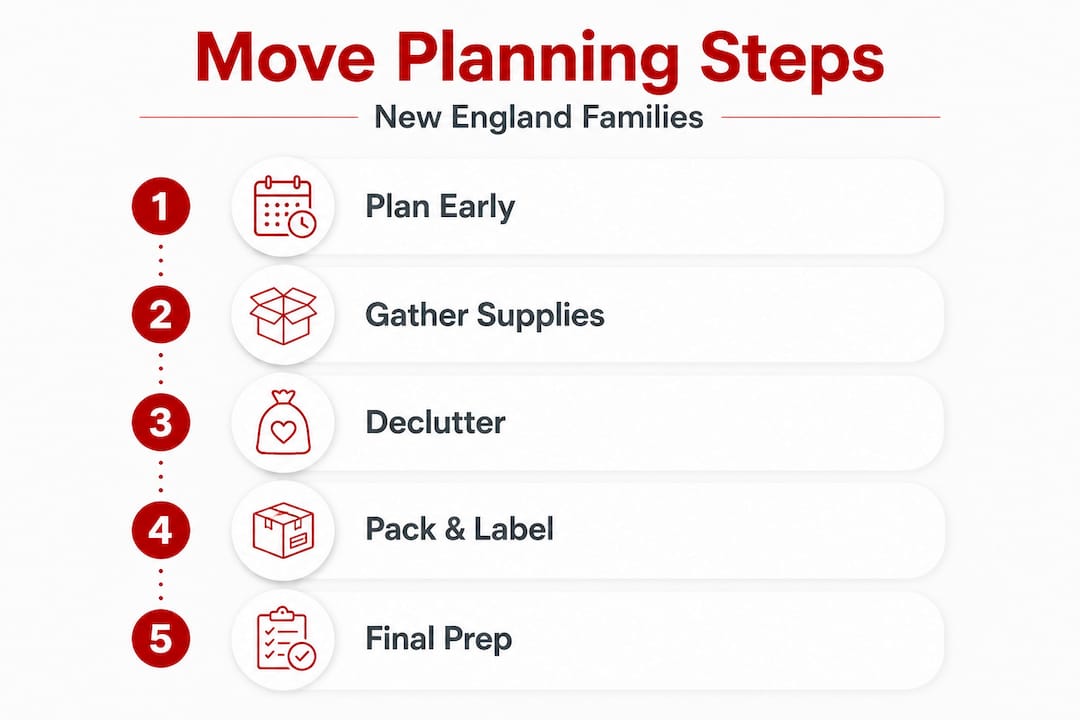
For families navigating the logistics of a local relocation, the guide to streamline local move workflow offers a step-by-step breakdown. If you are still weighing your options between movers, the guide to hiring movers walks you through exactly what questions to ask and what red flags to avoid.
Pro Tip: Assign specific checklist items to each family member. Give teenagers responsibility for packing their own rooms. Have a partner manage utility transfers while you handle school notifications. Shared ownership of the plan reduces the pressure on any one person and helps everyone stay engaged and accountable.
Decluttering and packing: reduce stress and cost
With your checklist in hand, the next big lever you can pull is honest, thorough decluttering. This step does more than reduce clutter; it directly lowers your moving cost and makes unpacking in your new home significantly faster.
For long-distance moves especially, decluttering reduces costs because many carriers price by weight or volume. Every extra item you haul adds to the bill. Even for local moves priced by the hour, fewer boxes means a shorter job.
Use the simple “four-pile” method as you work through each room:
- Keep: Items you use regularly and genuinely need in your new home.
- Donate: Gently used items that local shelters, thrift stores, or community groups can put to good use.
- Toss: Broken, expired, or genuinely unusable items that no one should take.
- Sell: Higher-value pieces worth listing online or at a garage sale before your move date.
“Moving is the perfect opportunity to reset. What you carry into your next home should represent the life you want there, not the accumulation of years of ‘I might use this someday.’”
Label every single box clearly with its destination room and a brief contents description. This one habit makes an enormous difference when movers are stacking boxes in your new home and when you are hunting for the coffee maker at 7 a.m. on your first morning.

Create a simple inventory list as you pack. Number each box and write a brief description in a notebook or spreadsheet. This serves two purposes: it helps you track everything during the move, and it provides a basic record for insurance purposes if anything is damaged in transit.
For specific guidance on sorting through your belongings, the donation and disposal options page at Bridges Bros. breaks down local New England resources for donating and disposing responsibly.
Pro Tip: Start with the spaces you visit least, like attics, basements, and guest rooms. These areas often hold the most forgotten clutter and take the longest to sort. Beginning there early prevents the last-minute panic of facing a packed storage room the night before move day.
Avoiding common mistakes: utilities, addresses, and arrival prep
Even well-organized movers can be tripped up by a few specific oversights. These are the mistakes that rarely get discussed until someone experiences them firsthand, and they can turn an otherwise great move into a genuinely miserable first day.
Plan utilities early to avoid arriving at a dark or cold home. It sounds obvious, but across the roughly 40 million Americans who move each year, utility setup is consistently one of the most overlooked tasks. In New Hampshire and Maine especially, arriving at a home without heat in October or November is more than an inconvenience. It can be a real safety concern.
Here is a checklist of the key tasks families most often forget:
- Electric and gas: Contact your new provider at least two weeks before move-in to ensure service is active on arrival day.
- Internet and cable: Schedule installation in advance. Many providers in New England have limited appointment windows, so waiting until move week often means going without for days.
- Water and trash: Confirm service transfer dates with local municipalities, especially if you’re moving between towns.
- Change of address: File a change of address with the U.S. Postal Service online. Then update your bank accounts, credit cards, insurance policies, voter registration, and subscription services individually.
- Schools and healthcare: Notify your children’s schools with enough lead time to transfer records. Update your family’s doctors, dentists, and any specialists as soon as your new address is confirmed.
“Arriving at a new home without heat, internet, or your medication is a problem that takes five minutes to prevent and a full day to fix.”
Pack a clearly labeled essentials box and load it last so it comes off the truck first. Include toiletries, a change of clothes for everyone, medications, phone chargers, basic kitchenware, important documents, and a few snacks. This box carries you through the first 24 hours while the rest of your life is still in boxes.
For a full breakdown of how to get your new space ready before the truck arrives, the prepping your new home guide covers everything from cleaning to setting up key rooms first.
Why real planning beats wishful thinking: a mover’s insight
Here is something we have seen play out over and over again in our more than a century of helping New England families move: the most common regret is not that something went wrong. It is that people knew what they should have done, and simply did not do it early enough.
The families who struggle most on move day are rarely the ones who faced impossible circumstances. They are the ones who assumed they would “get to it” and then ran out of time. They did not write anything down. They did not declutter until the night before. They called to set up utilities the morning of the move.
We have seen last-minute panics over forgotten utility setups in December, entire rooms left unpacked because there were no boxes left, and families arriving at a new home with no idea where their medication was. Every single one of those situations was preventable with a written plan started six weeks earlier.
The conventional wisdom says moving is inherently chaotic. We disagree. Moving is complex, but complexity is manageable when it is organized. A checklist is not a personality trait; it is a tool. Using it does not mean you are overly cautious. It means you respect the scale of what you are undertaking.
Treat your move with the same seriousness you would give any other major life decision. It deserves that level of attention. And if you take the time to understand the full picture, including the differences between local vs long-distance moving before you begin, you will make smarter decisions at every stage.
The families who arrive at their new homes calm, organized, and ready to start their next chapter are almost always the ones who planned early, wrote everything down, and asked for help when they needed it.
Connect with proven, family-owned movers
Knowing what to do is a great start. Having the right team behind you makes every step easier. At Bridges Bros. Movers, we have been helping families across New Hampshire, Maine, and Massachusetts since 1919, and we bring that experience to every move, large or small. Our team supports you with full moving services that cover everything from initial planning and professional packing help to secure storage and final cleanup. We hold a 4.9 out of 5 average customer satisfaction rating, and we earn it by treating every home like it is our own. Whether you need a personalized moving plan, a free quote, or just a few honest answers, we are here. Explore our service area coverage to see how close we are to you, and reach out when you are ready to get started.
Frequently asked questions
How early should I begin planning my move?
For the best results, start planning 6-8 weeks before your move date, whether you are moving locally or long distance. This window gives you enough time to book movers, declutter, pack, and handle all the administrative tasks without rushing.
What is the most overlooked moving task?
Setting up utilities at your new home is the step most families forget. According to moving industry data, planning utilities early is critical to avoiding arriving at a home without heat, electricity, or water, especially in New England winters.
How can decluttering lower my moving costs?
Reducing the number of items you move directly cuts down on truck space, labor hours, and, for long-distance moves, weight and volume charges. Even donating or selling a modest amount before move day can result in meaningful savings.
Should I hire professional movers or do it myself?
Hire professional movers for large homes, valuable or fragile items, long-distance relocations, or any move where time and reliability matter most. A DIY approach works best for small, simple moves where you have plenty of help, flexible timing, and few high-risk items.