
Moving across New Hampshire, Maine, or Massachusetts should be exciting, not overwhelming. Yet many families and small businesses encounter hidden fees, damaged belongings, and unreliable movers that turn relocation into a nightmare. This guide walks you through selecting trustworthy full-service movers who deliver transparent pricing, proper licensing, and genuine peace of mind so you can focus on settling into your new space instead of firefighting moving disasters.
Table of Contents
- Understanding Your Moving Needs And Prerequisites
- Researching And Verifying Moving Companies In New England
- Getting Accurate Estimates And Understanding Pricing
- Comparing Service Options And Their Tradeoffs
- Common Mistakes To Avoid When Selecting Moving Services
- Expected Results And Success Metrics For Your Move
- Make Your Move Easier With Bridges Bros. Movers
- Frequently Asked Questions
Key takeaways
| Point | Details |
|---|---|
| Assess your needs first | Identify move size, timeline, and budget before contacting movers to get accurate estimates. |
| Verify credentials thoroughly | Check FMCSA licensing, state registration, insurance coverage, and BBB ratings to avoid scams. |
| Get detailed written estimates | Compare multiple quotes that itemize all services and fees to prevent surprise charges. |
| Understand service tradeoffs | Weigh full-service convenience against partial or DIY options based on your time and stress tolerance. |
| Document everything | Photograph inventory, confirm contracts in writing, and clarify communication protocols to protect yourself. |
Understanding your moving needs and prerequisites
Before you call a single mover, take stock of what you’re actually moving. Walk through every room and estimate how many boxes, furniture pieces, and specialty items like pianos or antiques you’ll need transported. This inventory shapes everything from truck size to crew requirements to final cost.
Consider your timeline carefully. Are you moving during peak summer season when rates climb, or can you schedule an off-peak winter move for better pricing? Local vs. long-distance moves require different planning horizons. Local moves within 50 miles often happen in a single day, while long-distance relocations need multi-day coordination.
Full-service moving simplifies your life but costs more upfront. Ask yourself whether packing, loading, transport, unloading, and optional cleaning justify the expense versus doing portions yourself. Small business owners often discover that paying for full service beats losing revenue during a prolonged DIY move.
Prepare essential documents now:
- Current home inventory with photos
- Important addresses and contact information
- Moving budget breakdown showing maximum spend
- Preferred move dates with flexibility windows
- Special requirements like elevator reservations or parking permits
Your initial budget should account for moving services, packing supplies, insurance, temporary storage if needed, and a 15-20% contingency buffer. This groundwork prevents scrambling later when movers request details you haven’t considered.
Researching and verifying moving companies in New England
Legitimate movers carry proper licensing and insurance. Interstate movers need FMCSA registration with a valid USDOT number you can verify through FMCSA safety verification. Intrastate movers within New Hampshire, Maine, or Massachusetts require state-specific licensing from transportation departments.
Over 20% of mover-related complaints involve unlicensed companies, so verification isn’t optional. Check the FMCSA database, your state’s moving company registry, and BBB moving scams warnings for complaint histories. Red flags include companies refusing to provide registration numbers or pressuring immediate deposits without written contracts.
Family-owned businesses with decades of local presence often provide more accountability than fly-by-night operators. A mover operating since 1919 in your community has reputation to protect. Look for award recognition like Best of Seacoast or state-level moving excellence honors.
When choosing a mover, examine their online presence. Professional movers maintain updated websites with clear service descriptions, transparent pricing frameworks, and real customer testimonials with names and dates. Generic five-star reviews without details suggest manipulation.
Trust your instincts during initial contact. Professional movers answer questions patiently, explain their process clearly, and never guarantee prices without assessing your specific situation. The how to choose a moving company guide offers additional screening criteria.
Verify insurance coverage thoroughly:
- Basic carrier liability (typically 60 cents per pound per item)
- Full value protection options
- Workers’ compensation for crew members
- Commercial vehicle insurance meeting state minimums
Getting accurate estimates and understanding pricing
Written estimates protect you from pricing games. Reputable movers offer in-home or virtual consultations where they assess your inventory, discuss special handling needs, and provide detailed quotes itemizing every service and fee. Phone estimates based solely on room counts lack accuracy and often lead to disputes.

Hidden fees occur in over 25% of complaints reported to BBB. Demand transparency on charges for stairs, long carries, shuttle services, packing materials, assembly, storage, and fuel surcharges. A trustworthy quote breaks these out individually rather than burying them in fine print.
Request estimates from at least three movers to establish baseline pricing for your move size and distance. Quotes varying dramatically suggest either missing details or inflated pricing. The middle estimate often reflects fair market rates.
Understand estimate types:
- Binding estimates lock in total cost regardless of actual weight or time
- Non-binding estimates provide approximate cost subject to adjustment
- Binding not-to-exceed estimates cap maximum charges while allowing lower finals if actual work requires less
Compare what each estimate includes. One mover’s “full service” might exclude packing supplies while another bundles everything. How to pick an affordable mover means evaluating total value, not just bottom-line numbers.
The step-by-step guide to hiring movers recommends scheduling estimates 4-8 weeks before your move date. Last-minute bookings limit options and negotiating power.
Pro Tip: Ask about financing options or payment plans if upfront costs strain your budget. Many established movers offer flexible payment structures that spread expenses across several months without interest.
Comparing service options and their tradeoffs
Full-service moving handles everything from packing your first coffee mug to arranging furniture in your new home. Professional crews bring packing materials, wrap fragile items expertly, load trucks efficiently, transport safely, unload carefully, and can even haul away boxes afterward. Some packages include short-term moving storage options if your closing dates don’t align.
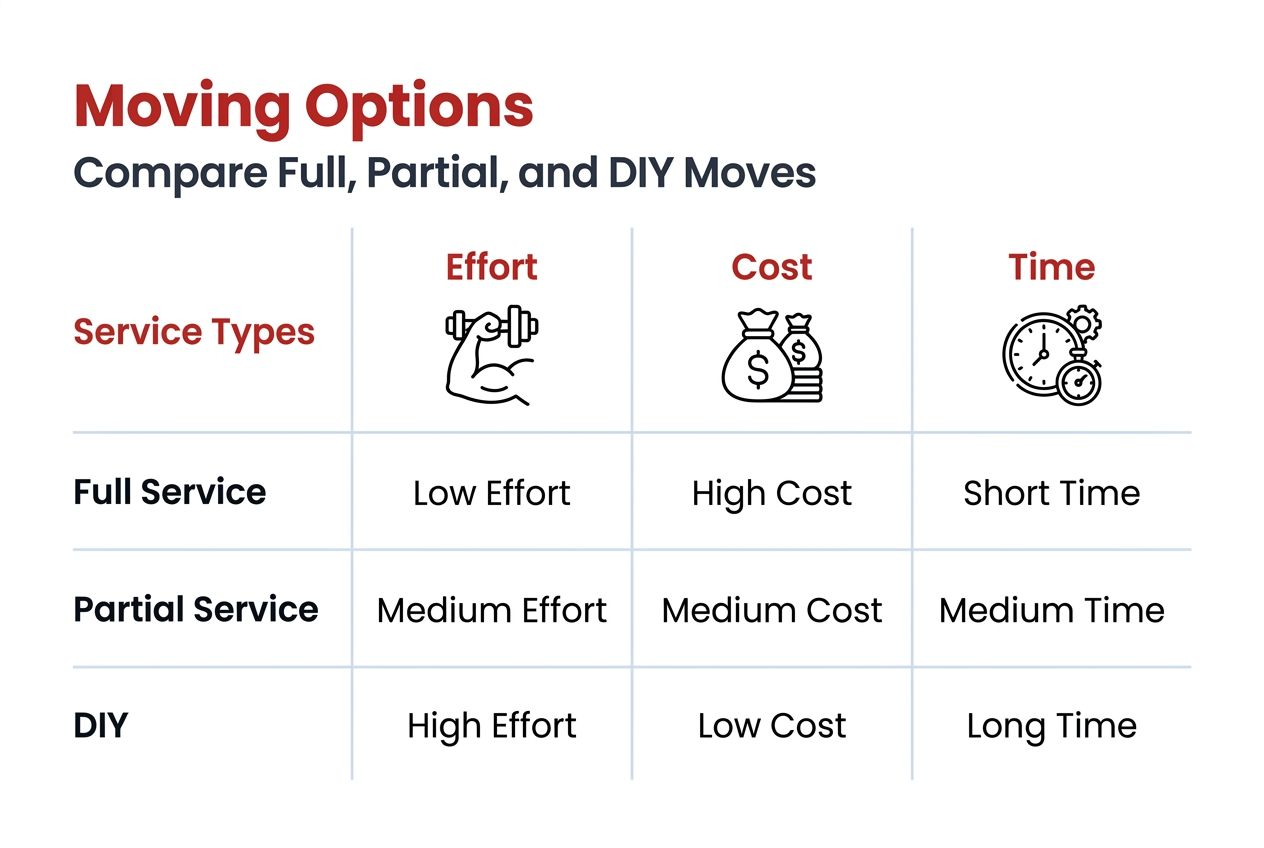
Full-service moving advantages extend beyond convenience. Professional packing reduces breakage risk significantly compared to amateur efforts. Experienced crews complete in hours what takes you days. Insurance coverage protects your belongings comprehensively when professionals handle everything.
Partial services let you control costs by doing some work yourself. You might pack boxes while movers handle furniture and transport. Or movers load and drive while you unpack at destination. Each task you assume saves money but increases your physical workload and time commitment.
DIY moves using rental trucks suit college students or minimal belongings, but families and businesses usually underestimate the challenge. Consider hidden costs like fuel, equipment rental, moving blankets, dollies, and potential injury or property damage from inexperience.
| Service Level | Typical Cost | Time Required | Physical Effort | Damage Risk | Best For |
|---|---|---|---|---|---|
| Full-Service | $2,500-$4,000 | 1-2 days | Minimal | Lowest | Families, businesses, long distance |
| Partial Service | $1,200-$2,500 | 3-5 days | Moderate | Medium | Budget-conscious with time |
| DIY | $600-$1,500 | 5-10 days | High | Highest | Students, minimal items |
Pro Tip: Families with young children benefit enormously from full-service moves that eliminate the chaos of packing around school schedules and bedtimes. Small businesses minimize revenue loss by staying operational while movers handle the physical transition.
Decide based on:
- Available budget versus time value
- Physical capability and helper availability
- Item fragility and replacement cost
- Scheduling flexibility and deadline pressure
- Stress tolerance and competing responsibilities
Common mistakes to avoid when selecting moving services
Choosing movers based solely on lowest price often backfires spectacularly. Rock-bottom quotes usually signal corner-cutting on insurance, unlicensed workers, or bait-and-switch tactics where prices balloon after loading your belongings. Over 25% of BBB complaints cite hidden fees creating unexpected costs.
Document your inventory thoroughly with photos and written descriptions before movers arrive. This evidence proves condition and ownership if items disappear or break. Without documentation, disputes become your word against theirs.
Many people skip reading contracts carefully, assuming standard terms protect them. Review every clause addressing liability limits, cancellation policies, payment schedules, and dispute resolution. Question anything unclear before signing.
Avoid these pitfalls:
- Accepting verbal estimates without written confirmation
- Paying large deposits to unverified companies
- Ignoring negative reviews or BBB complaints
- Failing to verify insurance coverage adequacy
- Not confirming move date and time in writing 48 hours before
Communication breakdowns cause preventable problems. Establish clear protocols for how movers contact you on moving day, who makes decisions if issues arise, and how to reach company management if field crews can’t resolve concerns.
“The biggest regret I hear from families is not checking credentials thoroughly before hiring. A company’s license status and insurance coverage matter far more than saving $200 on the estimate.”
The stress-free moving tips guide emphasizes building buffer time into schedules. Rushing selections under deadline pressure increases mistake likelihood dramatically.
Understanding moving insurance prevents assuming coverage you don’t have. Basic carrier liability reimburses by weight, not value. A 50-pound antique dresser worth $2,000 receives only $30 under standard coverage. Purchase additional protection for valuable items.
Watch for common moving scams like hostage loads where movers demand payment increases before unloading, phantom websites mimicking legitimate companies, or operations using multiple names to escape bad reputations.
Expected results and success metrics for your move
Typical full-service moves in New England run $1,000 to $4,000 depending on home size, distance, and service scope. A 2-bedroom apartment moving 30 miles might cost $1,200, while a 4-bedroom home relocating 200 miles approaches $3,800. These figures include packing, transport, and basic insurance.
Timeline expectations vary by complexity. Local moves within the same town often complete in 6-8 hours. Intrastate moves across New Hampshire, Maine, or Massachusetts typically finish within 1-3 days. Interstate relocations spanning multiple states require 7-14 days from loading to delivery.
| Move Type | Distance | Typical Duration | Expected Cost Range |
|---|---|---|---|
| Local | Under 50 miles | 1 day | $800-$1,800 |
| Intrastate | 50-300 miles | 1-3 days | $1,500-$3,000 |
| Interstate | Over 300 miles | 7-14 days | $2,800-$5,500 |
Successful moves finish with final costs within 10% of original estimates. Significant overruns suggest poor initial assessment or hidden fee practices. Licensed movers rarely deviate more than 5-8% from binding estimates.
Customer satisfaction metrics show dramatic differences between licensed, reviewed movers and budget alternatives. Professional movers achieve 90%+ satisfaction ratings with minimal damage claims. Unlicensed operators average 60% satisfaction with frequent disputes over lost or broken items.
Measure your move’s success by:
- Final cost versus estimate accuracy
- Items delivered intact without damage
- Timeline adherence to promised schedule
- Crew professionalism and communication quality
- Resolution speed if problems occurred
The hiring movers guide recommends setting clear expectations upfront. Discuss preferred communication methods, expected crew arrival windows, and how changes get handled if weather or logistics shift.
Post-move, evaluate whether the stress reduction and time savings justified the expense. Most families report that full-service moves delivered value far exceeding the cost when they factor in preserved sanity, avoided injuries, and faster settling time.
Make your move easier with Bridges Bros. Movers
Applying this guide becomes effortless when you work with movers who already follow these best practices. Bridges Bros. Movers brings over a century of trusted service to families and businesses across New Hampshire, Maine, and Massachusetts, combining the reliability discussed throughout this guide with genuine local expertise.

Our transparent pricing means written estimates with every fee itemized, exactly as recommended above. Licensed, insured crews handle your belongings with the professionalism that reduces damage risk to nearly zero. Whether you need residential moving services for your family or commercial moving services for your business, full-service options eliminate the stress that makes moving overwhelming.
We understand New England’s unique challenges from narrow historic streets to unpredictable weather to strict building regulations. Our team navigates these obstacles daily, ensuring your move stays on schedule regardless of complications. The same choosing a mover tips that led you to this guide point directly to partnering with experienced professionals who treat your relocation as seriously as you do.
Request a free estimate today to experience the difference that proper licensing, comprehensive insurance, and century-proven reliability make in transforming moving day from nightmare to milestone.
Frequently asked questions
How far in advance should I book moving services in New England?
Book 4-8 weeks before your preferred move date for best availability and pricing. Summer months and month-end dates fill quickly, so early scheduling prevents settling for less convenient times. Last-minute bookings within two weeks often incur rush fees or limited crew availability.
What credentials should I verify before hiring movers?
Confirm USDOT registration for interstate moves and state licensing for local relocations through official databases. Verify current insurance certificates covering liability, cargo, and workers’ compensation. Check BBB ratings and complaint histories to identify patterns of poor service or unresolved disputes. The choosing a moving company resource provides step-by-step verification instructions.
Do I need additional moving insurance beyond basic coverage?
Basic carrier liability reimburses only 60 cents per pound, inadequate for valuable items. Purchase full value protection if you own antiques, electronics, or furniture exceeding replacement cost calculations. Review moving insurance details to understand coverage options and costs before moving day.
How can small businesses minimize downtime during commercial moves?
Schedule moves during slow business periods or weekends to maintain operations. Full-service movers handle packing and setup so your team focuses on serving customers. Plan IT infrastructure migration separately with specialized vendors. Communicate move timeline clearly to clients and vendors to manage expectations.
What should I do if movers quote prices significantly lower than competitors?
Extremely low quotes signal potential scams or hidden fees. Request detailed written estimates explaining the price difference. Verify licensing and insurance thoroughly since unlicensed movers often underbid to attract customers before demanding payment increases. A 20-30% variance below market rates deserves serious scrutiny.
How do I handle disputes about damaged items after the move?
Document damage immediately with photos and written descriptions. Notify the moving company within timeframes specified in your contract, typically 24-48 hours for visible damage. File formal claims with supporting evidence including original inventory photos. Licensed movers maintain claims processes; unlicensed operators often disappear when disputes arise.