
TL;DR:
- Moving insurance is often misunderstood, with default coverage providing minimal protection and many policies excluding valuable items.
- To truly safeguard belongings, movers should evaluate their options, document high-value items, and consider supplemental third-party policies for comprehensive coverage.
Moving day brings a lot of moving parts. You’re coordinating trucks, timelines, and to-do lists that seem to grow longer by the hour. In the middle of all that activity, most people assume the moving company has their belongings fully covered. That assumption can be costly. The truth is that standard mover coverage often pays only a fraction of what your items are actually worth, leaving you responsible for the difference when something breaks or disappears. This guide cuts through the confusion so you can make confident, informed decisions about protecting your belongings before your next move in New Hampshire, Maine, or Massachusetts.
Table of Contents
- Why moving insurance matters: Common misconceptions vs. reality
- What does moving insurance actually cover?
- Valuation, liability, and supplemental insurance: Making smart choices
- Moving insurance for businesses: Beyond lost property to continuity risk
- The moving insurance mistake even smart people make
- Get peace of mind: Partner with local moving experts
- Frequently asked questions
Key Takeaways
| Point | Details |
|---|---|
| Default coverage is limited | Mover-provided coverage rarely pays the true value of lost or damaged items. |
| Third-party insurance fills gaps | Extra insurance is vital for high-value, irreplaceable, or self-packed belongings. |
| Business moves require special planning | Combine moving insurance with strategies for minimizing downtime and asset loss. |
| Smart selection prevents regrets | Assess both financial and sentimental value when choosing insurance. |
Why moving insurance matters: Common misconceptions vs. reality
Most people picture moving coverage as something close to insurance. You pay for a service, the movers handle your belongings, and if something goes wrong, you get compensated for the full value of whatever was lost or damaged. That picture is wrong in ways that can surprise even careful, well-prepared people.
There is a critical distinction between valuation and insurance. Valuation is the mover’s liability for your goods, set by federal law for interstate moves. Insurance is a separate financial product that pays you based on actual loss. When you hire a moving company, you are automatically enrolled in basic valuation coverage, not a true insurance policy. This is an important difference that affects how much you can recover if something goes wrong.
“Released value protection is the minimum default option for interstate moves and typically pays far less than replacement cost.”
Here is what trips up most homeowners and businesses:
- Default coverage is essentially free because the payout is minimal. For interstate moves, released value protection pays just $0.60 per pound per item. A 50-pound flat-screen TV worth $800 would receive only $30 in compensation.
- Many people believe their homeowners or renters insurance automatically covers a move. Most standard policies exclude items while in transit, so that assumption leaves a real gap.
- Business owners often assume their commercial property insurance covers office equipment during a move. In many cases, it does not, or it covers only a narrow set of circumstances.
- Self-packed boxes may be partially or entirely excluded from mover liability, even under upgraded coverage plans.
Understanding moving insurance explained is the first step toward protecting yourself from financial loss. For a deeper look at how insurance terms in transport apply to your situation, it helps to learn the foundational vocabulary before signing anything.
What does moving insurance actually cover?
Having separated myth from reality, let’s dig into what types of protection are really available and what they truly cover in the event of loss or damage.
There are three primary protection options available to movers. Each one works differently and pays differently when a claim is filed.
| Protection type | Cost | Payout method | Best for |
|---|---|---|---|
| Released value protection | Free | $0.60 per lb. per item | Budget moves with low-value items |
| Full value protection | Additional fee | Repair, replace, or cash at current value | Most residential and business moves |
| Third-party insurance | Separate premium | Replacement cost or agreed value | High-value, fragile, or irreplaceable items |
Released value protection is the default. It costs nothing, but it pays almost nothing meaningful. A box of books that weighs 30 pounds and contains a rare first edition worth $1,500 would receive an $18 payout under this plan.
Full value protection is offered directly by moving companies for an additional fee. Under this plan, the mover is responsible for repairing damaged items, replacing them with items of similar kind and quality, or paying the current market value. This is a significantly better option, but it still comes with limitations. Items packed by the owner, certain electronics, and antiques may be excluded or subject to special conditions. The comprehensive transport insurance information landscape is broader than many people realize, and understanding each layer helps you build a smarter protection plan.
Third-party moving insurance is purchased from an independent insurer. These policies often cover scenarios that mover valuation does not, including natural disasters, vehicle accidents, or total loss. They can be written as replacement cost coverage, which pays what it would cost to buy the same item new, or agreed value coverage, which sets a fixed payout amount upfront.
Here is a practical numbered process for confirming what you actually have:
- Ask your mover in writing what protection level you are enrolled in by default.
- Request the full valuation options and their associated costs before your move date.
- Contact your homeowners or renters insurance provider to ask specifically whether items in transit are covered.
- Inventory high-value items with photographs and receipts before packing begins.
- Get a third-party insurance quote if your items exceed what full value protection would reasonably cover.
Pro Tip: Create a dedicated folder, either physical or digital, with photos, serial numbers, and estimated values for every high-value item before the moving truck arrives. This documentation dramatically speeds up any claim process.
Review the full coverage options guide to see side-by-side comparisons and real-world examples that match common move scenarios in New England.
Valuation, liability, and supplemental insurance: Making smart choices
Armed with an understanding of what’s covered and what isn’t, it’s time to apply smart frameworks so you can choose insurance that actually matches your risk profile and belongings.

The right coverage choice depends on what you’re moving, how much it’s worth, and how much financial risk you can absorb if something goes wrong. Here is a simple data table to illustrate how liability calculations play out across different coverage levels:
| Item | Weight | Value | Released value payout | Full value payout |
|---|---|---|---|---|
| Laptop computer | 5 lbs. | $1,200 | $3 | $1,200 |
| Dining table | 80 lbs. | $900 | $48 | $900 |
| Antique mirror | 15 lbs. | $3,500 | $9 | Varies (may be excluded) |
| Office server rack | 120 lbs. | $8,000 | $72 | $8,000 |
The numbers in this table make it clear: released value protection is almost always insufficient for a real-world move. But even full value protection has gaps, particularly for antiques, artwork, and custom-built items that don’t have a standard market replacement value.
A practical decision-making framework:
- List your top 10 most valuable items and calculate what released value protection would pay for each one. If the gap is significant, you need an upgraded plan.
- Check for exclusions under full value protection before assuming you’re covered. Ask specifically about electronics, self-packed items, and anything over a certain dollar threshold.
- Get third-party quotes if you’re moving artwork, jewelry, collectibles, or custom business equipment. The premium is often lower than people expect, and the peace of mind is worth it.
- Consider your deductible. Some full value protection plans include deductibles that reduce your actual payout, so a $500 deductible on a $600 claim means you recover very little.
- Review regularly. If your circumstances change between quotes and move day, update your inventory and confirm coverage still matches.
Practical decision rule: use valuation choices to manage mover liability, then decide whether you need third-party moving insurance to fill the remaining gaps.
Pro Tip: For business moves especially, ask your mover whether their full value protection applies to equipment that requires special handling or installation. If not, a rider on your commercial property policy or a standalone transit policy may be the smarter path.
For tailored guidance specific to commercial relocations, review these commercial move insurance tips that address scenarios common to New Hampshire and Massachusetts businesses.
Moving insurance for businesses: Beyond lost property to continuity risk
Not all moves are the same. For businesses, protecting equipment is vital, but mitigating downtime and lost productivity is just as important.
A residential move gone wrong might mean replacing a broken couch. A business move gone wrong might mean days or weeks of interrupted operations, lost client relationships, and the cost of replacing specialized equipment that cannot simply be ordered overnight. The risk profile is fundamentally different.
Here are the core risks unique to business relocations that standard residential coverage does not address:
- Specialty equipment such as medical devices, industrial machinery, or custom IT infrastructure may require agreed-value insurance policies written specifically for high-replacement-cost items.
- Data and digital assets stored on servers or workstations can be permanently lost during a move if hardware is damaged and backups are inadequate.
- Downtime costs are rarely covered by any moving policy, yet they represent the largest financial exposure for many small businesses. A restaurant equipment move that goes wrong, for example, can mean days without revenue.
- Regulatory compliance may require certain businesses to document chain of custody for sensitive materials, which standard movers are not equipped to provide without explicit arrangements.
“For businesses, moving insurance/valuation planning should be tied to operational continuity risk (e.g., downtime and replacement of specialized equipment)…”
Local businesses in New Hampshire, Maine, and Massachusetts face particular challenges. Regional weather events, older building infrastructure, and the logistical complexity of coastal routes can all increase the likelihood of delays or damage during a commercial move. Reviewing your existing commercial property and liability coverage before move day is essential. Most business policies do not automatically extend to transit, and even those that do often have strict documentation requirements.
For a broader look at business transport insurance options and how they apply to commercial relocations, it’s worth speaking with both your insurance broker and your moving company before finalizing any plan.
Additional steps to minimize operational impact during a business move:
- Schedule critical equipment moves during off-peak hours to reduce exposure time.
- Establish a clear IT backup and recovery protocol before any server or workstation is loaded.
- Designate a single point of contact internally to manage move-day claims or incidents in real time.
- Confirm in writing with your mover which items require special handling and how liability applies to those specific categories.
Explore more business moving insurance strategies to build a protection plan that addresses both property loss and operational risk.
The moving insurance mistake even smart people make
Here is what we see consistently, even with clients who have done their homework: people focus almost entirely on the monetary value of their belongings and overlook two other categories of loss that no insurance policy can fully restore.
The first is sentimental value. Photographs, handwritten letters, family heirlooms, and irreplaceable keepsakes have no replacement cost. A policy can pay you $3,000 for a piece of furniture, but it cannot pay you anything meaningful for the box of childhood memories that gets lost in a long-distance move. The best protection for items like these is to keep them with you personally during the move, not on the truck. This is a point many people hear but rarely act on until it’s too late.
The second is claims process friction. Even when you have the right coverage on paper, filing a claim is rarely straightforward. Adjusters require documentation, photographs, and sometimes independent appraisals. Claims for self-packed boxes face additional scrutiny. High deductibles can make small claims not worth pursuing. Many people walk away from legitimate claims simply because the process is more demanding than they expected.
The practical wisdom here is to treat your moving insurance strategy the way a careful traveler treats a passport: prepare it well before you need it, know exactly where it is, and make sure it’s valid for the entire journey. Using a thorough packing checklist for interstate moves is one of the most underrated ways to strengthen your position in any potential claim, because documented, professionally packed items are far easier to recover compensation for.
The smartest movers are not those who spend the most on insurance. They are the ones who match their coverage to what they actually value most, document everything, and go in with clear expectations about how the claims process works.
Get peace of mind: Partner with local moving experts
Now that you understand how to protect what matters, the next step is working with a team that can guide you through both the logistics and the coverage decisions that come with any serious relocation.
At Bridges Bros. Movers, we have been serving families and businesses across New Hampshire, Maine, and Massachusetts since 1919. Our team understands the regional complexities of New England moves, from navigating narrow coastal streets to handling the logistics of a multi-floor commercial relocation in a busy downtown. We walk every client through their coverage options during the planning process, so there are no surprises on move day. Explore our full suite of moving services to see everything we offer, from packing to storage to junk removal. We also provide professional packing material options that help reduce the risk of damage and support stronger claims if issues arise. When you’re ready to take the next step, request a moving insurance quote and get a personalized plan from a team that treats your move like it’s their own.
Frequently asked questions
Does home or renters insurance cover my items during a move?
Most standard home or renters insurance policies specifically exclude items while they are in transit, so you should call your provider and confirm your policy’s exact language before moving day.
Is released value protection enough for expensive items?
No. Released value protection pays only $0.60 per pound per item, which means a $1,200 laptop weighing five pounds would receive just $3 in compensation.
How do I know if I need third-party moving insurance?
If you have high-value, fragile, or irreplaceable items, a third-party moving insurance policy fills the gaps that mover valuation leaves open, particularly for custom, antique, or specialty items.
What does moving insurance not cover?
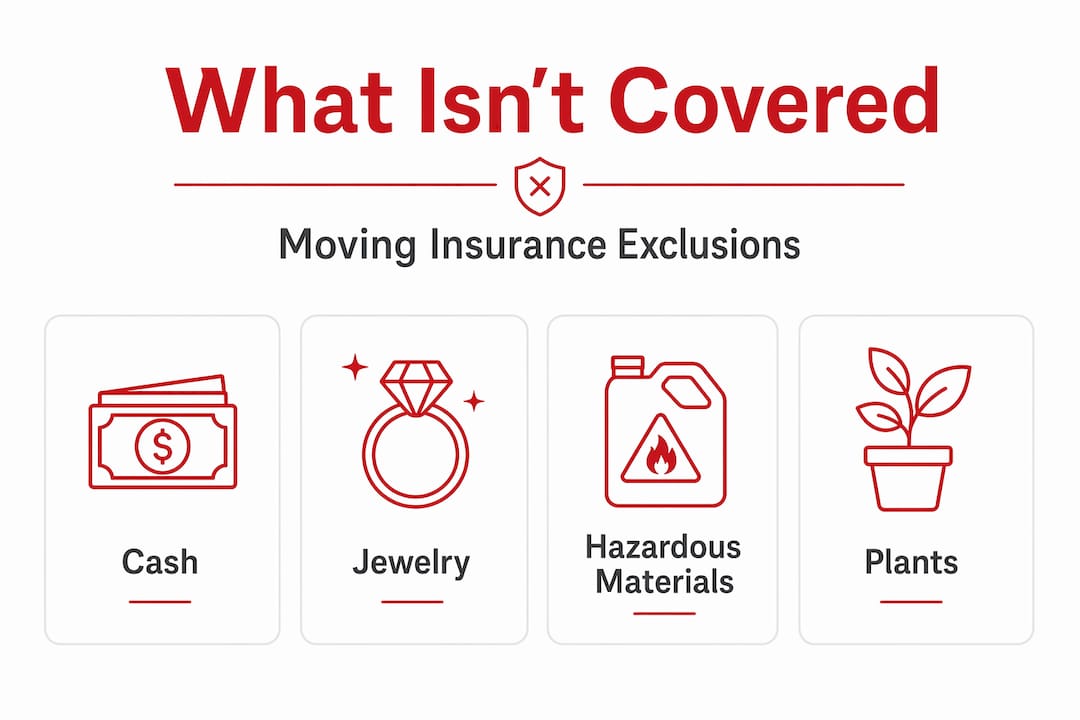
Common exclusions include cash, jewelry, hazardous materials, plants, and items packed by the owner, unless those items are specifically listed and appraised in a separate agreement before the move.
Can my business’s existing insurance cover a relocation?
Some commercial property policies offer partial coverage, but most business moves require supplemental or move-specific insurance because standard policies do not account for operational continuity risk tied to downtime and equipment replacement during transit.