
New Hampshire is one of the most financially attractive states in the country for relocating families, but the full picture is more nuanced than the headline tax benefits suggest. You get no state income tax on wages, no sales tax, and as of January 1, 2025, no Interest & Dividends tax either. What you will encounter, though, are property tax rates averaging between 1.88% and 2.05%, among the highest in the nation. The lifestyle rewards are real: four seasons, world-class outdoor recreation, tight-knit communities, and a quality of life that keeps drawing people north from Massachusetts and beyond.
Key advantages of moving to New Hampshire:
- No state income tax on wages or salaries
- No state sales tax, saving money on everyday purchases
- Strong public schools and access to higher education
- Abundant outdoor recreation, from White Mountain hiking to Lake Winnipesaukee
- Close-knit communities with genuine small-town character
Key trade-offs to plan for:
- Property taxes are high and vary widely by town
- Winters are cold, snowy, and require real preparation
- Job opportunities concentrate in Manchester and Nashua; smaller towns offer less
- Public transit is limited outside urban areas, making a car essential
- Housing prices are above the national median, especially near the Massachusetts border
Pro Tip: Before you fall in love with a town, look up its specific property tax rate on the NH Department of Revenue Administration website. Two towns 20 minutes apart can have rates that differ by nearly a full percentage point, which adds up to thousands of dollars annually on a median-priced home.
What is the lifestyle really like in New Hampshire?
New Hampshire’s four-season climate is one of its defining features. Winters bring heavy snowfall and temperatures that regularly dip well below freezing, while summers are warm, green, and genuinely beautiful. Autumn foliage draws visitors from across the Northeast, and spring, though muddy, signals the return of farmers’ markets and outdoor festivals that anchor community life.

Outdoor recreation is woven into daily living here. The White Mountains offer year-round hiking and skiing, Franconia Notch State Park draws serious climbers, and Lake Winnipesaukee is a summer anchor for boating and lakeside living. If your family enjoys being outside, New Hampshire delivers more options per square mile than most states its size.
Housing costs reflect the state’s desirability. The median home price sits around $482,600, well above the national median, and southern cities like Nashua and Manchester face the most competition due to their proximity to Boston. The education system is a genuine draw: public schools consistently rank among the top in New England, and the University of New Hampshire anchors a network of higher education options statewide.
- Car ownership is not optional for most residents; public transit is limited outside Concord, Manchester, and Nashua
- Community events like town meetings, harvest festivals, and local fairs are central to social life
- No major international airports in the state; most residents use Boston Logan or Manchester-Boston Regional for travel
How do New Hampshire’s taxes and economy affect your move?
New Hampshire ranks 3rd on the 2026 State Tax Competitiveness Index, a reflection of its deliberately lean tax structure. The state collects no income tax on wages or salaries and no sales tax. The Interest & Dividends tax, which previously applied to investment income, was fully repealed effective January 1, 2025. For working families, this translates to a noticeably larger take-home paycheck compared to neighboring Massachusetts.
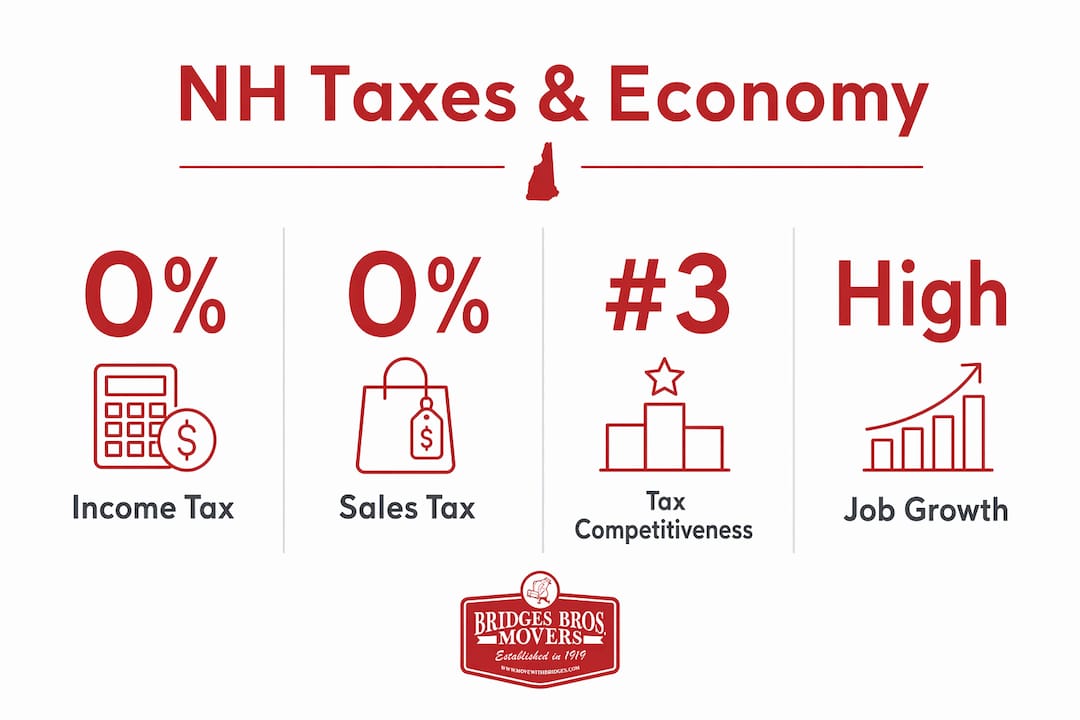
The trade-off is property taxes. New Hampshire funds public services almost entirely through local property levies, and the burden is real. Rates vary significantly by municipality, so two homes with identical values in different towns can carry very different annual bills.
| Tax Category | Rate / Status | Notes |
|---|---|---|
| Individual income tax (wages) | None | Eliminated for all wage earners |
| Sales tax | None | Makes NH a retail destination for neighbors |
| Interest & Dividends tax | Repealed Jan. 1, 2025 | No longer applies to investment income |
| Property tax (avg. effective rate) | 1.88%–2.05% | Among the highest nationally; varies by town |
| Business Profits Tax | 7.5% (corporate income tax) | Applies to corporate income |
Property tax reality check: New Hampshire’s average effective property tax rate of 1.88%–2.05% means a home valued at $482,600 could carry an annual tax bill of roughly $9,000–$9,900 before any exemptions. That figure often surprises newcomers who focused on the income and sales tax savings.
The job market is strongest in Manchester and Nashua, where healthcare, technology, and manufacturing sectors are well established. Many residents commute to Massachusetts for higher-paying positions, particularly in the Boston metro corridor. Smaller towns offer fewer local employment options, so your job situation should factor heavily into which part of the state you target.
No state sales tax also makes New Hampshire a genuine shopping destination. Residents of Maine, Vermont, and Massachusetts regularly cross the border for major purchases, and that dynamic keeps retail prices competitive statewide.
What practical steps should you take before relocating to New Hampshire?
Planning your move carefully makes a real difference in how smoothly the transition goes. New Hampshire rewards preparation, especially given its climate and the wide variation in local conditions from town to town.
- Research property taxes by town first. Rates differ enough between municipalities that your choice of town should factor in the tax bill, not just the home price.
- Budget for a reliable vehicle. Car dependency is near-total outside the main cities. Ride-sharing services are often unreliable in smaller communities, and rural roads can be challenging in winter.
- Prepare for winter seriously. Stock your home with emergency supplies, invest in quality snow removal equipment, and make sure your vehicle has all-season or winter tires before the first storm arrives.
- Target your job search geographically. If you’re not commuting to Massachusetts, focus on Manchester, Nashua, or Concord for the widest range of local opportunities.
- Time your move strategically. Spring and early fall offer the most manageable moving conditions. Late fall and winter moves are possible but require extra coordination around weather.
Pro Tip: If you’re moving from Massachusetts to New Hampshire, plan your move date around the school calendar if you have children. Arriving before September gives kids time to settle before classes start, and local school enrollment processes can take a few weeks.
The housing search near the Massachusetts border moves quickly. Homes in towns like Derry, Salem, and Londonderry often receive multiple offers, so getting pre-approved for a mortgage before you start touring is worth doing early. If you need temporary storage while you search, storage solutions can bridge the gap between your move-out and move-in dates without adding pressure.
What is New Hampshire’s political and cultural identity?
New Hampshire operates as a genuine swing state, and that balance shapes the culture in ways that feel different from most New England neighbors. At the federal level, the state has leaned Democratic in recent presidential and Senate races. At the state level, Republicans have held the governorship and legislative majority. Voters frequently split their tickets, which produces a political environment that is more pragmatic than ideological.
- Libertarian influence is measurable: the Free State Project has brought several thousand participants to New Hampshire as of 2022, shaping local governance debates around individual rights and limited government
- Town meetings remain a genuine institution, giving residents direct input on local budgets and ordinances
- Community life centers on local traditions rather than partisan identity for most residents
The state’s demographics skew older. The average age in New Hampshire is 44, about six years above the national average, and senior services have grown accordingly. Diversity is limited compared to urban states, though newcomers from other regions are gradually changing that profile, particularly in the southern cities. If you’re relocating from a more diverse metro area, that shift is worth factoring into your expectations.
Bridges Bros Movers has helped families plan stress-free moves across New England for over a century, and New Hampshire relocations are among the most common requests the team handles. Whether you’re coming from Boston or from across the country, having a local expert who knows the roads, the seasons, and the communities makes the process considerably less stressful. For a full picture of what to expect on moving day, residential moving services from a team that knows the state well can save you time, money, and a lot of uncertainty.
Key Takeaways
New Hampshire’s tax advantages are real, but property taxes and car dependency mean your total cost of living depends heavily on which town you choose and how you plan.
| Point | Details |
|---|---|
| No income or sales tax | NH imposes no tax on wages and no sales tax, boosting take-home pay and everyday purchasing power. |
| High property taxes | Average effective rates of 1.88%–2.05% vary by town and can offset headline tax savings significantly. |
| Competitive housing market | The median home prices in the state exceeds the national median, with southern cities seeing the most demand. |
| Car dependency is real | Public transit is limited statewide; a reliable vehicle is essential, especially in rural areas and winter. |
| Job market is city-centered | Manchester and Nashua offer the strongest local employment; many residents commute to Massachusetts. |
FAQ
Is moving to New Hampshire a good idea?
For most families, yes, particularly if you value low taxes, outdoor recreation, and strong public schools. The main trade-offs are high property taxes and limited public transit, so your experience depends heavily on which town you choose and whether you have reliable transportation.
Is New Hampshire a red or blue state?
New Hampshire is a swing state. Federal offices have recently leaned Democratic, while state-level offices are largely Republican-controlled. Voters frequently split tickets, making the political environment more moderate than most neighboring states.
What are the biggest downsides of living in New Hampshire?
The two most common complaints are property taxes and winters. Property tax rates average between 1.88% and 2.05% and vary widely by municipality, which catches many newcomers off guard. Winters are long, cold, and snowy, requiring genuine preparation for both your home and your vehicle.
How much is $100,000 after taxes in New Hampshire?
Because New Hampshire imposes no state income tax on wages, salaries are subject only to federal income tax and FICA contributions. Your net take-home will be noticeably higher than in a state like Massachusetts, which levies a state income tax on top of federal obligations.