
TL;DR:
- Client testimonials help families evaluate moving companies based on real customer experiences and consistency across multiple platforms. Reading detailed, recent reviews about communication, pricing, and handling offers better insight into reliability than star ratings alone. Responding to negative feedback with professionalism signals a company’s accountability and dedication to customer service.
Client testimonials are firsthand accounts that reveal how a moving company actually performs under real conditions, making the role of testimonials in choosing movers one of the most reliable filters available to families planning a relocation. Moving is a high-stakes transaction. You are trusting strangers with your furniture, your fragile items, and your schedule. Successful movers typically receive 71%–84% positive reviews, yet 15%–28% of clients still report issues like damage, unexpected charges, and delays. That gap is exactly where testimonials earn their value. Reading them carefully before you book can be the difference between a smooth move and a costly dispute.
What is the role of testimonials in choosing movers?
Testimonials, also called customer reviews or client feedback, give you a window into a mover’s day-to-day behavior that no brochure or sales call can replicate. They capture real outcomes: whether the crew arrived on time, whether the final bill matched the estimate, and whether fragile items survived the trip intact. Industry guidance recommends reading at least 20 recent reviews across two independent platforms rather than relying on company-curated testimonials alone. That standard exists because a single platform can be gamed, but patterns across multiple sources are much harder to fake.

The impact of testimonials on moving choices goes beyond simple star counts. A company with 200 reviews averaging 4.2 stars tells you far more than one with 12 reviews averaging 5.0 stars. The volume and variety of feedback signal that real customers, with real experiences, have weighed in. When you check moving company testimonials across platforms like Google, Yelp, and the Better Business Bureau, you build a composite picture that is far more reliable than any single source.
How to evaluate moving company testimonials effectively
Reading reviews well is a skill. Most people scan star ratings and move on. That approach misses the most useful information buried in the text itself.
Start by looking for patterns, not outliers. One complaint about a broken lamp could be a freak accident. Five complaints about broken items across different reviewers signals a handling problem. Recurring review patterns are more predictive of your experience than any individual rating, and companies with wide-ranging authentic reviews are generally more reliable than those with suspiciously perfect scores.
Focus on specificity. Generic praise like “great service!” tells you almost nothing. A review that says “the crew wrapped every piece of furniture in moving blankets, communicated arrival times by text, and finished 30 minutes ahead of schedule” gives you concrete expectations. Detailed testimonials about communication and handling are far more predictive of satisfaction than vague five-star endorsements.
Watch for these signals when reading testimonials:
- Specificity about logistics: Reviews that mention crew names, arrival times, or packing methods are more credible than generic praise.
- Mentions of pricing accuracy: Customers who confirm the final bill matched the estimate are signaling a trustworthy quoting process.
- Communication quality: Feedback about how well the company communicated before and during the move predicts your experience better than speed scores.
- How problems were handled: A reviewer who says “something broke but the company resolved it quickly” is actually a positive signal about accountability.
- Recency: Reviews from the past 6–12 months reflect current staff and processes, not a company’s reputation from three years ago.
Pro Tip: Check the filtered or “not currently recommended” sections on Yelp. Review platforms sometimes hide legitimate critical feedback under filtering algorithms. Those hidden reviews can contain some of the most truthful information available.
Common themes in moving testimonials and what they reveal
Positive and negative themes in moving reviews cluster in predictable ways. Knowing what to look for saves you time and helps you spot red flags before they cost you money.
What positive reviews consistently highlight
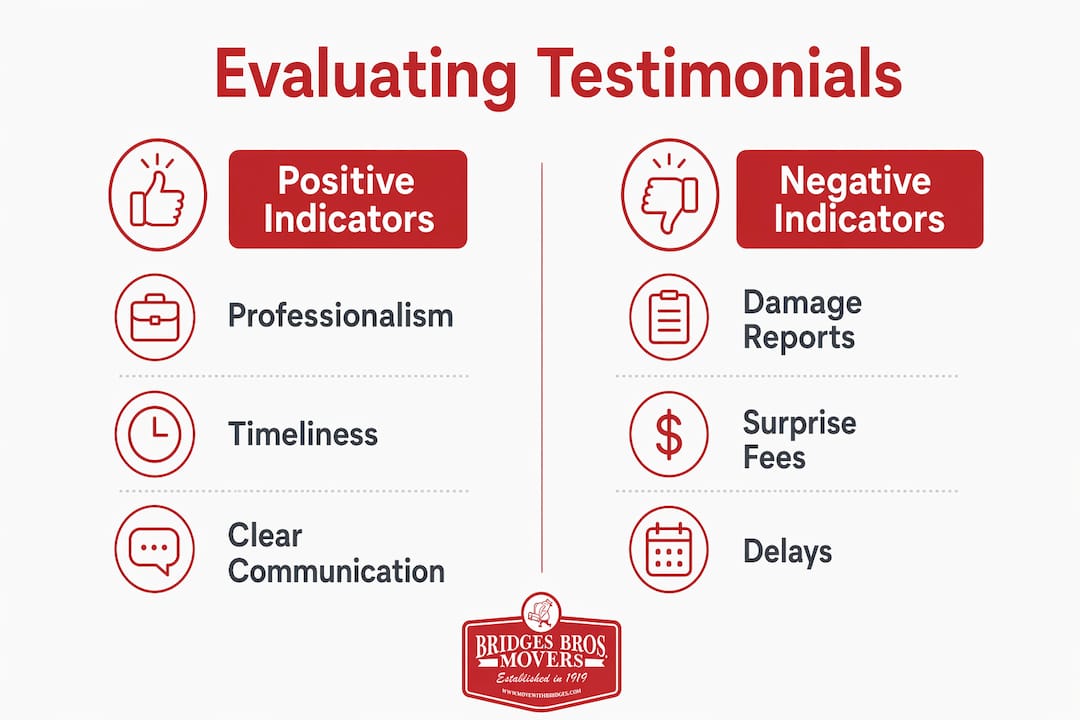
The most credible positive testimonials mention professionalism, timeliness, careful handling of belongings, and clear communication about pricing. Reviews that specifically praise upfront pricing communication are a particularly strong signal. Complaints in the moving industry are shifting away from pure service quality and toward pricing mismatches, which means a company that gets praised for honest estimates is doing something genuinely right.
What negative reviews consistently reveal
Damage, surprise fees, and delays are the three most common complaints across the industry. A company that draws repeated complaints about undisclosed charges has a systemic pricing problem, not a one-time mistake. Delays tied to poor scheduling communication point to operational issues that will likely affect your move too.
| Theme | What it signals |
|---|---|
| Praise for matching estimates | Transparent quoting process; low risk of surprise charges |
| Complaints about damage | Possible handling or packing training gaps |
| Praise for communication | Reliable scheduling and proactive updates |
| Complaints about delays | Scheduling or logistics management problems |
| Praise for crew professionalism | Trained, accountable staff on the ground |
Pro Tip: Movers who use video surveys and locked digital quotes before your move date generate far fewer pricing complaints. When you see reviews praising a mover’s transparent estimate process, that is a sign the company has built safeguards into its operations, not just its marketing.
How to use testimonials alongside other verification methods
Testimonials are powerful, but they work best as one layer in a broader vetting process. Relying on reviews alone leaves gaps that a dishonest mover can exploit.
Follow these steps to combine testimonial research with practical due diligence:
- Verify licensing and insurance first. A mover can have glowing reviews and still be uninsured. Check the Federal Motor Carrier Safety Administration database for interstate movers and your state’s consumer protection office for local ones. Reviews cannot substitute for legal compliance.
- Read 20+ reviews across at least two independent platforms. Google and the Better Business Bureau are good starting points. Avoid relying solely on testimonials posted on the mover’s own website, since those are curated and rarely include criticism.
- Request a written, itemized estimate. Reviews that praise pricing accuracy mean little if you do not have a written quote to hold the company to. Ask for a locked digital quote or a binding estimate before signing anything.
- Cross-reference review themes with your specific needs. If you are moving a piano or fragile antiques, search reviews specifically for mentions of specialty items. A company with great general reviews but no mention of specialty handling may not be the right fit.
- Ask the company directly about its complaint resolution process. How a mover answers that question in person often matches how it responds to negative reviews online. Consistency between the two is a good sign.
Learning how to spot a sketchy moving company before you book is the most effective way to protect your move. Testimonials are your first filter, but licensing, insurance, and written estimates are your safety net.
Why a mover’s response to negative testimonials matters
How a moving company handles public criticism tells you more about its character than its best reviews do. A five-star average built on 15 reviews is far less informative than watching how a company responds when something goes wrong.
A mover’s public response to complaints is a strong indicator of its customer service commitment. Companies that reply calmly, acknowledge the issue, and offer a resolution demonstrate accountability. That behavior does not happen by accident. It reflects a company culture that takes customer outcomes seriously.
Watch for these response patterns when reading negative reviews:
- Professional, calm replies: The company acknowledges the complaint without being defensive and explains what steps were taken to resolve it.
- Specific responses: Generic “we’re sorry you feel that way” replies suggest the company is managing its image, not actually solving problems.
- No response at all: Silence on negative reviews is a red flag. It suggests the company does not monitor feedback or does not care about resolution.
- Defensive or dismissive replies: A company that argues with unhappy customers in public will likely argue with you if something goes wrong on your move day.
How companies respond to negative feedback is a more trustworthy indicator of reliability than star rating perfection. A mover with a 4.3-star average and thoughtful responses to every complaint is a safer choice than one with a 4.9-star average and zero engagement with criticism. You can read more about evaluating mover accountability in tips for hiring the right moving company.
Key Takeaways
Client testimonials are most useful when read analytically across multiple platforms, combined with licensing checks and written estimates, rather than treated as a simple star-rating score.
| Point | Details |
|---|---|
| Read volume, not just ratings | Read 20+ reviews across two independent platforms to identify reliable patterns. |
| Prioritize specific feedback | Detailed reviews about communication and pricing predict your experience better than generic praise. |
| Watch for pricing transparency | Reviews praising accurate estimates signal a mover with honest quoting practices. |
| Evaluate negative review responses | Calm, constructive replies to complaints show accountability and a trustworthy service culture. |
| Layer your verification | Combine testimonial research with license checks, insurance verification, and written estimates. |
What I have learned from years of watching people choose movers
Patrick here. After years of working in this industry and watching families make moving decisions, the single biggest mistake I see is treating star ratings as a verdict. A 4.8-star average feels reassuring. It is not always earned.
The reviews that actually predict a good experience are the ones that read like a story. The customer describes what happened, how the crew handled a specific problem, and whether the final bill matched what they were told. Those reviews are rare, but they are worth 10 generic five-star posts. Moving is a high-stress experience, and emotional extremes skew reviews in both directions. The angriest reviews and the most effusive praise are often the least useful. The calm, detailed, middle-ground reviews are where the truth lives.
My honest advice: spend 20 minutes reading reviews the way you would read a product report, not a social media feed. Look for the company’s response pattern on negative reviews. That response pattern is the clearest window into how the company will treat you if something goes wrong. A mover that engages honestly with criticism has built a culture of accountability. That culture protects you on move day far more than a perfect star score ever could. Family-owned movers with long community histories tend to score well on this measure because their reputation is personal, not just corporate.
— Patrick
Bridges Bros Movers puts transparency where it counts
Bridges Bros Movers has served families across New Hampshire, Maine, and Massachusetts since 1919, and the company’s review record reflects that longevity. Every estimate comes with clear, upfront pricing so the final bill matches what you were told. The team responds to customer feedback publicly and professionally, which you can verify by reading real client testimonials on their profiles. If you want to see the full range of residential and commercial moving services Bridges Bros Movers offers, including packing, storage, and junk removal, the services page is the right place to start. Getting a quote is straightforward, and the process is built to give you confidence before move day arrives.
FAQ
How many reviews should I read before choosing a mover?
Industry guidance recommends reading at least 20 recent reviews across two independent platforms. That volume is enough to identify reliable patterns rather than reacting to individual outliers.
Are perfect five-star ratings a good sign?
Not necessarily. Companies with uniformly perfect scores may have manipulated or curated their feedback. A mover with a mix of four and five-star reviews and detailed, specific testimonials is generally more trustworthy than one with suspiciously flawless ratings.
What should I look for in a mover’s response to negative reviews?
Look for calm, specific, and constructive replies that acknowledge the problem and explain the resolution. Defensive or dismissive responses, and especially no response at all, are red flags about how the company handles real problems.
Can I trust testimonials on a mover’s own website?
Company-curated testimonials are useful but incomplete. They are selected to show the best feedback and rarely include criticism. Always cross-reference with independent platforms like Google and the Better Business Bureau.
What review topics predict the best moving experience?
Reviews that specifically praise accurate pricing estimates and clear communication before and during the move are the strongest positive signals. These topics reflect operational discipline, not just a friendly crew on a good day.