
TL;DR:
- Many families mistakenly view moving estimates as simple price tags, but they are formal documents with legal and contractual implications.
- Understanding whether an estimate is binding or non-binding is crucial, as it influences final costs, protections, and potential surcharges during interstate moves.
Most families assume a moving estimate is simply a price tag. Hand over your address, describe your furniture, and get a number. But that’s where the confusion starts. A moving estimate is actually a formal document that carries contract implications, legal protections, and potential cost changes depending on what type it is. For interstate moves, estimates must be written and clearly identified as binding or non-binding. Understanding those distinctions before you sign anything could save you hundreds of dollars and a lot of stress.
Table of Contents
- What is a moving estimate?
- Types of moving estimates: Binding vs. non-binding
- What factors impact your moving estimate?
- State regulations and regional estimate quirks
- How to use moving estimates to protect your budget
- A moving professional’s take: Why the structure of your estimate matters more than the price
- Ready for a reliable moving estimate?
- Frequently asked questions
Key Takeaways
| Point | Details |
|---|---|
| Estimate types matter | Binding and non-binding estimates offer very different protections and risks. |
| Cost drivers are complex | Many variables like move type, services, and distance can change your final cost. |
| State rules affect pricing | Massachusetts and other New England states have their own estimate rules and quirks. |
| Details protect your wallet | Demand itemized, clear estimates and keep documentation to avoid surprise charges. |
What is a moving estimate?
A moving estimate is a written projection of what your move will cost based on the information you provide, your inventory, the services you need, and the distance involved. It is not automatically a contract, but it is one of the most important documents in the moving process. Treating it casually is one of the most common mistakes families make.
For interstate moves, federal rules require that movers provide estimates in writing. According to the FMCSA Subpart D, every written estimate must clearly state whether it is binding or non-binding. That distinction changes everything about what you owe at the end of your move.
“A moving estimate is a written document that projects how much a move will cost; for interstate moves it must be provided in writing and clearly identify whether it is binding or non-binding.” — FMCSA Subpart D (Estimating Charges)
Here is why getting this right matters from the start:
- A vague or verbal estimate offers no legal protection.
- An estimate that doesn’t list all services can lead to add-on charges you didn’t anticipate.
- Skipping a review of the estimate type before signing can result in a final bill that looks nothing like what you expected.
Before you schedule or sign anything, make sure you understand what kind of estimate you’re holding. When you’re ready to compare offers from multiple movers, learning about comparing moving quotes can help you evaluate them side by side with confidence.
Types of moving estimates: Binding vs. non-binding
This is the most critical distinction in the entire estimating process. The type of estimate you accept determines how much pricing flexibility the mover has and what protections you carry.
Binding estimates
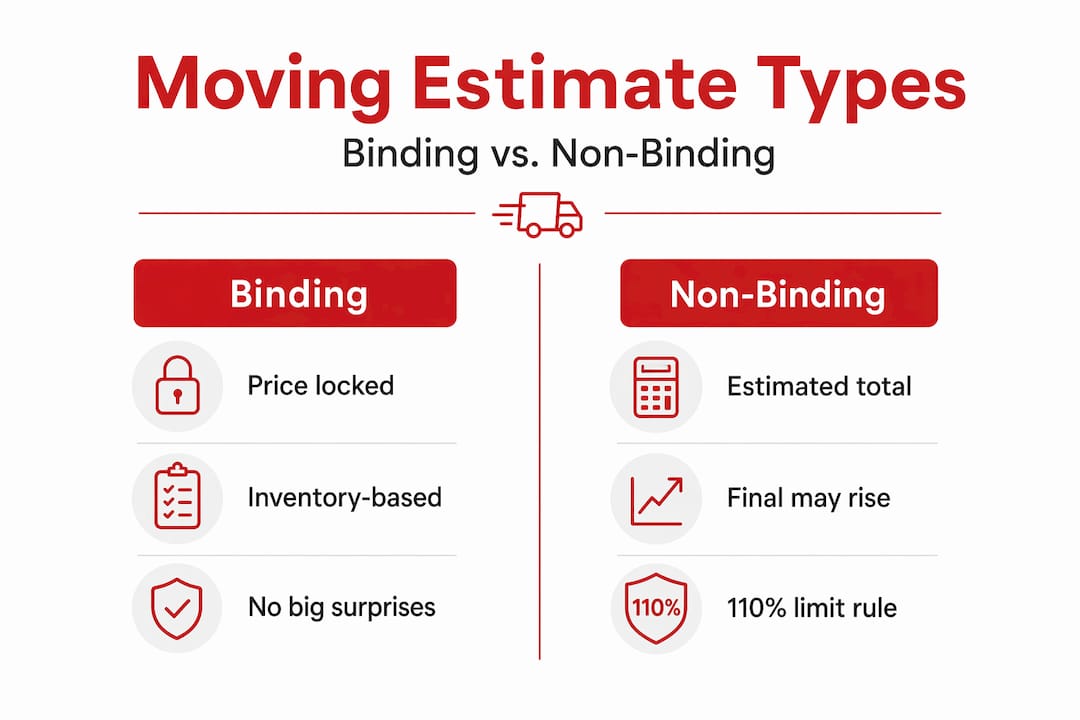
A binding estimate locks the price for the specific inventory and services listed in the document. If your shipment turns out to weigh more than expected, the mover generally cannot charge you more than the agreed amount, as long as you don’t add items or request extra services. Binding estimates lock the price for the inventory and services listed, and the bill should not change simply because the shipment’s actual weight differs.
That said, binding estimates are only as solid as the inventory list underneath them. If you add furniture on moving day or request last-minute packing help, the mover has the right to revise the estimate or issue a separate charge. Always review your inventory list carefully before agreeing to a binding estimate.

Non-binding estimates
A non-binding estimate is the mover’s best projection based on what you’ve described. The final cost is calculated after the actual shipment weight and services performed are tallied. This means the price can go up or down. Non-binding estimates are a good-faith projection; final charges are based on actual weight and services, but interstate moves carry FMCSA’s 110% delivery-day rule as a protection.
The 110% rule is a consumer safeguard. It says a mover cannot require you to pay more than 110% of the original non-binding estimate at delivery. If your bill comes in higher, the remaining balance is invoiced and you have 30 days to pay. This rule only applies to interstate moves regulated by the FMCSA.
| Feature | Binding estimate | Non-binding estimate |
|---|---|---|
| Price locked at signing | Yes | No |
| Final cost based on weight | No | Yes |
| 110% rule applies | No | Yes (interstate only) |
| Good if inventory changes | No | More flexible |
| Risk of surprise charges | Lower | Moderate |
Pro Tip: Always ask your mover in writing whether the estimate is binding or non-binding before any document is signed. If they can’t answer clearly, that’s a red flag worth addressing before you go further.
Understanding which type you’re working with also depends on whether you’re doing a local vs. long-distance move, since interstate protections don’t always apply to moves that stay within one state.
What factors impact your moving estimate?
Moving costs are primarily driven by move type, inventory size, labor time, accessorial services, and distance. Every one of these factors can shift your estimate significantly, sometimes by hundreds of dollars. Understanding them gives you real leverage when reviewing quotes.
Here are the main drivers, ranked by typical impact on your estimate:
- Move type. Local moves are typically billed by the hour. Long-distance or interstate moves are usually priced by weight and mileage. This single factor shapes the entire estimate structure.
- Inventory size and weight. More items mean more truck space and labor time. For interstate moves, every pound counts toward your final bill under a non-binding estimate.
- Labor time. The number of movers and hours required drives up hourly costs for local moves. Factors like elevator access, tight hallways, and disassembly/reassembly all affect this.
- Accessorial services. These are add-on services such as packing, crating, long-carry fees (when the truck can’t park close to your door), stair fees, and storage. These are often where estimates and final bills diverge. Reviewing accessorial service considerations before your move helps you ask the right questions upfront.
- Distance and mileage. For moves between New Hampshire and Massachusetts, or up to Maine and back, mileage adds up quickly and affects fuel, time, and driver costs.
| Factor | Typical impact on estimate | Notes for New England moves |
|---|---|---|
| Move type (local vs. interstate) | High | NH and ME local moves billed hourly |
| Inventory weight | High | Critical for interstate weight-based billing |
| Accessorial services | Moderate to high | Stairs and long-carry common in older New England homes |
| Distance/mileage | High for interstate | Boston to Portland distance adds measurable cost |
| Packing services | Moderate | Full-pack vs. self-pack changes cost significantly |
| Storage | Variable | Climate-controlled options affect rate |
Benchmark cost ranges for Maine can serve as context, but they are not the same as binding quotes for your specific inventory and service scope. Every move is different.
Pro Tip: Always request an itemized estimate, not just a total. Ask the mover to separate labor, transportation, and accessorial charges. This makes it much easier to spot inflated line items or missing services. You can also use a moving cost calculator to set reasonable expectations before your first conversation with a mover.
The impact of packing materials alone can surprise many families. Full packing service, specialty item crating, and supply costs can add hundreds of dollars to an estimate that looked affordable at first glance.
State regulations and regional estimate quirks
New England families face a set of rules that don’t apply everywhere in the country. Massachusetts has particularly detailed household-goods tariff rules that affect how estimates work for in-state moves.
“For movers operating under Massachusetts household-goods tariff rules, estimates/quotations are not guarantees; carriers treat written or electronic estimates as subject to lawful rates and charges, and pricing can depend on valuation choices.” — Massachusetts Better Call Moving Tariff
This is important. In Massachusetts, even a written estimate is not automatically a guaranteed price. The carrier’s lawful tariff rates apply, and your final cost can be affected by the valuation coverage you choose at the time of booking. Choosing a lower valuation level keeps costs down upfront but reduces your protection if something is damaged.
In New Hampshire and Maine, local moves are not subject to the same FMCSA interstate rules, so the 110% protection doesn’t apply. State consumer protection laws still cover you in cases of fraud or extreme overcharging, but the federal safety net only kicks in once a move crosses state lines.
Here is a checklist of what to request from any mover in New England before you commit:
- Written estimate clearly labeled as binding or non-binding
- Complete inventory list that reflects your actual belongings
- Itemized breakdown of accessorial charges
- Valuation and coverage options in writing
- Confirmation of their operating authority (especially for interstate moves)
- Clear statement of payment terms and accepted methods
Understanding how moving insurance and rates work in your state can also help you make smarter valuation decisions that protect your belongings without overextending your budget.
How to use moving estimates to protect your budget
Getting an estimate is step one. Using it wisely is what keeps your move from going over budget. Here is a practical process that works whether you’re moving across town in Portsmouth or across state lines to Boston.
- Build an accurate item list before calling any mover. Go room by room. Be specific: list large appliances, furniture, specialty items like pianos or antiques, and anything that needs disassembly. The more detailed your list, the more accurate your estimate will be.
- Request estimates from at least three movers. This gives you a realistic range and exposes lowball offers that may come with hidden add-ons. When comparing, make sure each estimate covers the same inventory and service scope.
- Read every line of the estimate document. Look for vague language like “additional charges may apply.” Ask the mover to clarify or remove those terms if they aren’t tied to specific, defined services.
- Confirm the estimate type in writing. Don’t rely on a verbal conversation. If the mover says it’s binding, the document should say so explicitly.
- Document your inventory with photos or video. This protects you if a dispute arises about what was included or damaged during the move.
- Keep copies of all paperwork. Your estimate, the bill of lading (the official moving contract), and your inventory list should all be saved.
If your final bill is higher than the estimate, ask for a step-by-step breakdown of every charge. Even with protections in place, final bills can exceed estimates when the shipment is heavier than projected or when services were added during the move. Your best defense is always accurate itemization and thorough documentation before pickup.
Pro Tip: If you’re uncertain about the scope of services you need, walk through your home with the mover during the estimate process rather than describing items over the phone. This leads to a more accurate projection and fewer surprises at delivery. For more guidance on what to look for, check the full breakdown on selecting moving services.
A moving professional’s take: Why the structure of your estimate matters more than the price
Here’s something we’ve seen play out dozens of times over the years: a family chooses the lowest estimate they receive, only to call us after the move asking why their final bill was 40% higher than expected. The low number wasn’t a mistake. It was the result of a sparse estimate that didn’t list all the services that move actually required.
The total price on an estimate gets all the attention. But it’s the structure underneath that number that tells you whether that estimate will hold up.
Ask yourself: Is this estimate binding or non-binding? Does it list every item in my home, or does it say “miscellaneous boxes” in one line? Does it specify whether packing, stair fees, or long-carry charges are included? If you can’t answer those questions from reading the document, the estimate isn’t protecting you.
We’ve also noticed that families who focus only on price tend to underestimate the relationship side of the moving process. A mover who gives you a detailed, itemized estimate and explains each line is showing you how they operate. Transparency at the estimate stage usually means transparency throughout the move. A lowball offer with a vague document is telling you something too.
If you want to choose an affordable mover without sacrificing reliability, the answer isn’t to pick the cheapest estimate. It’s to find the estimate that offers the most clarity for the best value. Those two things are not the same, and learning to tell them apart is the most useful skill you can bring to the moving process.
Ready for a reliable moving estimate?
Putting this knowledge to work starts with finding a mover who values transparency as much as you do. At Bridges Bros Movers, we’ve been serving families across New Hampshire, Maine, and Massachusetts since 1919, and we build every estimate to be clear, itemized, and easy to understand. Whether you’re planning a residential move across town or a longer haul across state lines, we walk you through every line of your estimate so there are no surprises. If you’re still comparing your options, our guide to choosing a mover gives you a practical framework for making that call with confidence. When you’re ready, request your moving estimate and take the first step toward a move that stays on budget.
Frequently asked questions
What’s the difference between a quote and an estimate for moving?
The terms are often used interchangeably in the industry, but the key distinction is whether the document is binding or non-binding, which determines how much pricing flexibility the mover retains. The FMCSA requires that interstate moving estimates be in writing and clearly labeled with that distinction.
Is a moving estimate always the final price?
No. Only a binding estimate locks the price for the listed inventory and services, while a non-binding estimate can shift based on actual shipment weight or added services, subject to FMCSA’s 110% delivery-day rule for interstate moves.
How accurate are moving estimates for New Hampshire, Maine, and Massachusetts?
Accuracy depends heavily on how detailed your inventory information is. In Massachusetts specifically, written estimates aren’t guaranteed and are subject to lawful tariff rates and your valuation choices, so providing complete and precise details from the start is essential.
What should I do if my final moving bill is higher than the estimate?
Request an itemized breakdown of all charges and check whether any extra services were added during the move. For interstate moves, the FMCSA 110% rule limits what a mover can collect at delivery for non-binding estimates, with any overage invoiced for later payment.
Why can moving estimates vary so much between companies?
Every mover evaluates inventory differently and prices services at different rates. Factors like packing, stairs, and special handling can produce wide variation. The core cost drivers are move type, inventory weight, labor time, accessorial services, and distance, and each company weighs those differently.