
TL;DR:
- Customized move planning tailors every aspect of your relocation to your specific needs, reducing stress and saving money. It includes personalized timelines, detailed inventories, flexible packing options, contingency plans, and post-move support, all managed through a single point of contact. Starting early and focusing on your unique situation ensures a smoother, more cost-effective move.
Customized move planning is the process of designing a personalized relocation plan that aligns precisely with your timeline, belongings, and individual needs. Unlike standard moving packages that bundle services you may not want, a modular, scope-based approach tailors every element of your move to your specific situation. The industry term for this is personalized relocation planning, and it covers everything from structured timelines and detailed inventory surveys to contingency plans for unexpected obstacles. Bridges Bros Movers has built its reputation since 1919 on exactly this kind of individualized service across New Hampshire, Maine, and Massachusetts.
What is customized move planning and what does it include?
Customized move planning is a modular relocation strategy that replaces one-size-fits-all bundles with itemized support built around your timeline, inventory, and risk tolerance. The core idea is simple: your move is not identical to anyone else’s, so your plan should not be either. A family relocating from Portsmouth, NH with three kids, a piano, and a closing date that keeps shifting needs a completely different plan than a single professional moving across town with a studio’s worth of furniture.

The building blocks of a personalized plan
A well-built custom moving plan covers five core areas:
- Timeline with milestones. Planning starts 6 or more weeks before your move date, with defined checkpoints at the 4–5 week mark, the 2–3 week mark, and final preparations. Each milestone has assigned tasks so nothing falls through the cracks.
- Detailed inventory survey. An in-home or virtual walkthrough catalogs every item you own. This step determines truck size, packing materials, labor hours, and any special handling needs for fragile or oversized pieces.
- Packing levels and labor logistics. You choose how much help you want. Full-service packing, partial packing, or self-pack with professional materials are all valid options. The plan reflects your choice without padding the bill with services you did not request.
- Contingency planning. Good plans account for narrow streets, elevator time limits, HOA restrictions, and weather delays before they happen. Anticipating these obstacles early prevents expensive last-minute scrambles.
- Post-move support. Settling-in assistance, storage coordination, and follow-up checks round out a complete plan.
Pro Tip: Book your moving consultation at least six weeks before your target move date. Calendars fill up quickly during peak season, and an early start gives your plan room to breathe.
| Component | What it covers |
|---|---|
| Timeline and milestones | Week-by-week task schedule back-calculated from move date |
| Inventory survey | Full item catalog to size labor, trucks, and materials |
| Packing options | Flexible levels from full-service to self-pack |
| Contingency planning | Pre-identified obstacles with assigned solutions |
| Post-move support | Storage, follow-up, and settling-in coordination |
How does customized move planning save money and reduce stress?
The financial case for personalized relocation planning is direct: you pay only for what you actually need. Standard moving packages often bundle services like full packing, specialty crating, and storage whether you want them or not. A custom plan strips those extras out and prices each service individually.
Proactive obstacle anticipation is where the real savings appear. When your plan already accounts for a narrow driveway, a freight elevator with a 30-minute booking window, or a building that requires a certificate of insurance from your movers, you avoid the emergency fees that catch unprepared families off guard. Those fees add up fast.
The stress reduction benefits are just as real. Consider what typically goes wrong in a generic move:
- No single person owns the full picture, so questions bounce between the truck driver, the office, and a third-party storage facility.
- Timelines are vague, leaving you guessing about when to take time off work.
- Responsibilities are unclear, so small tasks like disconnecting appliances or reserving a parking spot get missed.
A personalized plan assigns a single point of contact for all vendors, realtors, and logistics. That one person knows your full situation and handles coordination so you do not have to. The result is fewer surprises and a clearer picture of what happens on move day.
“Customized plans reduce severe stress by managing both the emotional and logistical complexity of relocation.” — Personalized relocation research
Pro Tip: Review your plan against a moving cost checklist before signing any contract. Identify every line item and ask what happens if you remove it. You may find services you assumed were required are actually optional.
Who benefits most from a custom moving strategy?
Personalized relocation planning delivers the greatest value when your situation has layers of complexity that a generic checklist cannot address. The following groups consistently get the most out of a tailored approach:
- Families with complex schedules. Two working parents, school enrollment deadlines, and childcare logistics require a plan that accounts for real life, not just boxes and trucks.
- People with mobility or health concerns. A move that requires ground-floor staging, elevator access, or specific timing around medical appointments needs built-in accommodations from day one.
- Owners of specialty items. Antiques, artwork, pianos, and wine collections each require unique handling that a standard plan ignores. A custom plan identifies these items during the inventory survey and assigns the right resources.
- Moves with building or HOA restrictions. Many buildings in Boston and Portsmouth require advance notice, proof of insurance, and reserved loading zones. A personalized plan captures these requirements before move day.
- Remote coordinators. If you are relocating for work and cannot be physically present during the move, a custom plan with a dedicated point of contact keeps everything on track without requiring your constant attention.
- Emotionally complex transitions. Downsizing after a loss, moving an aging parent, or leaving a longtime family home all carry emotional weight. Personalized relocation addresses those nuances directly, building in pacing and support that generic moves skip entirely.
The broader shift in the moving industry confirms this. Clients increasingly demand services that support building a life in a new place, not just transporting possessions from one address to another.
What should you expect during the move planning process?
A well-run custom move planning process follows a clear sequence. Knowing what to expect at each stage removes uncertainty and helps you prepare.
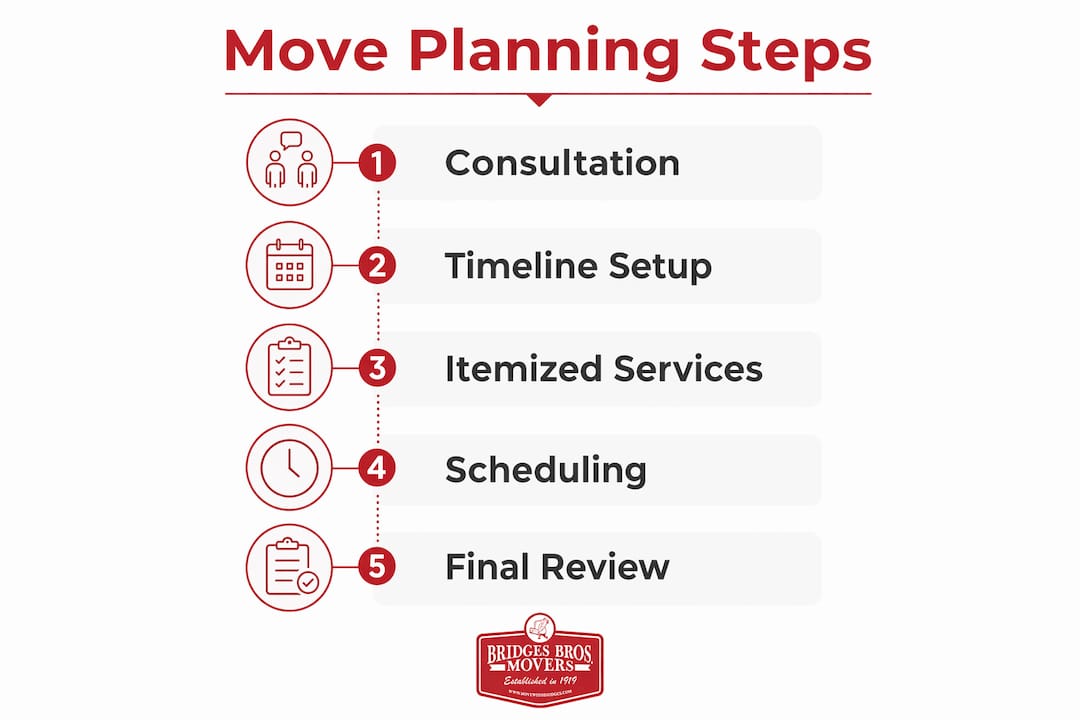
- Comprehensive consultation. The process starts with a 30–60 minute meeting, either in-home or virtual, to assess your needs. Your planner covers family dynamics, building access, special items, and your target move date. This is the most important step because everything else builds from it.
- Project blueprint development. Your planner back-calculates from your move date and creates a written plan with milestones at 6 or more weeks, 4–5 weeks, 2–3 weeks, and final preparations. Each milestone lists who is responsible for what.
- Service coordination. Your point of contact assigns tasks, books vendors, and confirms logistics. This includes professional packing services if you selected them, storage arrangements, and any specialty handling.
- Plan adjustment as circumstances change. Closing dates shift. Sellers ask for extensions. Life happens. A good custom plan is a living document that adjusts in real time without requiring you to rebuild everything from scratch.
- Post-move follow-up. After the truck leaves, your planner checks in to confirm everything arrived correctly and helps coordinate any remaining tasks like storage pickup or home cleaning.
Pro Tip: Ask your moving consultant to walk you through the difference between a moving consultant and a relocation consultant. A moving consultant focuses on physical logistics. A relocation consultant manages broader transitions including real estate and community integration. Knowing which one you need saves time and money.
What are common pitfalls in customized move planning?
Even a well-intentioned custom plan can go sideways if a few key principles are ignored. These are the mistakes that cost families the most time, money, and peace of mind.
- Skipping the upfront needs assessment. A thorough needs assessment uncovers hidden constraints like building rules, HOA restrictions, and specialty item requirements that a generic checklist misses entirely. Skipping this step means discovering those constraints on move day, when your options are limited and fees are high.
- Treating the plan as fixed. Moves evolve. A plan that cannot adapt to a changed closing date or a surprise repair at your new home creates more stress than it relieves. Build flexibility in from the start.
- Using multiple points of contact. Coordinating with a separate packing crew, a storage company, and a truck dispatcher individually is a recipe for miscommunication. One contact who owns the full picture keeps everything aligned.
- Ignoring emotional readiness. Moving ranks among the most stressful life events. A plan that accounts only for logistics and ignores pacing, rest days, and emotional support leaves families depleted before they have even unpacked. Consider moving storage solutions that reduce the pressure of doing everything at once.
- Waiting too long to engage professionals. The best custom plans take shape 6 or more weeks before move day. Waiting until two weeks out limits your options and increases costs.
Pro Tip: Use a moving checklist as a starting point, then layer your custom plan on top of it. The checklist catches standard tasks; the custom plan addresses everything specific to your situation.
Key Takeaways
Customized move planning works because it replaces generic bundles with a modular, needs-based approach that addresses your specific timeline, inventory, and emotional readiness from the start.
| Point | Details |
|---|---|
| Start planning early | Begin your custom plan 6 or more weeks before move day to secure resources and build in flexibility. |
| Needs assessment is critical | An in-home or virtual survey uncovers hidden constraints that generic checklists miss. |
| One contact reduces stress | A single point of contact for all vendors and logistics prevents miscommunication and surprises. |
| Plans must stay flexible | Treat your moving plan as a living document that adjusts when closing dates or circumstances change. |
| Customization saves money | Paying only for services you need eliminates unnecessary bundled costs and prevents emergency fees. |
Why I think most people underestimate what a custom plan actually does
People tend to think of customized move planning as a premium add-on, something for complicated corporate relocations or people moving across the country. In my experience, that framing misses the point entirely.
The families who benefit most from a personalized plan are often the ones doing a relatively straightforward local move. They assume a standard package will cover everything, then discover on move day that nobody accounted for the third-floor walk-up, the building’s two-hour elevator window, or the fact that their dining table does not fit through the new front door. Those are not rare edge cases. They are the norm.
What a good custom plan actually does is force a real conversation about your specific situation before any truck is booked. That conversation surfaces the details that matter. It also puts someone in charge of the full picture, which is the single biggest factor in whether a move feels manageable or chaotic.
My honest recommendation: engage with a moving consultant earlier than you think you need to. The consultation itself costs nothing at Bridges Bros Movers, and the clarity it provides is worth far more than the time it takes. Generic checklists are a starting point. A plan built around your actual life is what gets you through move day without regret.
— Patrick
How Bridges Bros Movers supports your personalized move
Bridges Bros Movers has offered customizable moving services across New Hampshire, Maine, and Massachusetts since 1919. Every move starts with a free in-home or virtual consultation where a dedicated moving consultant builds a plan around your schedule, your belongings, and your budget. You choose the services you need, from professional packing and specialty item handling to storage and home cleaning, without paying for what you do not. Bridges Bros Movers has earned “Best Mover in NH” recognition by treating every relocation as a unique project, not a standard transaction. Request a free quote and get a plan that fits your move, not the other way around.
FAQ
What is customized move planning in simple terms?
Customized move planning is a personalized relocation strategy that replaces standard moving packages with a modular plan built around your specific timeline, belongings, and needs. Every element, from packing levels to contingency planning, is tailored to your situation.
How early should I start a custom moving plan?
A custom moving plan works best when started 6 or more weeks before your move date. That timeline allows for a thorough needs assessment, milestone scheduling, and enough flexibility to adjust if your closing date or circumstances change.
Does customized move planning cost more than a standard package?
Not necessarily. Because you pay only for the services you actually need, a custom plan often costs less than a bundled package that includes services you would not use. Proactive planning also prevents costly last-minute fees from unaddressed obstacles.
Who handles coordination in a customized moving plan?
A single point of contact manages all vendors, logistics, and scheduling on your behalf. This model prevents the miscommunication that happens when families try to coordinate a packing crew, a truck, and a storage facility independently.
Can a custom moving plan adjust if my closing date changes?
Yes. A well-built custom plan is a living document designed to adapt when circumstances shift. Your moving consultant updates milestones and reassigns tasks without requiring you to start the planning process over from scratch.