
TL;DR:
- Flexible moving allows customers to customize services and control costs by paying only for what they need.
- It offers scheduling flexibility suitable for small, local, or uncertain moves, reducing stress and cost.
Flexible moving is a relocation approach that lets you customize the timing, services, and cost of your move instead of committing to a rigid, fixed-price package. Rather than buying a bundled deal that includes services you may not need, you select only what fits your situation. You might hire movers for a few hours of loading help, arrange transport separately, or schedule your move on a weekend with short notice. This guide explains how flexible moving works, what advantages it offers over traditional full-service moves, and how to plan one successfully so you stay in control from start to finish.
What is flexible moving and how does it differ from traditional moves?
Flexible moving is defined as a customizable moving service where customers choose the specific type of help they need, pay only for what they use, and schedule on terms that work for their life. The industry often refers to this as “à la carte” or partial-service moving. Traditional full-service moving, by contrast, bundles packing, loading, transport, unloading, and unpacking into one fixed price. You pay for the whole package whether you need every piece of it or not.

Flexible moving services allow customers to select only the services they need, such as packing assistance, transport, or unloading help. That means a family moving across town can hire movers for two hours of heavy lifting without paying for a full-day crew. A person relocating from a one-bedroom apartment may only need a truck and two movers for loading. The service scope fits the actual move, not a standard template.
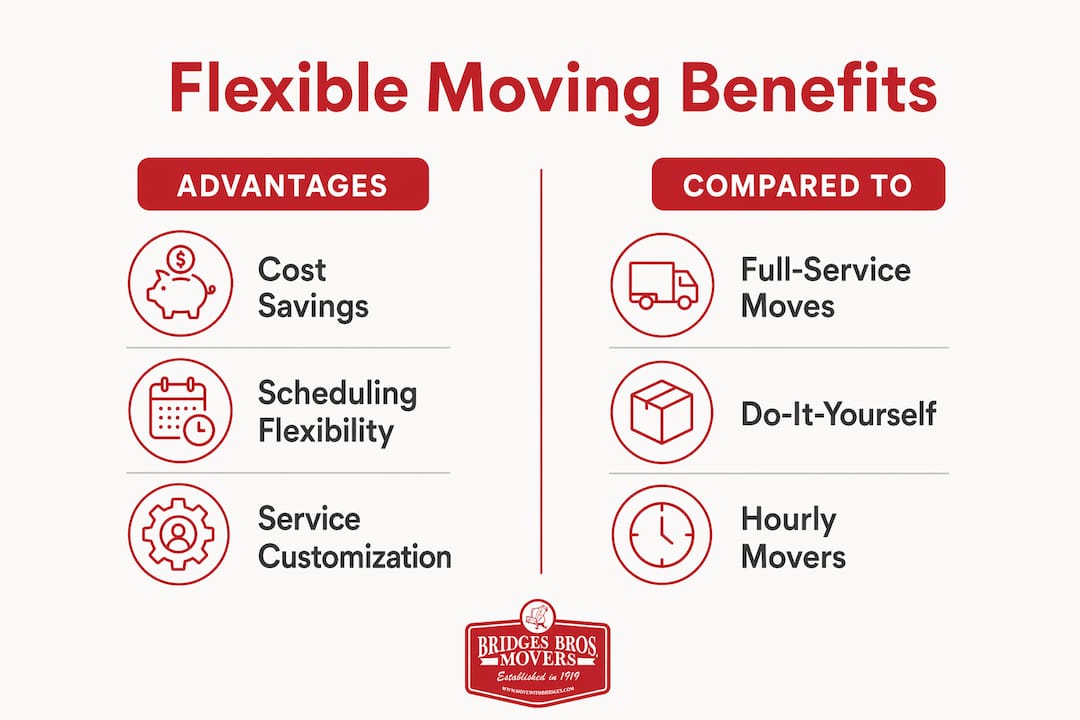
This approach sits between a do-it-yourself move and a full-service package. Flexible options provide a middle ground that lets you use professional help where it counts while keeping budget and time in your own hands. For families in New Hampshire, Maine, and Massachusetts, where housing markets shift quickly and closing dates can change, that kind of control matters.
How does flexible moving work? Key components and options
The most common form of flexible moving is hourly labor. Hourly moving means paying professional movers based on time worked instead of a fixed price package. You pay for the hours the crew is on site, which gives you direct control over cost. If your move wraps up in three hours instead of five, you pay for three.
Beyond hourly labor, flexible moving services typically include several distinct options:
- Packing help only. Movers come to your home, pack your belongings, and leave. You handle transport yourself.
- Loading and unloading only. You rent a truck or portable container; movers handle the physical labor at each end.
- Transport only. You pack and load; the moving company drives your belongings to the new address.
- Short-notice and weekend scheduling. Customers needing weekend, last-minute, or same-day moves benefit from providers that offer flexible scheduling, making the service accessible for people with unpredictable timelines.
- Hybrid packages. You combine two or three of the above services based on what you can handle yourself.
Pro Tip: Before booking, write down every task involved in your move and mark which ones you genuinely need help with. That list becomes your service scope and keeps your hourly bill predictable.
Scheduling flexibility is another core feature. Unlike traditional movers who fill peak-season calendars quickly, flexible moving providers often accommodate off-peak hours, weekday moves, and short booking windows. Flexible scheduling on weekends and short notice builds trust and improves the overall customer experience. That reliability matters when your timeline is tight or uncertain.
What are the benefits of flexible moving compared to full-service moves?
The clearest benefit is cost control. You pay only for the labor and services you actually use. A family that can pack their own boxes and disassemble furniture saves a significant portion of what a full-service move would cost. That savings can go toward first-month rent, utility deposits, or new furniture.
The advantages of flexible moving go beyond price:
- Schedule control. You choose the date, time, and duration. If your closing date shifts by a week, you reschedule without penalty clauses or rebooking fees common in fixed packages.
- Reduced stress. Flexible moving reduces stress by letting people move on their own terms with adaptable scheduling and service options. Stress drops when you are not locked into a single move date that may no longer work.
- Better fit for smaller moves. A studio apartment or a single-room move does not need a full-service crew. Hourly movers handle it efficiently without the overhead of a large package.
- Adaptability to real-estate timing. Closing dates shift. Lease start dates change. Flexible moving lets you adjust your move window without starting over on a booking.
- Partial professional help. You stay involved in the parts of the move you prefer to manage, such as packing personal items or setting up your new space, while professionals handle the heavy work.
For families managing a move around school schedules, work deadlines, or a real-estate transaction, that adaptability is not a luxury. It is a practical necessity.
Limitations and considerations when using flexible moving services
Hourly moving carries a real cost risk. Hourly moving can become more expensive if the move takes longer than expected, especially when unpredictable obstacles arise. Narrow staircases, elevator waits, long carry distances, or disorganized packing all add time and cost. A move budgeted for three hours can stretch to five if the scope is not clearly defined upfront.
Other limitations to plan around include:
- Scope creep. Without a written list of tasks, movers may spend time on items you did not intend to include, or you may ask for additional help mid-move that adds to the bill.
- Truck availability. If you book labor only and arrange your own truck, availability gaps between the two can create delays. Coordinating separate vendors requires more planning.
- Customer coordination burden. Flexible moving puts more responsibility on you. You manage the schedule, communicate the scope, and track progress. That suits organized movers but can feel like extra work for those who prefer a hands-off experience.
- Limited coverage for complex moves. Long-distance moves with specialty items, such as pianos or antiques, often benefit from a full-service approach where liability and logistics are handled end to end.
Pro Tip: Build a 30-minute buffer into each phase of your move day. If loading takes longer than expected, that buffer keeps the rest of your schedule intact without extra cost.
Successful flexible moves require clear scope definition and communication to avoid escalating costs or delays. Write down your task list, share it with your mover before the job starts, and confirm any additions before the crew begins new work.
How to plan your flexible move for smooth execution
Good planning is the single biggest factor in keeping a flexible move on time and on budget. Follow these steps to set yourself up well:
- Start 6–8 weeks out. Planning your move 6 to 8 weeks in advance improves scheduling flexibility and can reduce costs. Early booking secures your preferred date and gives you time to compare service options without pressure.
- Define your service scope. List every task: packing, disassembly, loading, transport, unloading, reassembly. Decide which tasks you handle and which you hire out. Share this list with your mover in writing.
- Assess your move size honestly. Count rooms, large furniture pieces, and specialty items. An honest assessment prevents underestimating time and cost.
- Build buffer days into your schedule. An early moving window with buffer days reduces stress when closing dates or lease starts do not align perfectly. If your closing is on a Thursday, plan your move for Saturday to give yourself room.
- Communicate clearly with your mover. Confirm the start time, parking access, elevator reservations, and any items that need special handling. Clear communication before move day prevents surprises on it.
For moves tied to real-estate timing, read Bridges Bros Movers’ guide on moving between closing dates for specific strategies on managing schedule gaps.
Here is a quick reference for planning your timeline:
| Task | Recommended timing |
|---|---|
| Book your mover and confirm service scope | 6–8 weeks before move day |
| Begin decluttering and packing non-essentials | 4–5 weeks before move day |
| Confirm truck or container rental if self-arranged | 3–4 weeks before move day |
| Pack remaining rooms and label all boxes | 1–2 weeks before move day |
| Confirm move day details with your mover | 2–3 days before move day |
Hourly movers versus full-service packages: which fits your move?
Choosing between hourly movers and a full-service package comes down to three factors: move size, timing certainty, and how much you want to be involved. Understanding how pricing works between hourly and full-service options helps you make a confident decision before you book.
| Factor | Hourly movers | Full-service package |
|---|---|---|
| Cost structure | Pay per hour of labor | Fixed price for bundled services |
| Flexibility | High: adjust scope and schedule | Low: set package, set date |
| Customer involvement | High: you coordinate and manage | Low: movers handle most tasks |
| Best for | Small, local, or simple moves | Large, complex, or long-distance moves |
| Cost risk | Higher if move runs long | Predictable upfront |
| Scheduling | More adaptable, off-peak options | Often booked weeks in advance |
Hourly movers work best for local moves, single-room relocations, or situations where your timeline is uncertain. Full-service packages suit large households, long-distance moves, or families who want a hands-off experience. Many movers in New Hampshire and Massachusetts find that a hybrid approach, hiring hourly labor for loading and unloading while handling their own packing, gives them the best balance of cost and convenience. For a deeper look at local versus long-distance move differences, Bridges Bros Movers covers the key trade-offs in detail.
Key Takeaways
Flexible moving works best when you define your service scope clearly, plan 6–8 weeks ahead, and build buffer days into your schedule to absorb real-estate timing changes.
| Point | Details |
|---|---|
| Definition of flexible moving | Customers select only the services they need and pay for time or tasks rather than a fixed bundle. |
| Hourly cost risk | Moves that run longer than planned cost more; a written scope and buffer time prevent overruns. |
| Best use case | Hourly and partial-service options suit small, local, or schedule-uncertain moves best. |
| Planning timeline | Starting 6–8 weeks out secures preferred dates and improves service availability. |
| Buffer days matter | Building extra days around your move window protects against closing date or lease start shifts. |
Why I think flexible moving deserves more credit than it gets
Most moving guides treat full-service packages as the gold standard and present hourly or partial-service moves as a budget compromise. That framing is wrong. After working with hundreds of families across New Hampshire, Maine, and Massachusetts, I have seen that the families who plan a flexible move carefully often have a smoother experience than those who book a full-service package and assume everything is handled.
The reason is involvement. When you define your own scope, you know exactly what is happening and when. You are not waiting on a crew to finish tasks you did not ask for. You are not paying for packing materials you already bought. You are in the move, not watching it happen to you.
The mistake I see most often is treating flexibility as an excuse to under-plan. Hourly moving rewards preparation. The families who write out their task list, confirm parking and elevator access in advance, and pack every box before the crew arrives finish on time and on budget. The ones who assume the crew will figure it out on the fly end up with a longer bill and a stressful day.
My recommendation: start with a hybrid approach. Handle your own packing, hire movers for loading and unloading, and keep a buffer day before your new place needs to be ready. That combination gives you cost control, professional muscle where it counts, and enough breathing room to handle the unexpected. If you are unsure how to pick an affordable mover that offers genuine scheduling flexibility, read that guide before you book anything.
— Patrick
How Bridges Bros Movers supports your flexible moving needs
Bridges Bros Movers has served families across New Hampshire, Maine, and Massachusetts since 1919, and flexible scheduling has always been part of how the company works. Whether you need a few hours of loading help on a Saturday, a partial-service move during a tight closing window, or professional packing services for a specific room, Bridges Bros Movers builds the service around your situation. The team offers weekend availability, short-notice bookings, and in-home or virtual consultations to define your scope before move day. Get started with a personalized quote through the residential moving page and find the right combination of services for your move.
FAQ
What is the definition of flexible moving?
Flexible moving is a relocation service model where customers choose only the specific services they need, such as hourly labor, packing help, or transport, rather than purchasing a fixed full-service package.
How does hourly moving work?
You pay professional movers based on the actual time they work on your move. The final cost depends on how long the job takes, so a well-organized move with a clear scope keeps the bill predictable.
Is flexible moving cheaper than full-service moving?
Flexible moving is typically less expensive for small or local moves because you pay only for the services you use. Costs can rise if the move takes longer than planned, so clear scope definition and early preparation are key.
When should I book a flexible mover?
Starting your move plan 6–8 weeks in advance gives you the best scheduling options and helps you avoid last-minute availability gaps, especially during peak moving seasons in spring and summer.
Can I mix flexible and full-service moving options?
Yes. Many families hire movers for loading and unloading only while handling their own packing. This hybrid approach reduces cost while keeping professional help where the physical work is heaviest.