
Most people assume that moving from New Hampshire to Massachusetts is just a longer version of moving across town. It is not. The moment your belongings cross a state line, an entirely different set of federal rules kicks in, and the moving company you hire must meet specific legal requirements to transport your household goods legally. Interstate moving is regulated federally and differs significantly from moves that stay within one state. Understanding this distinction before you book a mover can save you from costly surprises, protect your belongings, and make your relocation between NH, ME, and MA far smoother than you might expect.
Table of Contents
- What does interstate moving mean?
- How does interstate differ from intrastate moving?
- What rules and paperwork are required for interstate moves?
- What does interstate moving actually cost in New England?
- Full-service vs. self-service: Pros, cons, and expert tips
- How to choose a trustworthy interstate moving company
- Ready to plan your interstate move in New England?
- Frequently asked questions
Key Takeaways
| Point | Details |
|---|---|
| Interstate moves are federally regulated | Every move crossing state lines must follow FMCSA rules and movers must have valid USDOT numbers. |
| Costs vary by distance and region | Moving between NH, ME, and MA is usually less expensive than cross-country, but price depends on services, timing, and season. |
| Choose verified, full-service movers | A trustworthy, full-service team with proper licenses ensures a smooth, stress-free move for your family. |
| Always get written estimates | Federal law requires movers to provide binding or non-binding written estimates to protect you from hidden charges. |
What does interstate moving mean?
Interstate moving means relocating your household goods from one state to another. Simple enough on the surface, but the legal implications run deeper than most families realize. The moment a moving truck crosses a state border, federal law takes over, and the company operating that truck must be registered with the Federal Motor Carrier Safety Administration (FMCSA).
“Any mover transporting household goods across state lines must hold a valid USDOT number and comply with federal regulations set by the FMCSA.”
This is not optional. Federal registration is mandatory for every company performing interstate moves, regardless of how short the distance is. Moving from Portsmouth, NH to Portland, ME is still an interstate move, even though it might take less than two hours.
For families in New England, this matters because the region’s states sit close together. It is easy to assume a short move is a simple move. But crossing from Massachusetts into New Hampshire triggers the same federal oversight as a cross-country haul. Before you book anything, use our interstate moving checklist to make sure you are prepared for every step.
How does interstate differ from intrastate moving?
Once you know what interstate moving is, it helps to compare it with intrastate moving, which is any move that stays entirely within one state. This is where many people get confused, and the differences have real consequences for your planning.
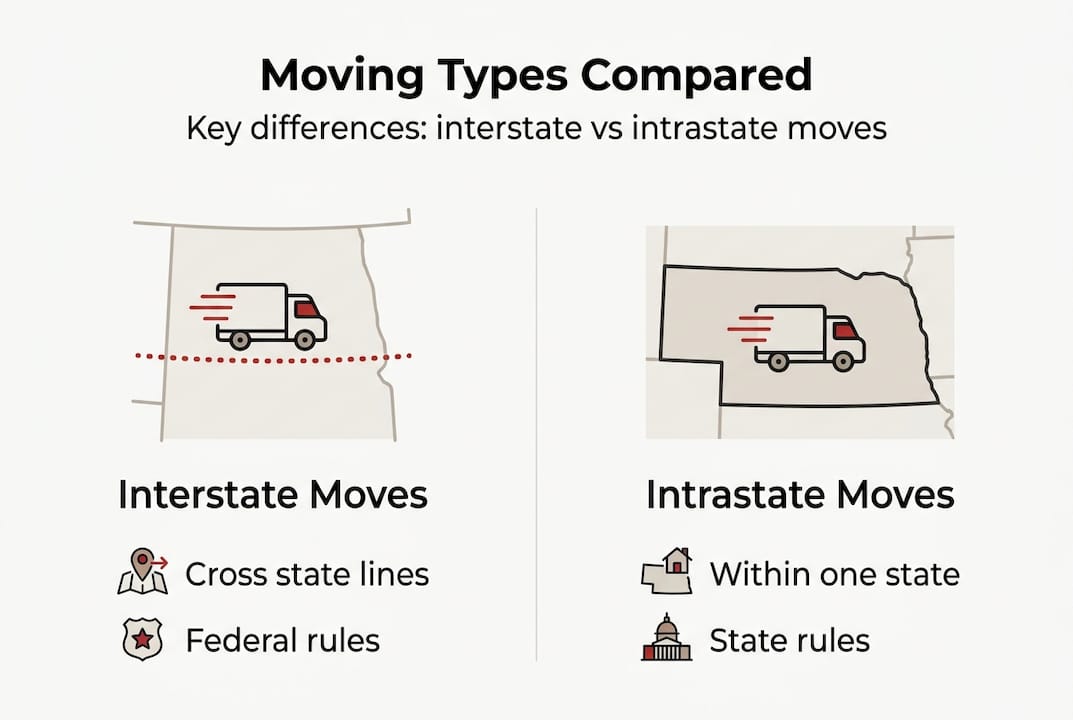
Intrastate moves are governed by individual state laws, which vary widely. Some states have strict consumer protections; others are more relaxed. Interstate moves, by contrast, follow a uniform federal standard that applies no matter which states are involved. That consistency is actually a benefit for you as a consumer.
| Feature | Interstate move | Intrastate move |
|---|---|---|
| Governing authority | Federal (FMCSA) | State law |
| Written estimate required | Yes, federally mandated | Varies by state |
| Valuation coverage | Federally required | Varies by state |
| USDOT number needed | Always | Not always |
| Consumer protections | Uniform nationwide | Inconsistent |
Here is what this means practically when choosing a moving company for a New England relocation:
- You have the right to a written estimate before any work begins
- Your mover must offer valuation coverage options
- You can dispute charges through federal channels if something goes wrong
- The mover must provide you with a copy of “Your Rights and Responsibilities When You Move”
These protections do not automatically apply to intrastate moves, which is one reason why crossing a state line actually gives you more legal leverage as a customer.
What rules and paperwork are required for interstate moves?
Knowing which authority governs your move is only part of the puzzle. The paperwork and legal protections are just as important, and skipping any of them can leave you exposed.
Here are the key documents and requirements for every interstate move:
- Written estimate. Your mover must provide either a binding estimate (a fixed price) or a non-binding estimate (an approximation) before the move begins. Never accept a verbal quote only.
- Bill of lading. This is your contract with the mover. It lists the services, the price, and the pickup and delivery dates. Keep a copy until your move is fully complete.
- Inventory list. The mover must create a detailed inventory of your belongings before loading. Review it carefully and note any pre-existing damage.
- Valuation form. You must choose your level of liability coverage. Released value protection is free but minimal. Full value protection costs more but covers repair or replacement.
- “Your Rights and Responsibilities When You Move” booklet. Federally required reading that your mover must give you before the move.
Pro Tip: Before signing anything, confirm your mover’s USDOT number and look them up at protectyourmove.gov. A legitimate company will have no problem with this request. Also review moving insurance requirements so you understand exactly what coverage you are getting.
The federal moving requirements exist to protect you, not to create red tape. Treat each document as a safeguard, not a formality. Our affordable mover checklist can help you compare companies side by side before you commit.
What does interstate moving actually cost in New England?
Understanding what is legally required is vital, but so is knowing what you might pay. Cost is one of the biggest concerns for any family planning a move, and the numbers vary more than most people expect.
Nationally, a typical 2-3 bedroom interstate move costs between $3,500 and $10,000. In New England, shorter distances between states like NH, ME, and MA generally bring that number down. Most families moving between these states can expect to pay somewhere in the $2,000 to $6,000 range, depending on the size of the home and the services selected.

| Move size | Estimated New England cost | National average |
|---|---|---|
| Studio or 1 bedroom | $1,200 to $2,500 | $1,500 to $3,500 |
| 2 to 3 bedrooms | $2,000 to $6,000 | $3,500 to $10,000 |
| 4+ bedrooms | $5,000 to $10,000+ | $7,000 to $14,000+ |
Several factors push costs up or down:
- Distance. Even within New England, moving from southern NH to northern Maine costs more than a short border crossing.
- Volume. More furniture and boxes means more truck space and labor time.
- Time of year. Peak season (May through September) typically raises prices by 10 to 20% due to high demand.
- Add-on services. Packing, storage, and specialty item handling all add to the total.
Planning ahead is the single best way to control costs. Our 8-week moving plan walks you through exactly when to book and what to prepare. You can also find region-specific advice in our New England moving tips guide.
Full-service vs. self-service: Pros, cons, and expert tips
Now that costs and rules are clear, it is time to make the most important decision: whether to hire full-service professionals or handle the move yourself. Both options have real trade-offs.
| Factor | Full-service mover | Self-service or DIY |
|---|---|---|
| Cost | Higher upfront | Lower upfront |
| Physical effort | Minimal for you | High |
| Risk of damage | Lower with pros | Higher without experience |
| Time investment | Low | High |
| Stress level | Low | Can be very high |
| Flexibility | Scheduled by mover | Fully in your control |
Full-service movers handle packing, loading, transport, and unloading. For families with young children, demanding work schedules, or fragile items, the value of handing off that responsibility is hard to overstate. Learn more about what this looks like in practice with our guide to full-service moving explained.
Self-service moves can save money, but the hidden costs add up. Truck rental, fuel, packing supplies, and the physical toll of moving heavy furniture yourself often close the gap more than people expect.
Key things to watch for with any mover:
- Avoid companies that only give you a quote over the phone without seeing your belongings
- Be cautious of unusually low estimates, which can signal a bait-and-switch
- Verify company credentials before signing any contract
Pro Tip: Always confirm that the company owns its own trucks. Some businesses act as brokers, meaning they sell your job to a third-party carrier you have never vetted. Ask directly: “Do you own your trucks and employ your drivers?”
How to choose a trustworthy interstate moving company
Confidently weighing full-service versus DIY is only half the equation. You also need to know how to pick a mover you can actually trust with your family’s belongings.
Follow these steps before signing with any company:
- Look up their USDOT number. Every legitimate interstate mover has one. Search it at protectyourmove.gov to confirm active registration and insurance.
- Request a written estimate. A reputable company will offer an in-home or virtual survey before quoting you. Walk away from anyone who refuses.
- Check their physical address. A real business has a real location. Search it on a map and confirm it is not a virtual office.
- Read recent reviews. Look beyond star ratings. Read what customers say about communication, punctuality, and how the company handled problems.
- Ask about their claims process. A trustworthy mover will explain clearly what happens if something is damaged.
Pro Tip: Use the FMCSA database to verify a mover’s licensing and insurance before you commit. This takes less than five minutes and can save you from a serious headache.
Our guides on spotting moving scams and our mover selection guide give you even more tools to make a confident, informed choice.
Ready to plan your interstate move in New England?
At Bridges Bros Movers, we have been helping families relocate across New Hampshire, Maine, and Massachusetts since 1919. We are fully licensed with a valid USDOT number, carry comprehensive insurance, and own our own trucks and employ our own crews. No brokers, no surprises. Whether you need full packing services, secure storage, or a straightforward load-and-go move, we build a plan around your schedule and budget. We offer in-home and virtual consultations so you get an accurate, written estimate before anything is signed. Reach out to our team today to get started, and let us take the stress out of your next interstate move.
Frequently asked questions
Do I need a specific license or paperwork to move between NH, ME, and MA?
You personally do not need a license, but your mover does. Federal regulations require every interstate mover to hold a valid USDOT number and provide written estimates before the move begins.
How can I check if an interstate moving company is legitimate?
You can verify any mover using their USDOT number at protectyourmove.gov or through the FMCSA database, which shows current registration status and insurance compliance.
What’s the average cost of moving from New Hampshire to Massachusetts?
New England moves are generally below the national average. Most households pay between $2,000 and $6,000, depending on home size and services, compared to the national range of $3,500 to $10,000 for a 2-3 bedroom move.
Should I hire a full-service interstate mover?
If you want a low-stress experience, yes. Full-service moves cover packing, loading, transport, and unloading, making them ideal for busy families or anyone moving fragile or high-value items.
Why do interstate moving costs increase in the summer?
Summer is peak moving season, and demand far outpaces mover availability. This typically pushes prices up by 10 to 20%, so booking early or choosing an off-peak date in fall or winter can lead to meaningful savings.