
TL;DR:
- Effective move management involves structured planning and coordination to ensure smooth relocations. It covers all phases, from assessment to evaluation, to keep operations on track and reduce errors. Properly owning the process allows for better decision-making, communication, and lessons for future moves.
Move management is defined as the structured planning, coordination, and execution of a relocation across its full lifecycle, from initial assessment through post-move evaluation. It covers logistics, IT, HR, and facilities requirements to keep operations running from day one at the new location. Whether you are moving a household or relocating an entire office, the move management process provides the control layer that keeps every vendor, timeline, and stakeholder aligned. Bridges Bros Movers has built its reputation since 1919 on exactly this kind of coordinated, full-service approach to relocation.
What does the move management process involve?
Move management spans five key phases: assessment, planning, execution, communication, and evaluation. Each phase builds on the last, creating a structured path from the first site visit to the final debrief. Skipping any stage is where most moves go wrong.
- Assessment. This is where you take stock of what needs to move, where it needs to go, and what constraints exist. For businesses, that means auditing furniture, equipment, and IT infrastructure. For households, it means cataloging belongings and identifying specialty items.
- Planning. A detailed move plan is built from the assessment data. It assigns responsibilities, sets timelines, and identifies vendors. A solid plan accounts for contingencies before move day arrives.
- Execution. Physical relocation happens here. Movers carry out the labor, but the move manager oversees sequencing, vendor coordination, and real-time problem solving.
- Communication. Keeping everyone informed throughout the process prevents confusion and delays. This phase runs parallel to all others, not just at the start.
- Evaluation. Post-move evaluation captures lessons learned and adjusts space and technology to meet actual productivity needs. This step is the most commonly skipped, and the most valuable for future moves.
Centralized project management tools reduce manual updates by over 50% and support real-time tracking across all five phases. That efficiency gain is the difference between a move that runs on schedule and one that stalls at every handoff.
Pro Tip: Assign one person to own the communication phase from day one. Confusion during a move almost always traces back to a gap in who was responsible for telling whom.

Who are the key roles in move management?
Move management is the control layer that aligns vendors, timelines, and stakeholders. It is entirely separate from the physical movers who execute the labor. Understanding this distinction saves a lot of frustration on move day.
The move manager owns the plan. Their responsibilities include:
- Decision authority. Move managers are authorized to make trade-offs when unexpected problems arise. If an elevator is unavailable or a delivery is delayed, they redirect without waiting for approval chains.
- Vendor coordination. They manage relationships with movers, IT contractors, furniture installers, and building management simultaneously.
- Stakeholder alignment. They keep facilities, HR, and department heads informed and accountable to the agreed timeline.
- Risk management. They identify potential breakdowns before move day and build contingency steps into the plan.
Supporting roles vary by move type. In a corporate relocation, IT handles equipment disconnection and reconnection, HR manages employee communications and relocation benefits, and facilities oversees access, parking, and building logistics. For a residential move, the equivalent roles might be a trusted family member coordinating with the moving crew and a property manager handling access at both ends.
Pro Tip: For office moves, loop in IT at the planning stage, not the week before. Technology setup is almost always the longest lead-time item and the most common cause of day-one productivity loss.
What are the benefits of professional move management?
Effective move management improves communication, reduces errors, lowers downtime, and improves employee engagement during relocations. Those outcomes apply whether you are moving a family of four or a company of 400. The mechanism is the same: centralized oversight replaces scattered decision-making.
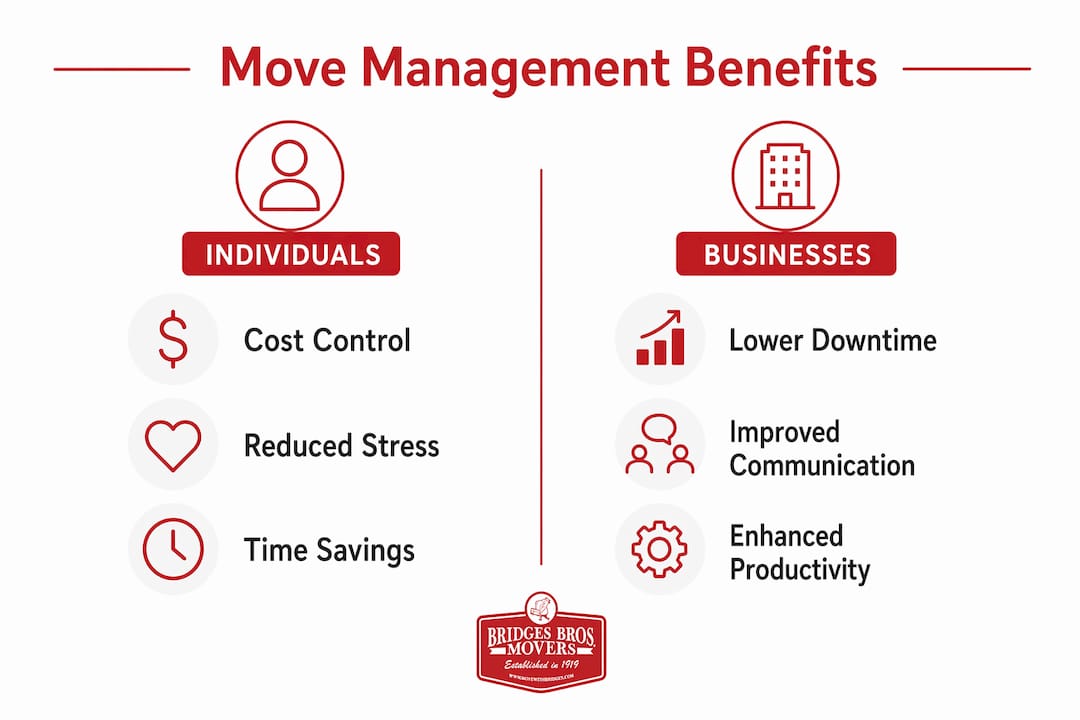
For businesses, the strategic value goes further. Move management has evolved into a function that supports mergers, rightsizing, and office consolidations without losing culture or productivity. That is not a minor administrative benefit. It is the difference between a transition that sets a company back six months and one that positions it for growth.
| Benefit | For individuals | For businesses |
|---|---|---|
| Cost control | Avoids duplicate purchases and last-minute fees | Reduces vendor overruns and unplanned overtime |
| Reduced downtime | Faster unpacking and setup at the new home | Employees productive from day one at the new office |
| Clear communication | Family members know the plan and their roles | Staff and leadership stay aligned throughout the process |
| Error reduction | Fewer lost or damaged items | Fewer IT failures, missing equipment, and setup delays |
| Post-move improvement | Lessons captured for future moves or renovations | Space and technology adjusted to actual workflow needs |
For a smooth office relocation, the benefits compound quickly. A well-managed move protects revenue, preserves team morale, and signals to employees that leadership handles change with care.
How do you implement move management for a successful relocation?
Applying move management principles does not require a large budget or a dedicated department. The core requirement is structure: one person owns the plan, everyone else knows their role, and decisions have a clear path.
Start with these practical steps:
- Appoint a move manager. For a home move, this might be you. For a business move, assign someone with authority to make real-time decisions. This person is not just a coordinator. They own outcomes.
- Build a written move plan. Document timelines, vendor contacts, access details, and contingency steps. A shared document or project management tool keeps everyone working from the same information.
- Use move management software or systems. Digital tools reduce manual updates and give all stakeholders real-time visibility. For larger moves, platforms that track task completion and flag delays pay for themselves quickly.
- Communicate in layers. Send a high-level overview to all stakeholders early. Follow with role-specific instructions closer to move day. Confirm details 48 hours before execution begins.
- Plan for the unexpected. Move management establishes decision ownership so that when obstacles arise, the plan does not break. Identify your two or three most likely problems in advance and write down how you will handle each one.
For a detailed walkthrough of the execution phase, the office relocation step-by-step guide from Bridges Bros Movers covers the sequencing decisions that most planners miss.
Pro Tip: Run a 30-minute post-move debrief within one week of completing the relocation. Ask three questions: What went as planned? What did not? What would we do differently? That conversation is worth more than any pre-move checklist.
Key Takeaways
Move management is the structured control layer that keeps every relocation on track, from the first assessment through the final post-move evaluation.
| Point | Details |
|---|---|
| Five-phase process | Assessment, planning, execution, communication, and evaluation form the complete move management lifecycle. |
| Control vs. labor | Move managers own decisions and coordination; movers execute physical labor. These are distinct roles. |
| Benefits for all | Individuals and businesses both gain cost control, reduced downtime, and clearer communication. |
| Post-move evaluation | Capturing lessons after the move is the most overlooked step and the most valuable for future planning. |
| Appoint ownership | Every successful move has one person with the authority to make real-time decisions when plans change. |
Move management is more than logistics
I have watched a lot of moves go sideways, and the cause is almost never the movers. It is the absence of a control layer. Someone assumed another person was handling vendor access. IT was not told about the move until the week before. The post-move debrief never happened, so the same mistakes repeated six months later during the next office shuffle.
Move management is the expert control that keeps a plan intact when reality does not cooperate. That is the part most people underestimate. They think hiring good movers is the solution. Good movers are necessary. But they execute labor. They do not own the sequence, the vendor relationships, or the decision path when the elevator is out of service on move day.
The shift I have seen in well-run organizations is treating move management as a strategic function, not an administrative task. It operationalizes change effectively, especially during mergers and consolidations where culture and productivity are genuinely at risk. The companies that get this right do not just move faster. They come out of the transition stronger.
— Patrick
How Bridges Bros Movers supports your relocation
Bridges Bros Movers has coordinated residential and commercial relocations across New Hampshire, Maine, and Massachusetts since 1919. The team brings the full move management process to every job: pre-move assessment, detailed planning, coordinated execution, and clear communication at every stage. For families, the residential moving services cover everything from packing to final placement. For businesses, the commercial moving solutions are built around minimizing downtime and keeping your team productive from day one. Request a quote or schedule a consultation to see how Bridges Bros Movers can put a real plan behind your next move.
FAQ
What is move management in simple terms?
Move management is the structured planning, coordination, and execution of a relocation from start to finish. It covers every phase from initial assessment through post-move evaluation to minimize disruption.
What does move management involve for a business?
For a business, move management coordinates vendors, IT, HR, and facilities under one unified plan. It assigns decision authority, sets timelines, and keeps employees informed throughout the transition.
How is a move manager different from a mover?
A move manager owns the plan and makes real-time decisions when problems arise. Movers execute the physical labor. The two roles are distinct and both are necessary for a well-run relocation.
What are the main benefits of move management?
Move management reduces costs, limits downtime, improves communication, and supports productivity during relocations. It also captures post-move lessons that improve future transitions.
Do individuals need move management or is it only for businesses?
Move management applies to any relocation, residential or commercial. The principles of structured planning, clear communication, and post-move evaluation improve outcomes for households and organizations alike.