
TL;DR:
- Many belongings, such as pianos, antiques, and large appliances, require early and specialized planning before a move. Proper packaging involves individually wrapping fragile items and labeling boxes clearly to prevent damage during transit. Coordinating utility services and securing valuables separately are essential for a smooth, stress-free relocation.
Most people assume that packing is packing. Box it up, tape it shut, load the truck. But knowing what items need special planning before a move can mean the difference between arriving at your new home with everything intact or dealing with broken heirlooms, missing documents, and frantic calls to utility companies. Certain belongings require a different approach entirely. From pianos and antiques to prescription medications and important paperwork, the items that need the most attention are often the ones people think about last.
Table of Contents
- Key takeaways
- Items that need special planning before a move
- Packing fragile, valuable, and specialty items
- Managing documents, valuables, and personal items
- Coordinating utilities, services, and logistics
- What I have learned from years of watching moves go wrong
- How Bridges Bros Movers handles specialty moves
- FAQ
Key takeaways
| Point | Details |
|---|---|
| Start early for specialty items | Begin planning at least eight weeks out to book specialty movers and coordinate logistics for large or unique belongings. |
| Wrap every fragile item individually | Transit vibrations cause breakage when items touch, so treat each piece as its own protected unit. |
| Keep valuables and documents with you | Pack critical papers, medications, and irreplaceable items separately so they stay accessible throughout the move. |
| Schedule utilities and services in advance | Notify providers several weeks before your move date to avoid gaps in service at both your old and new home. |
| Use a moving calendar | Tracking tasks by date helps you stay ahead of deadlines for packing stages, service calls, and specialty logistics. |
Items that need special planning before a move
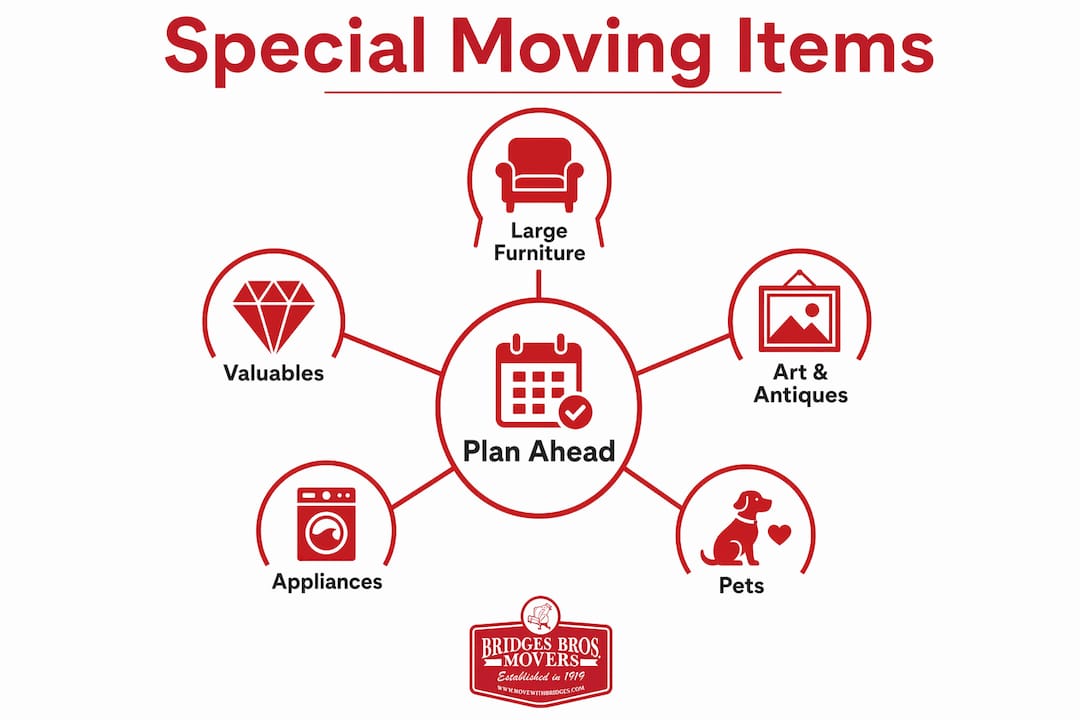
Some belongings cannot be handled with the same approach you use for kitchen plates or clothing. These are the items that need early scheduling, specialized equipment, or professional handling. Getting ahead of them is what separates a smooth move from a stressful one.
Large furniture and bulky items
Large furniture is one of the most common sources of moving-day delays. Sofas that will not fit through doorways, bed frames that take 40 minutes to disassemble, and bookshelves that require two people just to tilt. Disassembling furniture and labeling parts in clearly marked bags before moving day saves a significant amount of time and reduces the chance of scratches or structural damage. Keep all screws, bolts, and hardware in zip-close bags taped directly to the furniture piece they belong to.
Early furniture disassembly does more than protect individual pieces. It also improves how efficiently the truck gets loaded and unloaded, which directly affects your total moving time and cost.
Specialty items that require professional help
Pianos, hot tubs, large gun safes, and pool tables fall into a different category entirely. These items are heavy, oddly shaped, and easy to damage without the right equipment. Scheduling a specialty mover for these items is not optional. It is a logistical necessity that requires booking weeks or even months in advance, especially during peak moving season in New England when movers’ calendars fill up quickly.

Appliances also need advance planning. Refrigerators should be defrosted 24 hours before the move. Washing machines need the drum secured with shipping bolts. Gas appliances require a licensed technician to disconnect them safely. These are not tasks you want to realize you have forgotten on the morning of your move.
Pro Tip: Contact a specialty moving service or appliance technician at least three to four weeks before your move date. For pianos or hot tubs, book even earlier since these crews have limited availability.
Here is a quick reference for items that need the most advance scheduling:
- Pianos and organs
- Hot tubs and swim spas
- Large gun safes or vaults
- Riding lawn mowers and outdoor equipment
- Appliances requiring gas or electrical disconnection
- Pool tables or large arcade equipment
Packing fragile, valuable, and specialty items
Fragile items are the category where most moving damage happens. The reason is almost always the same: items were not wrapped individually, boxes were too heavy, or packing materials were inadequate. Fixing these three issues will protect the vast majority of your breakables.
How to protect fragile items correctly
Follow these steps when packing anything breakable:
- Wrap every item individually. Never let two fragile items touch each other inside a box. Transit vibrations cause breakage when surfaces make contact, even over short distances.
- Use the right materials. Bubble wrap, packing paper, and foam sheets are not interchangeable. Use packing paper for filling gaps, bubble wrap for direct item protection, and foam for electronics and particularly delicate pieces.
- Stay within weight limits. Fragile boxes should weigh 15 to 20 lbs at most. Heavy boxes get dropped. Overloaded boxes with ceramics or glassware almost always result in broken pieces.
- Reinforce every box bottom. Apply at least three strips of quality packing tape to the bottom of each fragile box. Do not use masking tape or duct tape. They do not hold under weight or humidity.
- Label clearly. Write “Fragile” and “This Side Up” on at least two sides of the box, not just the top. Movers handle dozens of boxes at once and need to see the label from any angle.
Artwork, antiques, and collectibles
These items often carry significant financial or sentimental value, which means the stakes are high. For framed artwork, use corner protectors and mirror boxes sized specifically for the piece. Antiques and collectibles benefit from custom crating, particularly for anything that cannot be replaced. For high-value belongings, moving insurance coverage is worth reviewing before your move date, not after.
Pro Tip: Photograph every valuable item before packing it. This creates a record that supports any insurance claim and helps you confirm nothing was damaged during transit.
Packing materials comparison
| Material | Best for | Not recommended for |
|---|---|---|
| Bubble wrap | Glassware, ceramics, electronics | Filling gaps in boxes |
| Packing paper | Filling space, wrapping soft items | Directly wrapping sharp or heavy items |
| Foam sheets | Electronics, mirrors, framed art | Structural support |
| Custom crates | Antiques, sculptures, high-value art | Everyday household items |
| Packing peanuts | Filling voids around light items | Heavy ceramics or items that shift easily |
For specialty packing materials and expert guidance, the packing supplies guide from Bridges Bros Movers is a practical starting point.
Managing documents, valuables, and personal items
This section covers items that have almost nothing to do with how well they are wrapped and everything to do with where you put them. Losing your passport, prescription medications, or house keys during a move is a genuinely disruptive problem. The solution is straightforward: keep these items separate from everything being loaded onto the truck.
Organizing important documents in a dedicated folder or binder before your move date prevents the frantic searching that happens when you need something immediately after arriving at your new home.
Here is what should go into a personal “moving day bag” that travels with you, not in the truck:
- Passports, birth certificates, Social Security cards, and legal documents
- Medical records and prescription medications (including at least a 7-day supply)
- Phone chargers, laptops, and tablets you will need on moving day
- House keys, car keys, and any access fobs for your new home
- Jewelry, watches, and small high-value items
- Snacks, water, and basic toiletries for the day
- A change of clothes and anything your children or pets need immediately
Planning for pets deserves its own moment of attention. Animals are stressed by moving activity. Arrange for a pet sitter or keep them in a quiet, closed room on moving day, then transport them in your personal vehicle with familiar items nearby.
Coordinating utilities, services, and logistics
The logistical side of a move has its own set of time-sensitive tasks that require advance notice. Forgetting to schedule these can leave you without electricity or internet access for days, which creates a very uncomfortable start in a new home.
Notifying utility providers several weeks ahead of your move date gives them enough lead time to schedule disconnection at your old address and activation at the new one. Most providers require at least a few business days, but scheduling two to three weeks out gives you flexibility if anything needs adjustment.
Here is a numbered sequence to follow for the logistical side of your move:
- Six to eight weeks out. Start your moving calendar and book your moving company. Confirm specialty services for any large or unique items.
- Four to six weeks out. Notify your electricity, gas, water, and internet providers of your move date. Submit a mail forwarding request with USPS.
- Two to three weeks out. Update your address with your bank, employer, insurance providers, and any subscription services.
- One week out. Confirm all bookings with movers and specialty service providers. Arrange childcare or pet care for moving day.
- Moving day. Do a final walkthrough of your current home before the truck leaves. Check every closet, cabinet, and outdoor space.
| Task | Recommended lead time |
|---|---|
| Book movers | 6 to 8 weeks |
| Notify utility companies | 3 to 4 weeks |
| Update mailing address | 3 to 4 weeks |
| Schedule specialty services | 4 to 8 weeks |
| Arrange childcare or pet care | 1 to 2 weeks |
What I have learned from years of watching moves go wrong
After seeing hundreds of residential moves across New Hampshire, Maine, and Massachusetts, I have noticed a consistent pattern. The families who struggle the most are not the ones with the most belongings. They are the ones who assumed that one or two items would “be fine” without extra attention.
A cracked antique mirror. A piano that would not fit up a narrow staircase because nobody measured it in advance. A family that arrived at their new home to discover the electricity was not scheduled for activation for three more days. These are not rare disasters. They are the predictable result of skipping the planning steps that feel unnecessary until they are not.
What I genuinely believe is this: the items that need special planning are not the expensive ones or the fragile ones specifically. They are any item where there is a hidden dependency you have not thought about yet. The appliance that needs a technician. The document you need on day one but packed in box forty-seven. The large sofa that requires a stairwell assessment before it can be moved.
My strongest advice is to walk through your home with a critical eye about four to six weeks before your move date. Ask yourself: what would happen if this item broke, disappeared, or could not fit? The answers to those questions will tell you exactly where your special planning needs to go. And when in doubt, ask a professional. That phone call almost always costs less than the problem it prevents.
— Patrick
How Bridges Bros Movers handles specialty moves
When you have items that require more than a standard moving truck, Bridges Bros Movers has the experience and resources to handle them properly. From residential moving services designed to protect specialty items, to professional packing services for fragile and high-value belongings, the team has been doing this across New England since 1919. Whether you need custom packing, secure storage during the transition, or guidance on what to consider before moving day arrives, Bridges Bros Movers offers in-home and virtual consultations to help you plan with confidence. Get a quote and start your move with a team that takes every item seriously.
FAQ
What items need special planning before a move?
Items requiring special planning include large furniture, pianos, appliances, fragile belongings, high-value collectibles, and important documents. Each of these needs either advance scheduling, custom packing, or separate handling to prevent damage or loss.
How early should I start planning for specialty items?
Experts recommend starting at least eight weeks before your move date, and even earlier for items like pianos or hot tubs that require specialty movers with limited availability.
How do I pack delicate items safely?
Wrap every fragile item individually in bubble wrap, keep box weight under 20 lbs, reinforce box bottoms with quality packing tape, and label each box clearly on multiple sides.
Should I move valuables and documents in the moving truck?
No. Valuables, medications, passports, and other critical documents should travel with you in a separate bag. This keeps them accessible and reduces the risk of loss or damage during the move.
When should I notify utility companies before moving?
Notify utility companies three to four weeks before your move date to schedule disconnection at your current address and activation at your new one, giving both parties enough time to accommodate any scheduling adjustments.