
TL;DR:
- DIY moving poses high injury risks and hidden costs, making professional help a safer choice.
- Professional movers reduce damage, injury, and stress through specialized training and equipment.
- Accurate planning, insurance, and early booking ensure a smoother, more predictable move.
Moving looks manageable on paper. You rent a truck, grab some friends, and carry boxes from one home to another. But the reality hits fast, and it hits hard. The logistics industry sees injury rates nearly double the national private sector average, and a single back injury from improper lifting can cost more than $40,000 in medical bills and lost wages alone. For families and individuals in New Hampshire, Maine, and Massachusetts, the stakes are real. This guide walks you through what most people overlook when planning a DIY move, and why bringing in experienced professionals often saves more than it costs.
Table of Contents
- Risks of DIY moving: What most people overlook
- How professional movers make your move safer and simpler
- Comparing costs: Professional movers vs. moving yourself
- What to look for in a New England mover
- The truth about stress-free moving: What most guides miss
- Get expert help for your New England move
- Frequently asked questions
Key Takeaways
| Point | Details |
|---|---|
| DIY risks are real | Moving on your own can lead to serious injuries and hidden expenses far beyond truck rental costs. |
| Pros save time and stress | Professional movers offer expert planning and labor, freeing you from heavy lifting and complex logistics. |
| Insurance adds protection | Hiring professionals means your belongings are covered and costly accidents are less likely. |
| Choose trusted movers | Look for licensed, insured companies with strong local reputations for a safe move. |
Risks of DIY moving: What most people overlook
Most people underestimate what a move actually involves until they’re standing in front of a fully loaded bedroom with a narrow stairwell and no plan. A sofa that seemed movable in the showroom becomes a completely different challenge when you’re angling it through a door frame with two friends who haven’t lifted anything heavier than groceries in months.
The physical risk is real and well-documented. The logistics sector reports 4.4 injuries per 100 workers, which is roughly double the national average for private industry workers. And those are trained workers using proper equipment every day. For someone who moves homes once every few years, the risk is considerably higher because technique, preparation, and conditioning all matter enormously when you’re lifting heavy, awkward objects repeatedly over several hours.
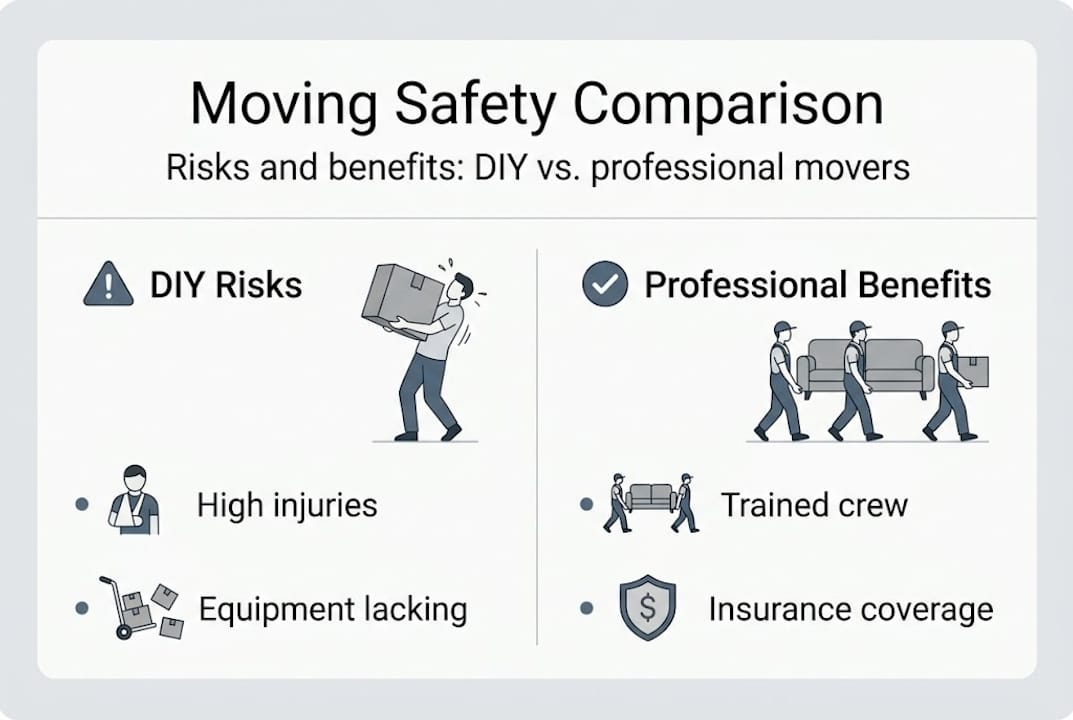
Back injuries are the most common and the most costly. A single serious back injury sustained during a move can average $41,757 in total costs, including medical treatment, physical therapy, and 12 to 15 lost workdays. That number alone should give anyone pause before deciding that renting a truck and doing it yourself is the budget-friendly option.
Beyond injury, the financial picture of a DIY move carries several hidden costs that don’t show up in the initial estimate:
- Truck rental fees: A large moving truck for a two-bedroom home can run $150 to $400 per day before factoring in mileage charges.
- Moving supplies: Boxes, bubble wrap, packing tape, mattress covers, and furniture pads add up quickly, often reaching $200 to $400 for a full move.
- Fuel costs: A large truck averages 6 to 10 miles per gallon, making a long-distance New England move significantly more expensive at the pump than you’d expect.
- Property damage: Without proper padding and equipment, furniture gets scratched, walls get dented, and fragile items break. Replacement costs can easily exceed what you saved on labor.
- Lost time: Taking multiple days off work, coordinating schedules with helpers, and managing the logistics of a full move is a time cost that rarely gets factored in.
The emotional toll is harder to quantify but just as real. Coordinating multiple people, managing timelines, and troubleshooting unexpected problems creates a stress load that can affect your health, your relationships, and your ability to settle into your new home with a clear head. Learning about stress reduction through packing shows just how much the preparation phase alone contributes to overall moving anxiety.
“The most expensive part of a DIY move is often the one you didn’t see coming, whether that’s a back injury, damaged furniture, or a two-hour delay because the truck is too small.”
Pro Tip: Most moving injuries happen when lifting large furniture pieces without the right equipment or technique. If you’re committed to a DIY approach for smaller items, hire professionals specifically for heavy furniture and appliances. For a fuller picture of what safe, stress-free moves look like, it’s worth reviewing what experienced teams do differently.
How professional movers make your move safer and simpler
When you hire a professional moving team, you’re not just paying for muscle. You’re paying for training, systems, equipment, and experience that reduce every major risk category associated with relocation.
Professional movers are trained specifically to lift, carry, and transport heavy objects without injury to themselves or damage to your belongings. They know how to use moving straps, dollies, furniture sliders, and custom blankets to protect both the items being moved and the walls, floors, and door frames of the home. The injury rate in the logistics sector is a well-known challenge, and reputable moving companies address it directly through ongoing training and proper equipment protocols. That investment in safety directly benefits you as the customer.
Here’s how a professional move typically compares to a DIY move:
| Factor | DIY move | Professional move |
|---|---|---|
| Injury risk | High (untrained lifters, no equipment) | Low (trained crew, proper tools) |
| Property damage | Moderate to high | Low (padding, blankets, systems) |
| Time required | 1 to 3 days | 4 to 8 hours typically |
| Hidden costs | Many (truck, fuel, supplies, damage) | Minimal (transparent quote) |
| Insurance coverage | None | Yes, included or available |
| Stress level | Very high | Significantly reduced |
Professional movers also bring systems that most people simply don’t have. Labeling protocols, load sequencing, and weight distribution plans mean your belongings arrive in the right order and in good condition. When unloading, teams know how to stage items efficiently so your new home doesn’t become a chaotic pile of boxes with no clear path forward.
Here’s what a well-organized professional move typically looks like, step by step:
- Pre-move consultation: A walkthrough (in-person or virtual) allows the moving team to assess volume, specialty items, and any access challenges at either location.
- Custom packing plan: Fragile items, artwork, and specialty pieces get appropriate materials and handling. Understanding how packing services help makes a big difference in protecting your most valuable possessions.
- Organized loading: Heavier items go first and are secured properly. Lighter boxes fill in gaps. Every item is accounted for.
- Safe transport: Professional trucks are equipped with tie-down systems and climate considerations that rental trucks often lack.
- Efficient unloading: Items are placed where you want them, not where they happen to land. Your furniture is assembled and positioned before the team leaves.
- Post-move walkthrough: Any concerns are addressed before the job is considered complete.
Insurance coverage is a significant advantage that’s easy to overlook. Professional moving companies carry liability coverage and offer valuation options that protect your belongings against loss or damage. If a television screen cracks during a DIY move, the cost comes directly out of your pocket. With professionals, you have a clear resolution process.
Pro Tip: Ask potential movers specifically about their handling process for specialty items like pianos, antiques, and large appliances. A good mover will have a clear answer and the equipment to back it up. For a full breakdown of the process, the step-by-step guide to hiring movers is a helpful starting point.
Comparing costs: Professional movers vs. moving yourself
The assumption that DIY is always cheaper is one of the most persistent myths in the moving industry. When you break down the actual numbers, the gap narrows considerably, and in many cases, it disappears entirely or reverses.

Typical cost breakdown for a local two-bedroom move:
| Expense | DIY estimate | Professional estimate |
|---|---|---|
| Truck rental | $150 to $300 | Included |
| Fuel | $50 to $150 | Included |
| Packing materials | $150 to $400 | Included or itemized |
| Equipment (dollies, straps) | $50 to $100 | Included |
| Friend help (food, drinks) | $75 to $200 | Not needed |
| Potential property damage | $0 to $1,000+ | Covered by insurance |
| Total estimate | $475 to $2,150+ | $800 to $1,500 |
That range tells an important story. A DIY move with no complications can be cheaper. But add one damaged piece of furniture, one injury, or one rental truck upgrade, and the numbers shift quickly.
The injury cost comparison is where the math becomes most striking. Back injuries from heavy lifting average $41,757 in total costs. A professional moving quote for a typical New Hampshire or Massachusetts home might run $1,200 to $2,500. A single serious injury costs more than ten times that amount. Even a minor strain requiring a doctor’s visit, imaging, and a week of reduced work can easily exceed $3,000 to $5,000 in direct and indirect costs.
Here are the hidden DIY costs that most people don’t factor in:
- Lost wages from taking extra days off work to complete the move or recover from physical strain.
- Replacement costs for broken items, damaged flooring, or scuffed walls in the home you’re leaving (which can affect your security deposit).
- Repeat rental fees if the first truck isn’t large enough and you need a second trip.
- The cost of your time when coordinating multiple helpers, managing a rental return, and handling the logistics of a move that takes twice as long as planned.
Transparent pricing from a reputable mover eliminates most of these surprises. Knowing your moving materials costs upfront and having them bundled into a single quote makes budgeting far more predictable. When you account for accountability and insurance, the value of moving with a trusted company becomes clear.
What to look for in a New England mover
Not all moving companies offer the same quality, and the difference between a reliable mover and a problematic one becomes very obvious when something goes wrong. Choosing carefully protects both your belongings and your budget.
Here’s what to evaluate before booking any moving company in New Hampshire, Maine, or Massachusetts:
- Licensing and insurance: Every legitimate mover should carry a USDOT number for interstate moves and state licensing for local moves. Ask to see proof of both general liability insurance and cargo insurance before signing anything.
- Local reputation and reviews: A company with strong reviews from your specific region understands local geography, seasonal challenges, and community standards. New England winters, narrow colonial-era streets, and coastal properties present unique logistical challenges that local experience addresses effectively.
- Transparent pricing: Reputable movers provide written, itemized quotes. Vague estimates or unusually low bids are warning signs worth taking seriously.
- Safety practices: Ask how the team is trained, what equipment they carry, and how they handle specialty items. Professional movers follow best practices to reduce risk and protect both workers and customers.
- Additional services: Look for companies that offer packing, storage, junk removal, and specialty item handling. These services add flexibility and simplify the overall process.
- Communication and responsiveness: A company that responds promptly and clearly before the move will be far easier to work with if any issue arises on moving day.
Knowing how to spot a sketchy moving company is equally important. Red flags include companies that demand large cash deposits upfront, provide quotes without seeing your inventory, or have no physical address or verifiable reviews.
For a practical framework on making the final decision, hiring the right moving company covers the key questions to ask during the selection process.
Pro Tip: In New England, peak moving season runs from late May through September. If your move falls during that window, calendars fill up quickly. Book at least 4 to 6 weeks ahead to secure your preferred date and team.
The truth about stress-free moving: What most guides miss
Most moving advice focuses on logistics: what to pack first, how to label boxes, when to book the truck. That’s all useful. But the real advantage of hiring professional movers is something most guides skip over entirely.
It’s the planning intelligence and crisis prevention that professionals bring. Experienced movers have seen nearly every scenario imaginable. A doorway that’s two inches too narrow for your sofa. A stairwell with a tricky turn. A parking situation that makes truck access difficult. They solve these problems before they become emergencies because they’ve navigated them dozens of times.
DIY moves fail in chain reactions. One miscommunication leads to a delay. A delay leads to helpers leaving early. Fewer helpers leads to rushed lifting. Rushed lifting leads to an injury or a dropped piece of furniture. That cascade happens fast and it’s genuinely hard to stop once it starts.
The logistics industry’s injury rates twice the private sector average reflect just how physically demanding this work is even for trained professionals. For someone doing it once, without proper equipment or technique, the risk is proportionally higher.
What you’re really buying when you hire professional movers is mental clarity. You’re not managing fifteen moving parts while also trying to physically move your home. You’re directing the process, making decisions about placement, and settling into your new space. That mental space has real value. For a wider look at how stress-free moving solutions work in practice, professional support makes a measurable difference in how smoothly the day unfolds.
Get expert help for your New England move
If you’re planning a move in New Hampshire, Maine, or Massachusetts, Bridges Bros. Movers has been serving New England families since 1919. That’s over a century of experience navigating local roads, seasonal challenges, and the full range of residential and commercial relocation needs. Explore the full range of Bridges Bros. moving services to find the right fit for your situation. Whether you need full-service support or just want help with the heavy lifting, options are available to match your schedule and budget. Take a closer look at professional packing services to see how proper preparation protects your belongings from the first box to the last. Get a personalized quote today and find out how straightforward your next move can be.
Frequently asked questions
Are professional movers worth the cost for short local moves?
Hiring professional movers reduces injury risk significantly even for local moves, and when you factor in time saved and property protection, the investment is worthwhile for most households.
What are the most common injuries when moving without help?
Back injuries are by far the most common, and they can be costly: back injuries average $41,757 in total costs including medical treatment and up to 15 lost workdays.
Do professional movers insure my belongings?
Yes, reputable movers carry cargo insurance and offer valuation options for coverage that protect your property against loss or damage during the move.
How early should I book movers in New Hampshire or Maine?
Book at least 4 to 6 weeks in advance, particularly between late May and September when demand peaks across the New England region.