
Over 80% of moving complaints in NH and MA involve unlicensed movers, yet many residents still overlook licensing when planning local and long-distance moves. Choosing a licensed mover isn’t just about compliance; it’s your strongest protection against fraud, financial loss, and stress. This guide explains why licensing matters for every move in New England and how to verify credentials confidently.
Table of Contents
- Understanding Mover Licensing: Definitions And Importance
- Legal And Regulatory Framework For Licensed Movers In New England
- Risks Of Hiring Unlicensed Movers And Common Scams
- Consumer Protections And Benefits Provided By Licensed Movers
- Common Misconceptions About Mover Licensing
- How To Verify Mover Licensing And Credentials
- Case Studies Illustrating Problems From Unlicensed Movers And Benefits Of Licensing
- Conclusion And Practical Tips For Choosing Licensed Movers In New England
- Discover Stress-Free Moving With Bridges Bros. Movers
- Frequently Asked Questions
Key takeaways
| Point | Details |
|---|---|
| Licensing ensures legal accountability | Licensed movers meet federal and state requirements, providing insurance and written contracts that protect consumers. |
| Unlicensed movers pose serious risks | Most moving fraud and financial loss in New England stem from unlicensed operators who lack insurance and oversight. |
| Verification prevents scams | Checking mover credentials through official databases like FMCSA and state agencies confirms legitimacy before you hire. |
| Local moves require licensing too | Massachusetts, New Hampshire, and Maine each mandate licensing for intrastate moves, not just interstate relocations. |
| Licensed movers offer recourse | Regulatory agencies provide complaint resolution and enforcement when issues arise with licensed moving companies. |
Understanding mover licensing: definitions and importance
Licensed movers are companies authorized by federal or state agencies to legally transport household goods. For interstate moves crossing state lines, the Federal Motor Carrier Safety Administration (FMCSA) requires registration and insurance minimums. Intrastate moves within Massachusetts, New Hampshire, or Maine fall under state Department of Public Utilities (DPU) oversight, with each state maintaining its own licensing standards.
The legal framework exists because moving your belongings involves significant trust and financial investment. Massachusetts mandates state-level moving licenses regardless of move distance, creating accountability through insurance requirements and written contract obligations. New Hampshire and Maine enforce similar protections, though specific rules vary.
Why does this matter for you? Licensed movers must carry cargo insurance, maintain bonding, and follow transparent pricing practices. These requirements protect you from common problems: damaged furniture without compensation, surprise charges, or movers disappearing with your deposit. Whether you’re moving across town or across New England, licensing provides the legal foundation for a stress-free move.
Pro Tip: Always verify a mover’s licensing status before signing any contract, even for short local moves. State and federal databases make this verification simple and free.
Licensing categories you should know:
- Interstate movers: Must have FMCSA DOT and MC numbers for moves crossing state boundaries
- Intrastate movers: Require state-specific licenses from agencies like Massachusetts Public Utilities
- Local movers: Often need municipal permits plus state licenses depending on your location
- Storage operators: May need separate licensing if handling long-term household goods storage
Legal and regulatory framework for licensed movers in New England
Federal and state laws create overlapping protections for your move. The FMCSA requires federal registration for any company moving household goods between states, mandating minimum insurance coverage of $750,000 per shipment. This federal oversight ensures interstate movers meet baseline safety and financial responsibility standards nationwide.
State licensing adds another protection layer. Massachusetts Household Goods Moving License requires legal accountability and insurance, forcing movers to maintain transparent contracts and pricing. New Hampshire’s moving regulations focus on consumer protection through mandatory written estimates and inventory documentation. Maine enforces similar standards, though with variations in bonding requirements.
Enforcement agencies take violations seriously. Unlicensed movers face fines up to $10,000 per violation in Massachusetts, plus potential criminal charges for fraud. State attorneys general actively prosecute moving scams, using consumer complaints to identify bad actors. These penalties exist because unlicensed operations cause measurable harm to families and businesses.
| State | Primary Agency | License Type | Key Requirements |
|---|---|---|---|
| Massachusetts | DPU | Household Goods License | State license, insurance proof, written contracts |
| New Hampshire | DOT & Attorney General | Operating Authority | Insurance minimums, complaint procedures |
| Maine | Public Utilities Commission | Mover Permit | Bonding, cargo insurance, transparent pricing |
| Interstate (all) | FMCSA | DOT/MC Numbers | Federal registration, $750K insurance, safety ratings |
These regulations protect specific consumer rights during your move. You’re legally entitled to a binding written estimate for moving from MA to NH or other interstate relocations. Licensed movers must provide inventory lists, specify pickup and delivery dates, and disclose all potential charges before loading your belongings.
Pro Tip: Request your mover’s license numbers upfront and verify them through FMCSA regulations databases before making any deposit payment.
Regulatory protection areas:
- Pricing transparency: Licensed movers must provide written estimates with clear pricing structures
- Insurance mandates: Minimum coverage protects your belongings during transit and storage
- Contract requirements: Written agreements outline all services, timelines, and dispute procedures
- Complaint processes: State agencies maintain formal channels for resolving customer disputes
Risks of hiring unlicensed movers and common scams
Unlicensed movers dominate moving complaint statistics across New England. Over 80% of moving complaints in NH and MA involve unlicensed movers, according to consumer protection agencies. These operators exploit customers because they face no regulatory oversight, carry no insurance, and disappear after causing damage or theft.
Common scams follow predictable patterns. The lowball estimate scam offers suspiciously cheap quotes to win your business, then dramatically inflates charges once your belongings are loaded on the truck. The hostage load scam holds your furniture ransom until you pay exorbitant fees not mentioned in the original quote. The deposit disappearance involves collecting upfront payments, then never showing up on moving day.
Financial consequences extend beyond lost deposits. Unlicensed movers lack cargo insurance, leaving you responsible for all damage or loss. If your antique dresser breaks or electronics disappear, you have zero legal recourse because no insurance policy covers the claim. Court judgments mean nothing when the company has no assets or insurance to collect against.
“Unlicensed moving operations account for the vast majority of consumer fraud complaints in our state, costing families thousands in unrecoverable losses annually.”
Legal complications multiply when unlicensed movers operate. You can’t file insurance claims, regulatory complaints hold no weight, and small claims court becomes your only option. Even winning a judgment rarely results in payment collection since these operators typically lack business assets or simply rebrand under new names.
How to spot a sketchy moving company:
- No physical business address, only mobile phone contact
- Cash-only payment demands with no receipt provided
- Rental trucks instead of company-branded moving vehicles
- Refusal to provide written estimates or licensing documentation
- Extremely low quotes that seem too good to be true
Protecting yourself starts with understanding these patterns. Use our hiring movers guide to learn verification steps that eliminate 99% of scam risk before you commit.
Pro Tip: If a mover can’t immediately provide license numbers and proof of insurance, walk away regardless of how attractive the price seems.
Consumer protections and benefits provided by licensed movers
Licensed movers deliver concrete protections that safeguard your belongings and finances. Licensed movers must provide mandatory cargo insurance and written contracts under Massachusetts and other New England state regulations. This insurance covers loss or damage during transit, giving you financial recourse if problems occur.
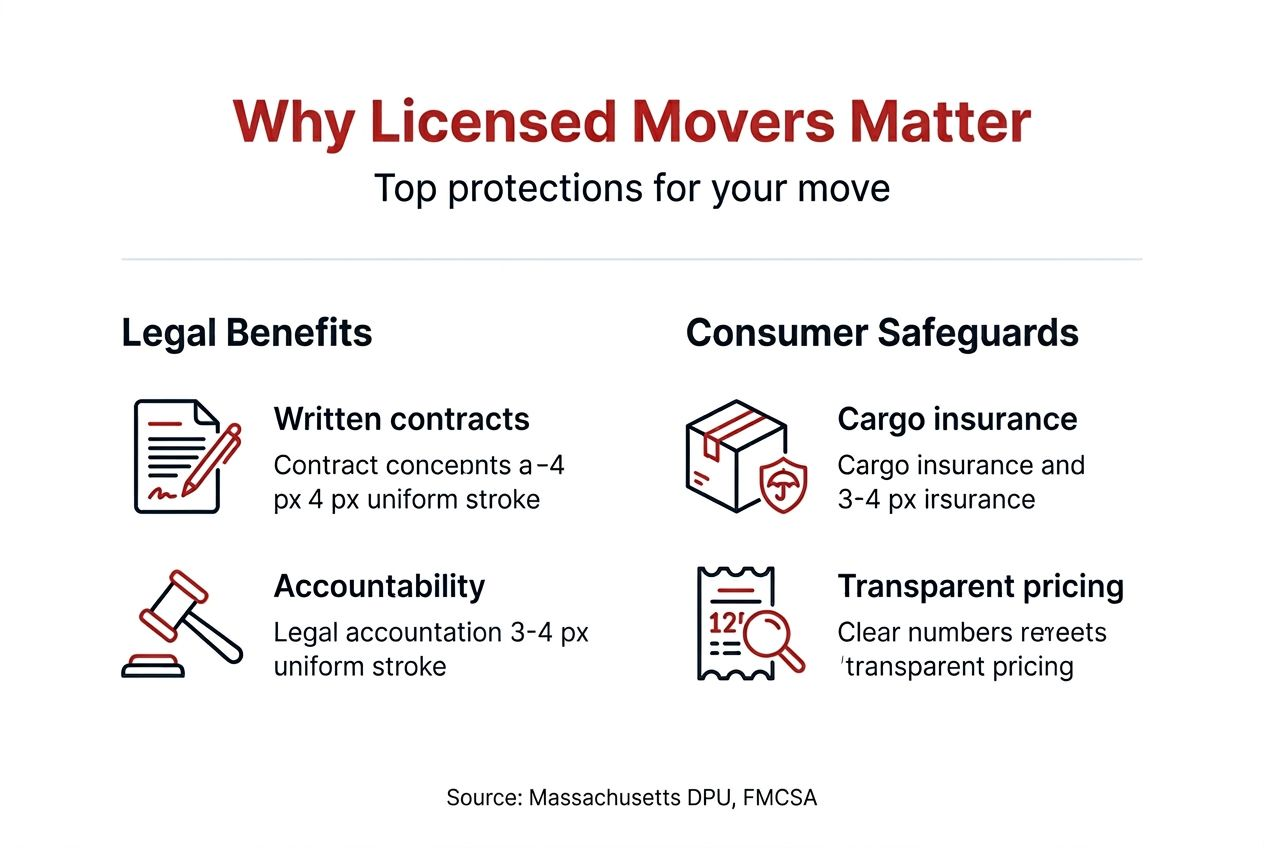
Written contracts establish clear expectations for both parties. Your contract specifies exact pickup and delivery dates, itemized pricing for all services, and detailed liability terms. These documents become legally binding, preventing surprise charges and providing evidence if disputes require mediation or court intervention.
Accountability mechanisms distinguish licensed operators from unregulated competitors. When issues arise, you can file complaints with state agencies that have enforcement power over licensed movers. These agencies investigate complaints, mandate corrective action, and can suspend or revoke licenses for serious violations. This regulatory oversight ensures movers maintain service standards and ethical practices.
| Protection Type | Licensed Movers | Unlicensed Movers |
|---|---|---|
| Cargo Insurance | Required by law | None or fake policies |
| Written Contracts | Mandatory with clear terms | Verbal promises or vague papers |
| Regulatory Oversight | State agency enforcement | No accountability |
| Complaint Resolution | Formal processes available | No recourse options |
| Pricing Transparency | Detailed written estimates | Surprise charges common |
Protections you should expect when choosing a mover:
- Comprehensive cargo insurance covering replacement value of damaged or lost items
- Detailed written estimate specifying all charges before work begins
- Signed inventory list documenting condition of all items at pickup
- Clear liability terms explaining claims procedures for damage
- Contact information for regulatory agencies overseeing the company
These safeguards transform moving from a high-risk transaction into a manageable, predictable process. Licensed movers invest in training, equipment, and insurance because their business depends on reputation and regulatory compliance. This investment directly benefits you through professional service and financial protection.
Pro Tip: Before signing any moving contract, confirm the insurance coverage amount and verify it matches the estimated value of your belongings. Request a certificate of insurance directly from the mover’s insurance provider.
Key benefits checklist:
- Financial security: Insurance protects against damage, loss, or theft during your move
- Legal recourse: Written contracts and regulatory oversight provide dispute resolution options
- Service standards: Licensed movers follow professional practices to maintain their legal authorization
- Transparency: Clear pricing and contract terms eliminate surprises on moving day
Common misconceptions about mover licensing
Many people believe licensing only applies to long-distance interstate moves, but local moves in Massachusetts require licensing too. This misconception causes residents to skip verification steps for moves within the same city or county, exposing themselves to unlicensed operator risks. Every state in New England mandates some form of licensing for intrastate household goods transportation.
Another prevalent myth confuses licensing with insurance as if they’re the same thing. Licensing proves legal authorization to operate, while insurance provides financial protection for your belongings. Both matter independently. A company can hold a valid license but carry inadequate insurance, or vice versa. You need to verify both credentials separately.
Assuming claimed licensing is legitimate without verification creates vulnerability. Scammers frequently display fake license numbers on websites and trucks, counting on customers not to check. State and federal databases make verification simple, yet many people skip this critical step because they assume regulatory compliance.
The reality contradicts these assumptions. Massachusetts requires all household goods movers to obtain DPU approval regardless of distance. New Hampshire enforces operating authority requirements for any compensated moving service. Maine’s permit system covers local and regional moves within state boundaries. Interstate moves add federal FMCSA requirements on top of state rules.
Why these myths endanger consumers:
- Skipped verification: Assuming local moves need no licensing leads to hiring unlicensed operators
- Incomplete protection: Confusing licensing and insurance means missing one critical safeguard
- Blind trust: Accepting claimed credentials without checking creates scam vulnerability
- Financial exposure: Operating without full legal protections leaves you liable for all problems
Understanding actual licensing requirements protects you from preventable losses. Every move, whether across town or across New England, deserves the same verification diligence. Selecting moving services based on confirmed licensing eliminates most scam and service quality risks before they materialize.
Pro Tip: Treat local moves with the same verification rigor as long-distance relocations. Distance doesn’t determine licensing requirements or scam risk.
How to verify mover licensing and credentials
Verifying mover licensing protects you from fraud and ensures legal compliance. Consumers can verify licensing via state public utility commission and FMCSA Safer databases, which maintain searchable records of all registered moving companies. This verification process takes 10 minutes and prevents thousands in potential losses.
Follow this numbered verification process:
- Request the company’s DOT number, MC number, and state license number during initial contact
- Check interstate credentials at FMCSA license verification using the DOT or MC number
- Verify state licensing through your state’s public utilities commission or transportation department website
- Confirm insurance coverage by requesting a certificate of insurance and calling the insurance company directly
- Research reputation through Better Business Bureau, Google reviews, and state attorney general complaint records
Insurance verification requires extra attention. Request certificates of insurance showing both cargo coverage and general liability. Call the insurance company listed on the certificate to confirm the policy is active and covers your move dates. Scammers often provide fake certificates that look legitimate but reference cancelled or nonexistent policies.
Red flags indicating illegitimate operations:
- Refusal to provide license numbers or insurance documentation
- License numbers that don’t appear in official databases
- Mismatched company names between quotes, websites, and official registrations
- No physical business address or only post office box listings
- Demands for large cash deposits before providing written contracts
Pro Tip: Cross-check company information across multiple sources. The company name, address, and contact details should match exactly across their website, FMCSA records, state licensing databases, and insurance certificates.
Verification resources for stress-free move tips:
- FMCSA Safer System: Federal database for interstate mover verification
- State PUC websites: Massachusetts, New Hampshire, and Maine licensing lookups
- Better Business Bureau: Complaint history and business accreditation status
- State Attorney General: Consumer complaint records and active fraud investigations
This systematic approach eliminates guesswork and prevents hiring unlicensed operators. Legitimate movers expect these verification requests and provide documentation immediately. Companies that hesitate, make excuses, or pressure you to skip verification deserve instant disqualification from consideration.
Case studies illustrating problems from unlicensed movers and benefits of licensing
Real experiences demonstrate why licensing matters. A Portsmouth family hired an unlicensed mover for a local relocation based on a low quote, only to watch their antique furniture sustain $8,000 in damage during transport. The unlicensed company carried no insurance and dissolved immediately after the move, leaving the family with zero recourse. Small claims court proved worthless since the operator had no traceable assets.
Contrast that with a Massachusetts client who chose a licensed mover for a Boston to Manchester relocation. When delivery delays occurred due to weather, the licensed company maintained communication, provided temporary storage at no charge, and compensated the client for inconvenience per their written contract. State licensing requirements ensured the company had proper insurance and followed professional standards.
Financial outcomes tell the story clearly. The Portsmouth family spent their entire moving budget plus thousands more replacing damaged items. The Massachusetts client paid their contracted price, received quality service, and had professional support resolving minor issues that arose. Licensed movers’ accountability mechanisms made the difference.
Emotional impacts matter too. Unlicensed mover victims describe feeling violated, helpless, and stressed for months after their moves. Licensed mover clients report confidence, reliability, and peace of mind even when small problems occurred. The psychological benefits of working with accountable professionals extend beyond financial considerations.
Key lessons from these experiences:
- Insurance protects finances: Licensed movers’ mandatory coverage prevents catastrophic personal losses
- Contracts provide recourse: Written agreements give you legal standing when problems arise
- Accountability reduces stress: Knowing you can complain to regulatory agencies provides psychological security
- Professionalism shows results: Licensed companies invest in training and equipment that improve service quality
These real outcomes reinforce the article’s central message. Licensing isn’t bureaucratic red tape; it’s the foundation of consumer protection in the moving industry. Every family deserves the security and professionalism that licensed movers provide, regardless of move distance or budget.
Conclusion and practical tips for choosing licensed movers in New England
Licensed movers provide legal protections, financial security, and professional accountability that unlicensed operators cannot match. From mandatory insurance coverage to regulatory oversight, licensing creates the framework for stress-free relocations across New England. These protections matter for every move, whether local or long-distance.
Your licensing verification checklist:
- Confirm DOT/MC numbers through FMCSA database for interstate moves
- Verify state licensing through your state’s public utilities commission
- Request and validate certificates of insurance showing adequate coverage
- Review written contracts specifying all services, prices, and liability terms
- Check company reputation through BBB and state consumer protection agencies
Using official resources eliminates 99% of scam and service quality risks. State and federal databases make verification simple and free. The 10 minutes you invest in checking credentials prevents thousands in potential losses and months of stress. Professional movers at choosing a mover expect and welcome these verification steps.
Common pitfalls to avoid:
- Assuming local moves don’t require licensing verification
- Confusing licensing claims with actual insurance coverage
- Accepting verbal promises instead of written contracts
- Choosing movers based solely on lowest price quotes
Smart practices reduce stress and protect your belongings. Request detailed written estimates from multiple licensed movers, compare coverage levels and service inclusions, and prioritize companies with strong local reputations. Your move represents significant financial investment and emotional energy. Working with licensed professionals ensures that investment pays off in successful, damage-free relocation.
Discover stress-free moving with Bridges Bros. Movers
Protecting your belongings starts with choosing fully licensed moving services that meet all New England regulatory requirements. Bridges Bros. Movers has served Massachusetts, New Hampshire, and Maine since 1919, maintaining complete licensing and comprehensive insurance coverage across all service areas. Our professional packing services and expert moving teams deliver the accountability and professionalism you deserve.

We understand that licensing and insurance provide the foundation for your peace of mind. Our transparent contracts, detailed estimates, and strong local reputation reflect over a century of professional moving service. Whether you’re relocating within Portsmouth or moving across state lines, our team brings expertise and regulatory compliance to every job. Explore our moving services in New Hampshire and surrounding states to see how proper licensing protects your next move.
Frequently asked questions
Are licensed movers always insured for my belongings?
Licensed movers typically must carry cargo insurance as part of their licensing requirements. However, coverage amounts vary significantly between companies. Always request written proof of insurance showing specific coverage limits before signing contracts to ensure adequate protection for your belongings’ value.
Can I hire licensed movers for local moves within Massachusetts?
Yes, Massachusetts requires all household goods movers to obtain state DPU licensing regardless of distance. Local moves within the same city or town fall under the same regulations as longer intrastate relocations. Hiring licensed local movers ensures legal compliance and provides the same consumer protections as interstate moves.
What are the risks of hiring unlicensed movers?
Unlicensed movers pose serious financial and legal risks including no insurance coverage for damaged or stolen items, lack of written contracts providing pricing transparency, zero regulatory oversight if disputes arise, and high probability of scams like hostage loads or disappearing deposits. Over 80% of moving complaints in New England involve unlicensed operators who leave consumers with no recourse for losses.
How long does mover license verification take?
Verifying a mover’s licensing takes approximately 10 minutes using free online databases. Check DOT and MC numbers through the FMCSA Safer System, then verify state licenses through your state’s public utilities commission website. This brief verification process prevents thousands in potential losses from unlicensed scams.