
Southern Maine delivers four seasons, strong schools, and real community
Southern Maine is one of the most practical relocation decisions you can make in New England right now. You get a long multi-use trail on the Eastern Trail, mountains and ocean within a 90-minute drive, and family-friendly towns like Yarmouth, Cape Elizabeth, Falmouth, and Cumberland that consistently rank among the best-rated communities in the state. The lifestyle here is not manufactured for tourists. It is built for people who actually live here year-round.
- Four distinct seasons with genuine outdoor engagement in every one
- The Eastern Trail spans 83 miles for walking, cycling, and active commuting
- Highly-rated school districts anchored by Yarmouth, Cape Elizabeth, Falmouth, and Cumberland
- Portland’s urban core within easy reach of quieter coastal and suburban towns
- Maine Medical Center serving as the regional healthcare hub for the entire area
- Coastal village character in Kennebunkport and Cape Elizabeth alongside suburban comfort in Falmouth and Scarborough
1. Outdoor recreation you can actually use every day
Southern Maine’s outdoor access is not a weekend bonus. It shapes how residents live Monday through Friday. The Eastern Trail runs for 83 miles, from South Portland through Scarborough, Falmouth, Cumberland, and into Yarmouth, giving residents a safe, non-motorized corridor for exercise and commuting alike. Properties near the trail sell faster and at higher prices than comparable homes without that access.
- Beaches: Old Orchard Beach for family-friendly sand and surf; Kennebunkport for upscale coastal character; Scarborough Beach State Park for managed day use
- Wildlife and quiet coastal access: the Rachel Carson National Wildlife Refuge in Wells protects miles of salt marsh and tidal habitat, ideal for birding and kayaking
- Skiing, hiking, and lake recreation all within 90 minutes north or west
- Summer temperatures averaging in the mid-70s°F along the coast, with low humidity compared to mid-Atlantic or Florida markets
Pro Tip: If trail proximity matters to your family, focus your home search in Falmouth and Scarborough first. Both towns offer direct Eastern Trail access and strong school districts at the same time.
Buyers relocating from Florida specifically cite the cooler summers and four-season variety as primary motivators. The shift from a single-season outdoor lifestyle to genuine year-round engagement is one of the most consistent themes among new arrivals to the region.
2. Community life and quality of living across Southern Maine towns
Southern Maine is not one community. It is a collection of distinct environments that happen to share excellent infrastructure. Portland anchors the region with walkable neighborhoods like the West End and Eastern Promenade, where dining, healthcare, and cultural venues sit within pedestrian distance. South Portland and Kennebunk offer similar walkability at a slightly smaller scale.
- Portland Museum of Art, Merrill Auditorium, and the First Friday Art Walk support an active cultural calendar
- Southern Maine Community College in South Portland and University of Maine extension programs offer affordable continuing education
- Maine Medical Center employs over 6,000 people and provides Level I trauma, cardiac, orthopedic, oncology, and neurology services
- Southern Maine Health Care serves York County residents, keeping specialist access within reach for those living farther south
The region’s neighborhoods are genuinely integrated across age groups and backgrounds. That intergenerational mix creates the kind of social fabric that is hard to find in purpose-built resort communities. Volunteering, community centers, and religious congregations all contribute to a social calendar that most newcomers find far more active than they expected.

3. Why families consistently choose Southern Maine
Families relocating to Southern Maine tend to land in the same handful of towns for good reason. The Falmouth School District is recognized for its strong graduation outcomes and is recognized for strong academics and extracurricular depth. Cape Elizabeth’s schools rank among the best in the state. Yarmouth, Greely in Cumberland, and Scarborough round out a group of districts that give families real options without sacrificing community character.
- Safe, low-density neighborhoods with suburban or coastal village atmospheres
- Public transportation through the Greater Portland Metro bus system connecting Portland, Westbrook, Falmouth, and Gorham
- Amtrak Downeaster stops in Wells, Saco, and Old Orchard Beach for families with Boston-area ties
- Portland International Jetport (PWM) provides daily connections to major U.S. cities
Beyond schools, families value the physical safety and social cohesion of these towns. Kids can participate in organized sports, arts programs, and community events without the logistical complexity of a dense metro area. The pace is manageable, and the outdoor access means children grow up with genuine recreational options rather than screen-dependent ones.

4. How the housing market has shifted toward year-round living
Southern Maine’s residential market has moved decisively away from seasonal and vacation-focused buying. Remote work accelerated a transition that was already underway, pushing demand toward well-insulated, year-round homes with high-speed internet access rather than summer cottages. That shift has changed what buyers prioritize and what sellers invest in before listing.
- Coastal towns like Kennebunk, Cape Elizabeth, and Scarborough command premium prices; inland towns like Buxton and Standish offer larger lots at more accessible price points
- Winterization matters: heating system type, insulation quality, and well and septic conditions require careful inspection before purchase
- Old Orchard Beach, Saco, and Biddeford properties may fall in FEMA flood zones, requiring specific due diligence
- Spring “mud season” and winter road conditions are real factors that affect daily life and infrastructure planning
Pro Tip: Always schedule a full home inspection before closing on any Southern Maine property. Older coastal homes frequently have private wells, oil heat, and septic systems that need condition assessments specific to Maine’s climate.
Towns near the New Hampshire border, including Berwick, offer a secondary advantage: proximity to tax-free shopping across the state line, which offsets some of Maine’s higher service costs for residents who plan ahead.
5. What does it actually cost to live in Southern Maine?
Southern Maine sits slightly above the national average in overall cost, but well below comparable coastal markets in Massachusetts, Connecticut, and coastal Florida. The Portland-South Portland metro area has a cost of living just above the national baseline, meaning it is 1.9% more expensive than the national baseline. Goods cost less than the national average, while services and rents tend to run higher.
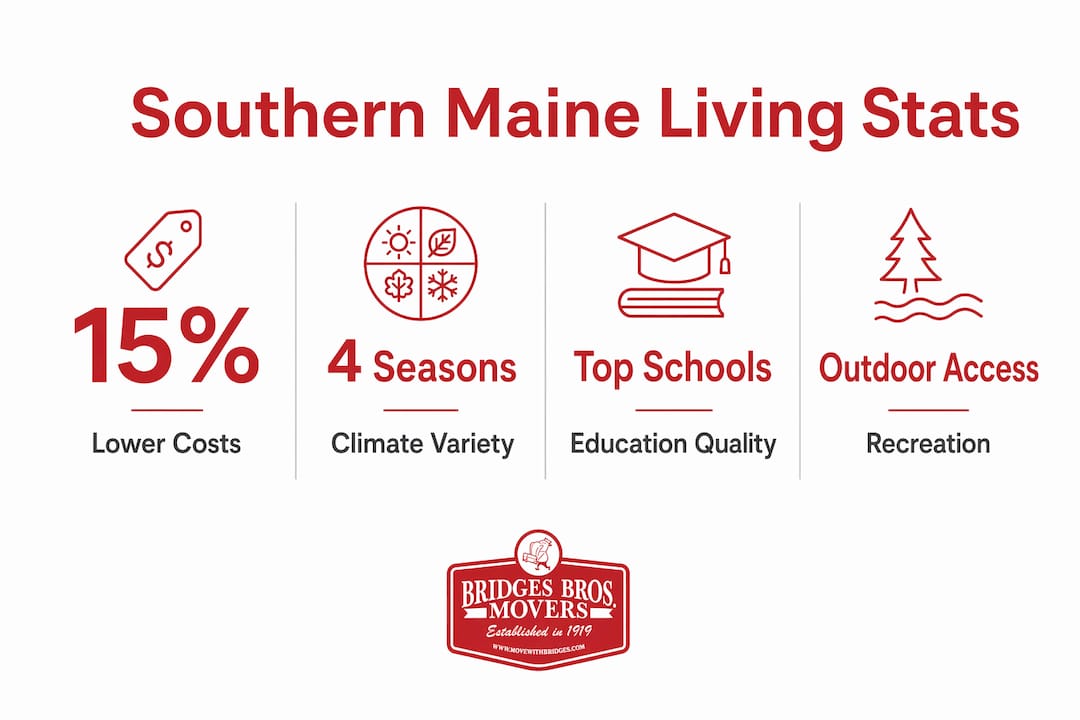
Within the region, costs vary considerably by town. Costs vary considerably by town, with Portland generally more expensive than towns like Biddeford, and places such as Saco and Westbrook falling in between. Maine’s tax environment includes a 7.15% top income tax rate, a 5.5% sales tax, and a 1.3% effective property tax rate. Compared to Massachusetts or New York, the property tax burden is notably lighter for most Southern Maine homeowners.
6. Job market and economic opportunities in Southern Maine
Healthcare, education, and technology anchor Southern Maine’s employment base. Maine Medical Center and its parent system MaineHealth are among the largest employers in the state. Other major employers include WEX, Unum, IDEXX Laboratories, and the University of Southern Maine, which also drives demand for professional services and research roles in the Portland area.
Tourism creates a parallel economy in coastal communities, supporting hospitality, retail, and food service jobs that peak in summer but increasingly extend into shoulder seasons as year-round residency grows. Portland’s finance, insurance, real estate, and technology sectors have expanded steadily, attracting professionals who want urban career options without urban density. Remote workers from Boston, New York, and beyond have found that Southern Maine’s cost structure and quality of life make it a genuinely competitive alternative to staying in high-cost metros.
Ready to make your move to Southern Maine?
If you have decided that Southern Maine is the right fit, the next step is planning a move that goes smoothly from start to finish with expert Moving Company SEO Services tailored for moving companies in the region. Bridges Bros Movers has served New England families since 1919, with deep experience in residential relocations across Maine, New Hampshire, and Massachusetts. Whether you are moving from Florida, the Boston area, or anywhere in the Northeast, the team handles full-service moving solutions including packing, storage, junk removal, and home cleaning. You can also review Maine service coverage to confirm your destination town is included.
Key Takeaways
Southern Maine offers a genuinely livable combination of outdoor access, strong schools, healthcare infrastructure, and cost that remains below comparable coastal markets in Massachusetts and Connecticut.
| Point | Details |
|---|---|
| Eastern Trail access | The Eastern Trail supports daily exercise, active commuting, and property value premiums in Falmouth and Scarborough. |
| Top school districts | Falmouth School District holds a 97% graduation rate; Cape Elizabeth ranks among the best in Maine. |
| Cost of living | Portland-South Portland’s cost of living is 1.9% above the national average. |
| Year-round housing shift | Remote work has pushed demand toward well-insulated, high-speed-internet-ready homes rather than seasonal properties. |
| Healthcare access | Maine Medical Center in Portland provides Level I trauma and comprehensive specialist services for the entire region. |
FAQ
Is Southern Maine a good place to live?
Yes. Southern Maine combines strong schools, accessible outdoor recreation, and healthcare infrastructure anchored by Maine Medical Center, at a cost of living only 1.9% above the national average in the Portland-South Portland metro area.
What are the nicest towns in Southern Maine?
Yarmouth, Cape Elizabeth, Falmouth, and Cumberland consistently rank highest for school quality, community safety, and overall livability. Kennebunkport and Scarborough are top choices for coastal character and outdoor access.
What is the downfall of living in Maine?
Maine winters bring significant snowfall from December through March, and spring “mud season” creates road and property maintenance challenges that new residents often underestimate. Service costs also run higher than the national average.
Why are some people leaving Maine?
Maine’s higher service costs, limited job diversity outside healthcare and education, and harsh winters lead some residents to relocate, particularly younger workers seeking broader career markets in Boston or other Northeast cities.