
TL;DR:
- Basic released value coverage offers minimal protection, often leading to inadequate compensation for damages.
- Insured movers provide liability coverage that may not fully cover high-value or owner-packed items.
- Proactively understanding coverage options and verifying insurance documentation ensures better protection during moves.
Imagine your 55-inch television tumbles off a dolly during your move from Portsmouth to Portland. You file a claim, expecting a fair payout. Instead, you receive a check for $33. That is not a typo. Under the most common default coverage, basic released value offers just $0.60 per pound per item, meaning a 55-pound TV worth $1,500 nets you next to nothing. Many homeowners and renters in New Hampshire, Maine, and Massachusetts assume their movers carry full protection for their belongings. Most do not. This article breaks down what “insured movers” really means, how different coverage types compare, and how to make sure your possessions are genuinely protected before moving day.
Table of Contents
- What does ‘insured mover’ actually mean?
- How much protection do you really get? Comparing coverage types
- Special considerations for high-value and owner-packed items
- Why insured movers matter for New Englanders
- The hard truth: Why cutting corners on mover insurance rarely ends well
- Ready for a safe, stress-free move?
- Frequently asked questions
Key Takeaways
| Point | Details |
|---|---|
| Minimal mover coverage explained | Standard released value pays only 60 cents per pound and often leaves you drastically undercompensated. |
| Full-value protection is best | Opting for full-value coverage or third-party insurance ensures high-value items are financially protected. |
| Home insurance gaps exist | Most homeowner or renter policies exclude moving losses, so mover insurance fills a vital gap. |
| Regional rules matter | NH, ME, and MA have specific requirements for mover insurance, and knowing your rights helps avoid common pitfalls. |
| Claims require action | For damaged goods, you must file timely claims and use insured movers for reliable recourse. |
What does ‘insured mover’ actually mean?
The phrase “insured mover” sounds reassuring. But it covers a range of protections that vary wildly in real value. Understanding the difference before you sign anything could save you thousands.
When a moving company says it is insured, it typically means it carries liability coverage, also called valuation coverage. This is not the same as traditional insurance you buy for a car or home. Valuation coverage is a legal obligation for movers, not a full replacement-cost guarantee. For interstate moves, the Federal Motor Carrier Safety Administration (FMCSA) sets the rules. For intrastate moves within NH, ME, or MA, each state’s transportation authority sets its own floor.
Here is a quick breakdown of what each level actually provides:
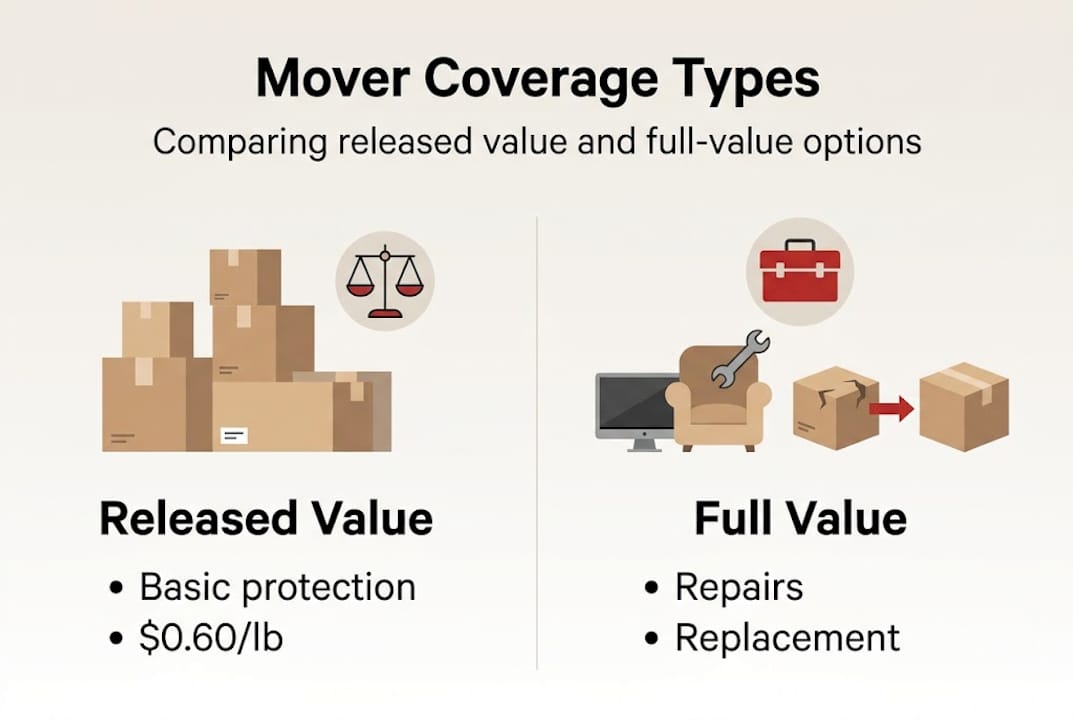
| Coverage type | Cost to you | Protection level |
|---|---|---|
| Released value | Free | $0.60 per lb per item |
| Full-value protection | Extra fee | Repair, replace, or cash payout |
| Third-party insurance | Separate policy | Depends on the insurer |
Most movers are legally required to offer both released value and full-value protection. The catch is that released value is the default unless you specifically request and pay for something better.
The gap between valuation and true insurance is real. Valuation is the mover’s own liability. Third-party insurance is purchased separately and pays out based on actual market value. Working with licensed movers in New England gives you access to both options and ensures the company is regulated.
Key things insured movers should be able to provide:
- Certificate of Insurance (COI) showing general liability and cargo coverage
- Proof of state licensing for intrastate moves
- FMCSA registration for interstate moves
- Written explanation of valuation options before signing
Pro Tip: Always ask for the COI before the move begins. A legitimate mover will provide it without hesitation. If they hesitate or cannot produce one, that is a red flag worth acting on.
For a full picture of your rights and options, review the moving insurance essentials before comparing quotes. And if you want to check federal requirements for valuation directly, federal resources outline exactly what movers must offer.
How much protection do you really get? Comparing coverage types
With the basic definitions clear, let’s see how these protections play out when real damage or loss occurs.
The three coverage types work very differently in practice. Released value is free but provides almost no real protection. Full-value protection costs more upfront but delivers meaningful recourse. Third-party insurance offers the most flexibility but requires a separate purchase.
Industry note: Modern electronics and antiques are particularly vulnerable under low coverage. A 30-pound laptop worth $1,200 recovers just $18 under released value, while a full-value policy would repair or replace it entirely.
A 30-pound $800 TV under released value yields only $18 in a claim. That is a stark illustration of why default coverage is rarely enough.

| Item | Value | Released value payout | Full-value payout |
|---|---|---|---|
| 30 lb flat-screen TV | $800 | $18 | $800 (replace) |
| 50 lb antique dresser | $2,000 | $30 | Repair or replace |
| 20 lb laptop | $1,200 | $12 | $1,200 (replace) |
Here is how a typical claim is processed step by step:
- You notify the mover in writing of the damage as soon as possible after delivery.
- The mover logs the claim and sends an acknowledgment within 30 days.
- An inspector may assess the damaged item in person or via photos.
- The mover accepts or denies liability and offers a settlement within 120 days.
- You accept or reject the offer. If rejected, you can escalate or use third-party arbitration.
Knowing this process ahead of time makes it much easier to understand mover insurance claims and act quickly if something goes wrong.
When choosing a qualified mover, ask specifically how they handle claims and what their average resolution time looks like. Transparent movers will answer confidently. For a deeper look at how valuation coverage options differ by carrier and move type, comparing the written terms side by side before signing is always a smart move.
Special considerations for high-value and owner-packed items
The type of coverage matters most when your move involves high-value belongings or boxes you pack yourself. Both situations carry hidden risks that catch many people off guard.
Movers define “high-value” items as anything worth more than $100 per pound. Think jewelry, original artwork, vintage instruments, and high-end electronics. These items require special handling and specific declarations before the move. Without declaring them, your payout under any valuation plan may still be capped.
For these situations, full-value protection or separate third-party coverage is essential. Standard valuation simply cannot account for the true worth of a one-of-a-kind item.
Here is what you need to know about exclusions:
- Owner-packed boxes (OPBs): If you pack it, the mover is rarely liable for damage inside, even under full-value protection.
- Weather-related damage: If items are damaged due to conditions outside the mover’s control, claims may be denied.
- Extraordinary value items: Jewelry, currency, and collectibles are typically excluded unless declared and specifically covered.
- Pre-existing damage: Movers will note any existing damage at pickup, so inspect items carefully at delivery.
Learn smart packing tips for valuable items to reduce the risk of exclusions and improve your claim outcome. When professionals handle the packing, your protection improves significantly, which is one strong reason to review why pros protect your valuables as part of your planning.
Pro Tip: Before moving day, create a written and photographic inventory of every high-value item. Note serial numbers, take close-up photos, and keep copies in a place separate from your belongings. This documentation is your strongest tool if a claim is disputed.
Documentation steps that make a real difference:
- Photograph items from multiple angles before packing
- Write down approximate replacement value for each item
- Ask your mover for a “high-value inventory” form
- Store copies of the inventory digitally and in print
Why insured movers matter for New Englanders
Coverage differences aside, let’s look at the specifics for those moving to, from, or within New Hampshire, Maine, or Massachusetts.
Each state has its own consumer protection framework. Massachusetts moves are regulated by the Department of Public Utilities (DPU). New Hampshire and Maine moves fall under their respective Departments of Transportation. These agencies set the minimum standards movers must follow, but they do not guarantee that your belongings are fully protected. That responsibility still falls on you.
Your homeowner’s or renter’s insurance may feel like a safety net, but transit coverage is often excluded or heavily limited in standard policies. Do not assume your existing policy picks up where the mover’s coverage ends without reading the fine print first.
For moves between MA and NH specifically, the move crosses state lines and triggers FMCSA rules, giving you federal recourse on top of state protections.
Key claim timelines every New Englander should know:
- 9 months to file a damage or loss claim after delivery
- 30 days for the mover to acknowledge the claim in writing
- 120 days for the mover to resolve or deny the claim
These strict claim timelines apply to interstate moves and are mirrored in many state rules. Missing these windows can void your right to recover anything.
A practical checklist for verifying your mover’s credentials:
- Confirm state license number with the relevant state agency
- Look up FMCSA registration at the SaferSys portal for interstate moves
- Request and review the COI before signing
- Ask for written confirmation of valuation options
- Read the Bill of Lading carefully before the truck leaves
For a full walkthrough of protecting yourself from start to finish, the stress-free New England move guide covers the major checkpoints in detail.
The hard truth: Why cutting corners on mover insurance rarely ends well
There is a common belief that a careful packer and a short drive are enough protection during a move. We have seen that play out countless times, and it almost never holds up when something actually goes wrong.
Low-cost, uninsured movers attract attention with attractive prices. But when damage happens, and it happens more often than people expect, those savings disappear quickly. A single denied or underpaid claim on a dining set or a home office setup can cost far more than the difference in price between insured and uninsured services.
The uncomfortable reality is that most people only learn to prioritize mover coverage after a bad experience. They pack carefully, the move looks smooth, and then they open a box to find a cracked screen or a broken leg on an heirloom table. At that point, the paperwork, the timelines, and the payout formulas feel overwhelming.
Being proactive is far easier. Reviewing moving best practices before you book gives you the tools to ask the right questions, choose the right coverage, and move with confidence.
The peace of mind that comes from working with a properly insured mover is not just emotional. It is financial. It is the difference between getting a fair settlement and receiving a check for $18.
Ready for a safe, stress-free move?
Now that you understand what mover coverage actually means and why it matters, the next step is working with a team that puts your protection first. Bridges Bros Movers has served homeowners and renters across New Hampshire, Maine, and Massachusetts since 1919, offering insured moving services backed by decades of local experience and a reputation for doing things right.
Whether you need professional packing to protect high-value items or guidance on choosing the right valuation coverage, our team walks you through every option before moving day. No surprises, no fine print left unexplained. When you are ready to move with confidence, get a free moving quote and let us show you what a fully insured, family-owned moving company looks like in action.
Frequently asked questions
What does ‘insured mover’ cover versus my homeowner’s insurance?
An insured mover covers loss and damage during transit through valuation protection. Most homeowner policies exclude or heavily limit coverage during a move, so you cannot rely on them as a backup.
What proof should I request from a mover to confirm insurance?
Ask for the Certificate of Insurance and verify their state or FMCSA license online. Local movers in New England follow state rules that mirror federal standards, so both apply depending on the move.
Are owner-packed boxes covered by insured movers?
Most insured movers exclude owner-packed items from full-value coverage. If damage occurs inside a box you packed yourself, the claim is likely to be denied.
What’s the claim deadline if my belongings are damaged?
You have up to 9 months to file, and movers must acknowledge the claim in 30 days and resolve it within 120 days. These strict timelines apply to interstate moves and are reflected in many state rules as well.
Is full-value protection worth it for a short, local move?
Yes. Even local moves carry real risk of breakage or loss. Valuation coverage provides regulated recourse for high-value items regardless of move distance, making it a smart investment on any move.
Recommended
- Moving Insurance | Bridges Bros. Movers
- Why hire professional movers? Safe, stress-free moves explained
- Why trust family-owned movers? Local expertise & peace of mind
- Why Move With a Trusted Company: Peace of Mind
- What is moving insurance and how to protect your items